
Super fast summary
I ran Badwater 135 last week. I first heard about this race when I crewed for my family friend, Mike, in 2008. That was also the first time that I saw a place for myself in any sport. In the intervening 16 years, I went from a lazy couch potato to a pretty okay runner. That entire time, I was completely disinterested in running Badwater – I had seen the race firsthand, and in my mind, it was not something I would ever be capable of accomplishing. It wasn’t until the last year that it occurred to me that I was not only qualified, but could possibly finish. I applied, and got in.
Training was hard.
The experience of running the race was incredible. I almost cried several times throughout the race thinking about the journey it took to even get to the start line and the support I had during the race. Running on the white line was iconic, and I intentionally appreciated that specific experience several times. My crew – Bob, Raj, Eric, and Kate – were absolutely, insanely, amazing. They stayed awake for 48 hours to drag me across the finish line. Seeing my parents at Lone Pine was such a boost. Knowing I had family and friends out in the world cheering for me and tracking my progress was so motivating. The scenery was gorgeous. I was well-trained for the heat and it was not a problem.
Physically, I felt great afterwards. Mentally and emotionally, I was proud, honored to be supported by my family and friends, and exhausted.
Would I do it again? Probably not. Once was special, and once was enough. I will remember and appreciate it forever. I am so grateful to have had the opportunity to do this.
The rest of the post is very long and detailed. The audience is future me, future Badwater runners who might find it helpful, and anyone else who is interested. For future Badwater runners: reach out anytime and I am happy to chat.
Relevant links and resources
- My results here; overall results for all competitors here
- My mile-by-mile finish time prediction model here; feel free to steal this in case it is helpful
- Strava details
- Training plan (executed) including sauna time (executed)
About the race
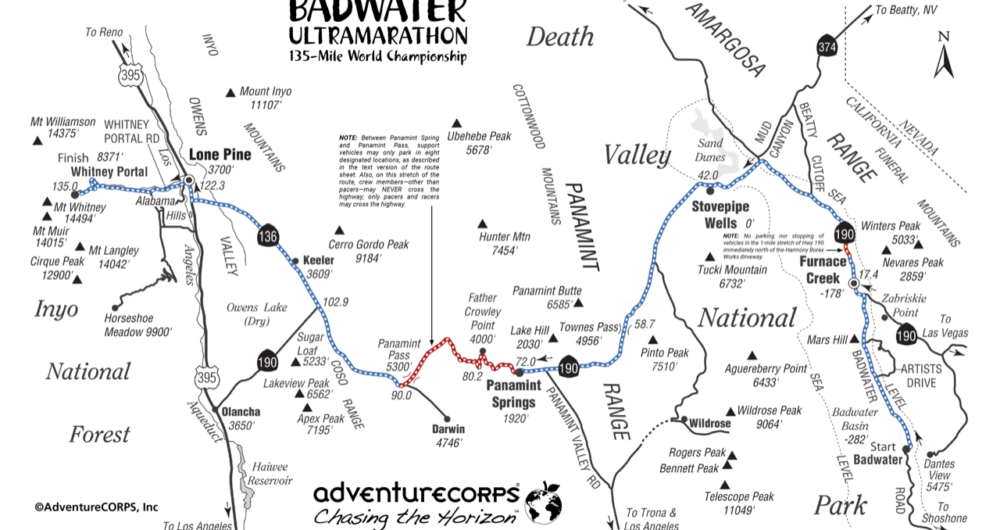
The Badwater 135 is a 135-mile ultramarathon race starting at −282 feet below sea level in the Badwater Basin, in California’s Death Valley, and ending at an elevation of 8,360 feet at Whitney Portal, the trailhead to Mount Whitney. It takes place annually in mid-July when the weather conditions are most extreme and temperatures can reach 130 °F. (thanks Wikipedia)
The course itself is pretty easy to navigate, because there are only three turns: one before Stovepipe wells and two in Lone Pine. Otherwise, there is one road, and you run on that road the entire time. This year, there was a 1.5-mile trail section on Whitney Portal Road, but otherwise the entire race is run on roads.
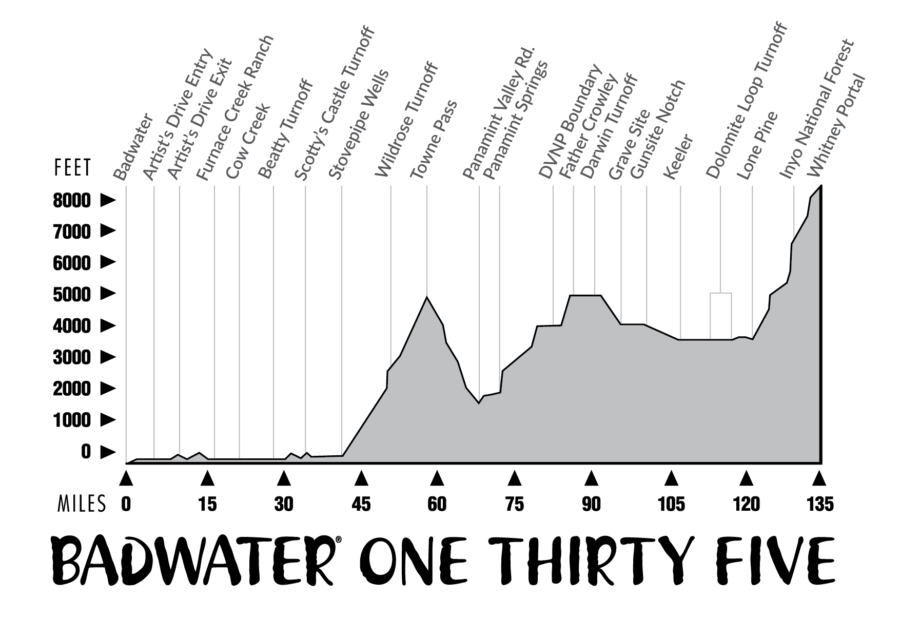
There is about 14,000 feet of climbing over three large hills. The hills are long, between 13 and 19 miles. Only about 1,000 people have completed this race.
Background
As mentioned, this is the race that got me into running. When I crewed for a Mike in 2008, I was still in college, and was incredibly slow and not into sports; in high school, I finished second-to-last in the mile on a regular basis.
Mike was like 80-90 miles into his Badwater run when he asked if I wanted to pace him. He looked like he was going pretty slow, which I didn’t understand, because it was the first time I had ever seen someone run at not-5k pace and didn’t realize that’s how ultras worked. I ran about 3 miles with him and did not immediately die afterwards. That’s when I realized that you don’t have to be breaking speed records every time you go for a run in order to be running. This experience resulted in a deep curiosity about these folks who were running long distances and the psychology behind it. I devoted a significant amount of my time as a student reporter to learning about that race, and I ultimately published this piece about the experience. Through that research, I developed an appreciation of – and fear for – the difficulty of the race, which stays with me to this day. I also started running a few miles a day. (Note – Mike has competed in Badwater 3 times and is an incredible athlete. I had no idea how accomplished is was at the time I was crewing him).
Since then, I’ve gone on to run a lot of races, but Badwater always seemed unattainable to me because of how hard it is and how good of a runner you had to be to do it. Some time last year, that changed. I applied, and somehow got in.
Training and Preparation
I probably trained harder for this race than I have for any other race in my life. I was largely motivated by fear of not being able to finish the race. There were five things I was worried about:
- Length of the race
- Heat
- Blisters
- Nutrition
- Race rules
Due to the nature of the race, there are particular considerations for each of these dimensions that are different from other ultras. I am going to go into some detail on each of these dimensions here in case it is helpful for future runners. Here’s what I did for each of the things.
- Length of the race: My plan was to accumulate a lot of miles on feet. I slowly increased my mileage from February to April, from a base load of ~60 miles per week to ~100 miles per week. From there, I did three 4-week blocks of training. In the block, the first three weeks I hit mileage of 100-110 miles per week, then followed that by a “down week” of 70-80 miles per week. I would do one long run per week (20-22 miles) and one workout per week (usually 800s on the track; probably not needed and some veterans actually discouraged it, but I enjoy that kind of workout). I had a couple of races in there just for fun, including one road 50k and one trail 100k. The trail 100k was not helpful for training and I wouldn’t recommend adding something like that in. I think the overall mileage volume helped quite a bit, as I felt physically very good during the race. I lifted 2-3x/week and stretched 4-6x/week, both for injury prevention. I did very little cross-training otherwise. My training plan is here.
- Heat: I did three things to train for heat. The first was spending time in the sauna. The second was running in hot conditions. Thirdly, I developed a plan for external cooling. These strategies seem to have worked very well, because I did not feel overheated during any part of the race.
- Sauna: I spent about 40 total hours in the sauna, starting in February. This volume is definitely overkill. The majority of the research suggests that you can get excellent heat adaptation in 2-4 weeks of sauna time. However, per above, I was highly motivated by fear, and figured that more time in sauna = better somehow. With no scientific basis, my beliefs were that (1) my body would adapt better over more months of sauna training, and (2) I would understand my body’s reaction to heat better if I spent more time in the sauna, which would allow me to troubleshoot heat challenges more effectively while on the course. #2 was definitely true. I read a lot of paperback books in the sauna to pass the time. Notably, I did not do any actual working out in the sauna, although people do that to train for the race. My sauna training is here.
- Running in hot conditions: I was able to get a few runs in 100*F+ after work on a few days. However, the majority of my heat training was “destination” heat training over two weekends. One weekend, I drove to Tracy, CA and ran 22 miles in 105*F. This was really awful and I felt terrible, mainly because I did not stick to my plan of using the car as an aid station every 3-4 miles (I got bored of seeing the same trail). Instead, I stupidly ran for 15 miles and then ran out of water before getting back to the car. On a different weekend, Zach and I went to Sacramento, and I did a number of medium / long runs in ~105*F. I successfully dodged boredom and was able to use the car as an aid station, and these runs were much more successful.
- External cooling during the race: While this wasn’t part of training, I did spend time ahead of the race strategizing about how to remain cool during the race. Raj introduced me to the three-temperatures framework: internal, skin, and air. The internal temperature was addressed by drinking cold water. The skin temperature was addressed by a neck buff with ice and a cold button down shirt. I actually had two shirts: one would sit in an ice cooler and I would wear the other one, then, when I saw my crew, they would swap the two, so I was wearing the cold one. This was a strategy that I picked up from Mike when I crewed for him, and it was effective. The icy shirt kept my body temperature down throughout the hottest parts of the race. I had other levers – ice in the hat, ice in arm sleeves – that I did not need to deploy because the buff and the shirt worked so well. Obviously the air temperature was not possible to modify.
- Blisters: I have almost never had blisters during long races, but almost everything I had read about Badwater indicated that the heat could cause bad blisters. This would be especially problematic in cases where feet had thicker callouses and a blister formed underneath the callous, preventing lancing of the blister, which is what happened to Bob when he ran in 2018. To combat this, I read the book Fixing Your Feet, which Bob and Eric both recommended as the seminal text on this topic, and I made five changes. These changes worked. My feet looked pristine at the end of the race and were literally the envy of other veteran ultrarunners. The changes I made were:
- Bigger shoes: I normally wear a size 8.5 – 9, but I sized up to a size 10 wide. I trained in these shoes as well. Feet swell in heat, so sizing up can be helpful for races like this.
- Toe socks: everyone recommended toe socks, so I got them. Unclear how much, if at all, this helped, but it didn’t hurt.
- Lubrication: I applied Body Glide between my toes, which is often where I get chafing. This helped quite a bit. There are other anti-chafe products out there, but Body Glide has always worked for me and this approach in particular was effective at preventing blisters.
- Cutting toenails: Obviously I had cut my toenails before, and had a routine of doing this before races; Fixing Your Feet had specific suggestions for how to do this, so I did that on my problematic pinky toes and it seemed to have helped.
- Proactive callous treatment: I used a Ped Egg to file down callouses for the 6-8 weeks leading up to the race, maybe 1-2x/week. Having slightly thinner callouses would allow for blister lancing in the case where I got any blisters. Importantly, many experts recommend starting foot care 1-2 months out from a race like this.
- I also had a bunch of tape, moleskin, lances, and other blister treatment tools at the ready, but didn’t need them. Always good to keep that sort of stuff on hand.
- Nutrition: My stomach has been known to shut down in long races, rejecting any food. I hypothesize this has to do with eating too much sugar. For this race, my plan was to eat low-sugar solid food during the race, which is literally the opposite of what everyone recommends for this race. Usually, the recommended nutrition is liquid-only, such as Maurten or Ensure, because stomachs are known to shut down even more in hot conditions. As the race got closer, I wished I had trained with some of those nutrition options, but because I didn’t, I stuck to my plan (nothing new on race day). To the race, I brought 20x baked potatoes, 12x cans of soup, and 5x burritos. I brought enough of each of these items to get me through the whole race if I ended up only eating those things. I also brought a bunch of sugary snacks (donuts, cookies, brownie bites, watermelon) as backup, but ate none of those. I ended up eating 8x baked potatoes, 8x cans of soup, and 1.5x burritos, as well as getting calories from Ginger Ale and Coca Cola. The chicken noodle soup was my main source of calories.
- Race rules. The race rules are insanely detailed. This is to keep runners safe, since the race happens on an open highway and in extreme conditions. Because it is in a national park, there are additional rules as well. I spent a LOT of time reviewing the rules, clarifying the rules with race director Chris, asking for advice on the Badwater Facebook group (fun fact – Mike started the FB group!), interviewing Badwater veterans, and discussing/interpreting the rules with my crew. The result is that we, as a crew, knew the rules VERY well on race day. I felt well-prepared going into the race that we were (1) not going to die and (2) not going to get disqualified for messing up the rules. I highly recommend that rookie runners spend time with the rules – there are a lot of them and it is easy to get tripped up.
Overall, I felt very prepared for this race based on my training and prep work.
Before the Start
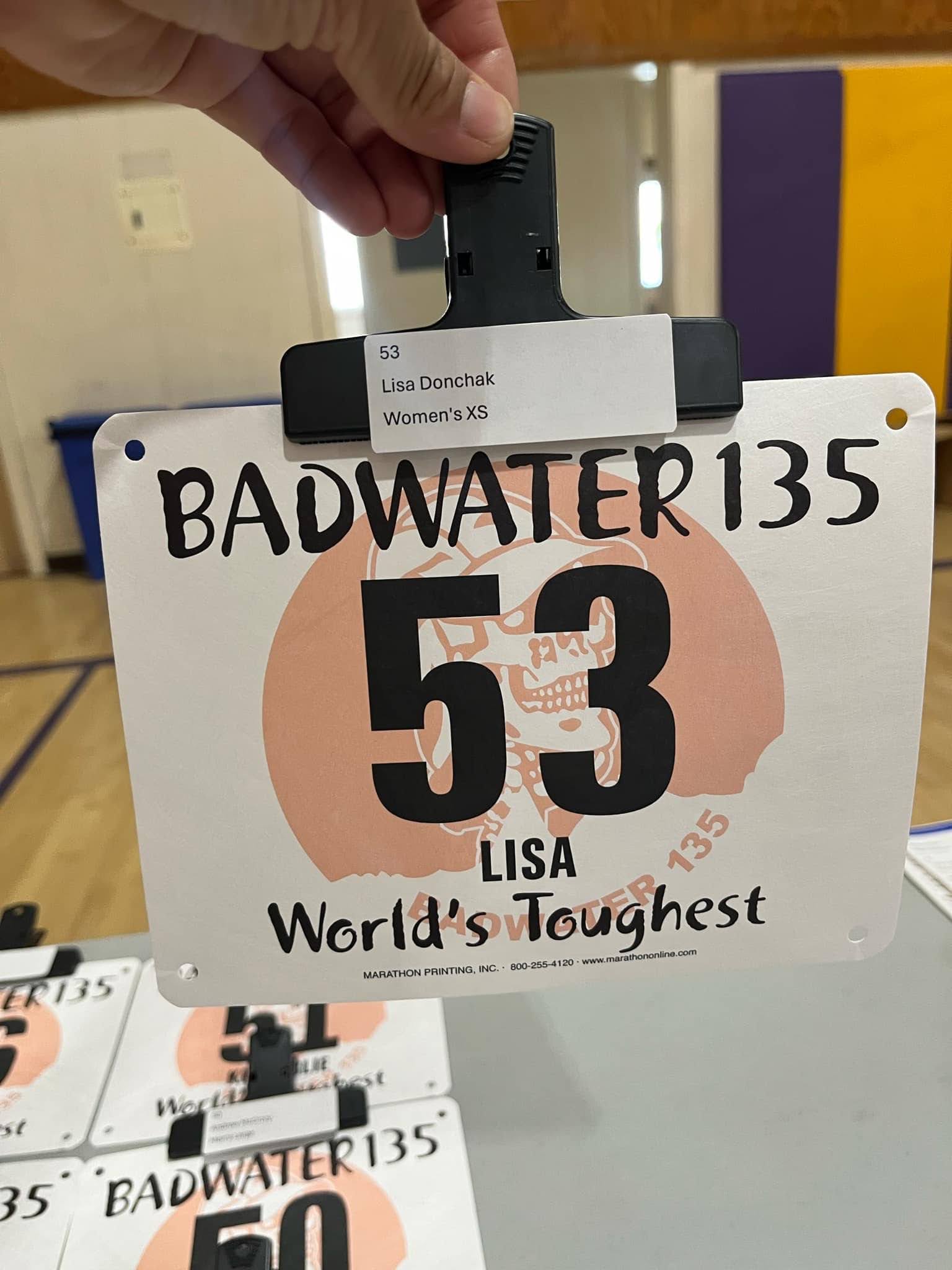
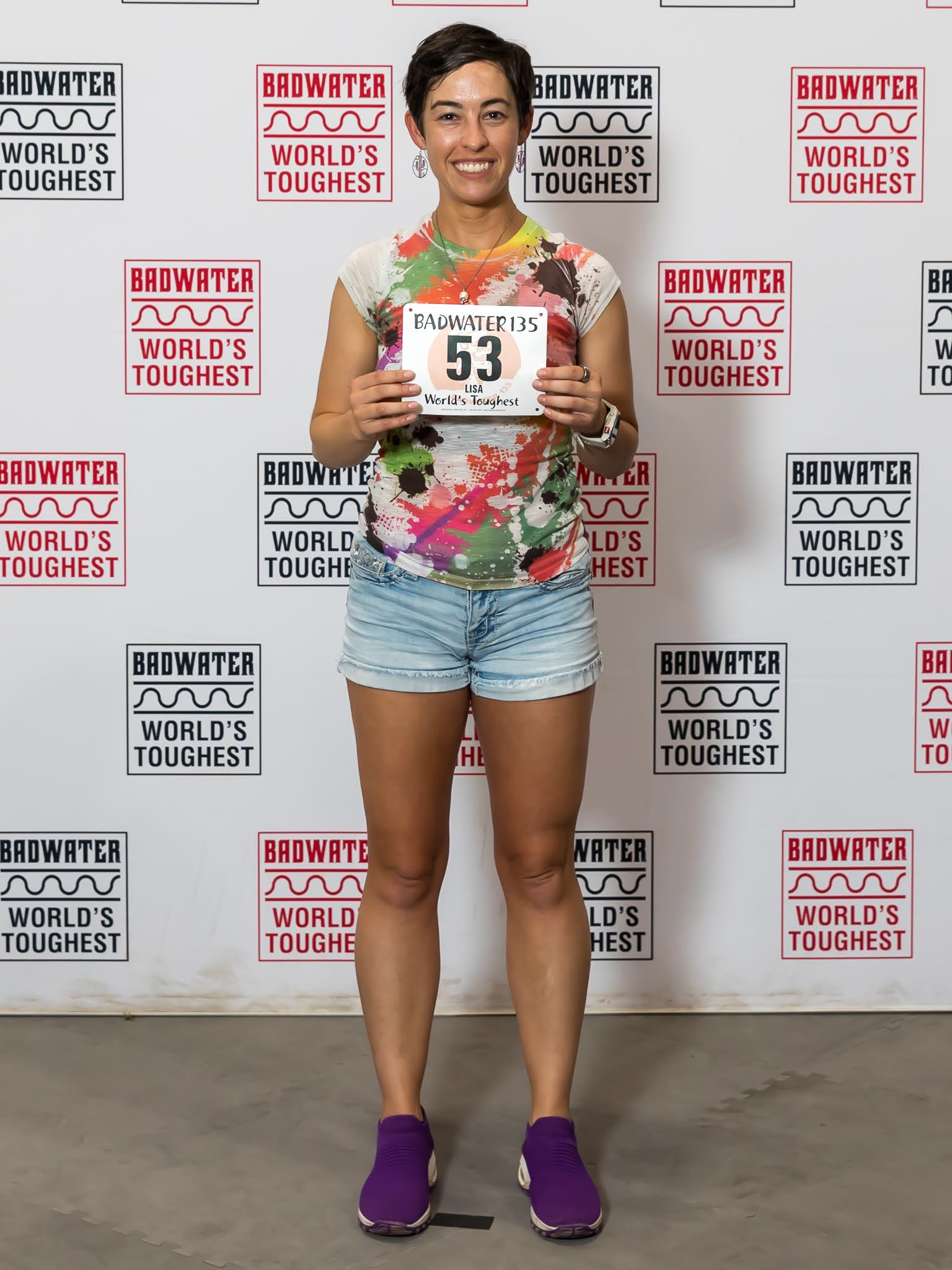
Bob, Raj, and I drove from San Francisco to Lone Pine, where check-in and the pre-race briefing were on Sunday. With some extra time between our check-in and the pre-race briefing, we got lunch, then hung out in the high school gymnasium, where Bob said hi to friends (he seemed to know everyone in the room from other races he has run). I napped in the car. After the briefing, we headed to Panamint Springs, where I had hotel rooms for the duration of the race.
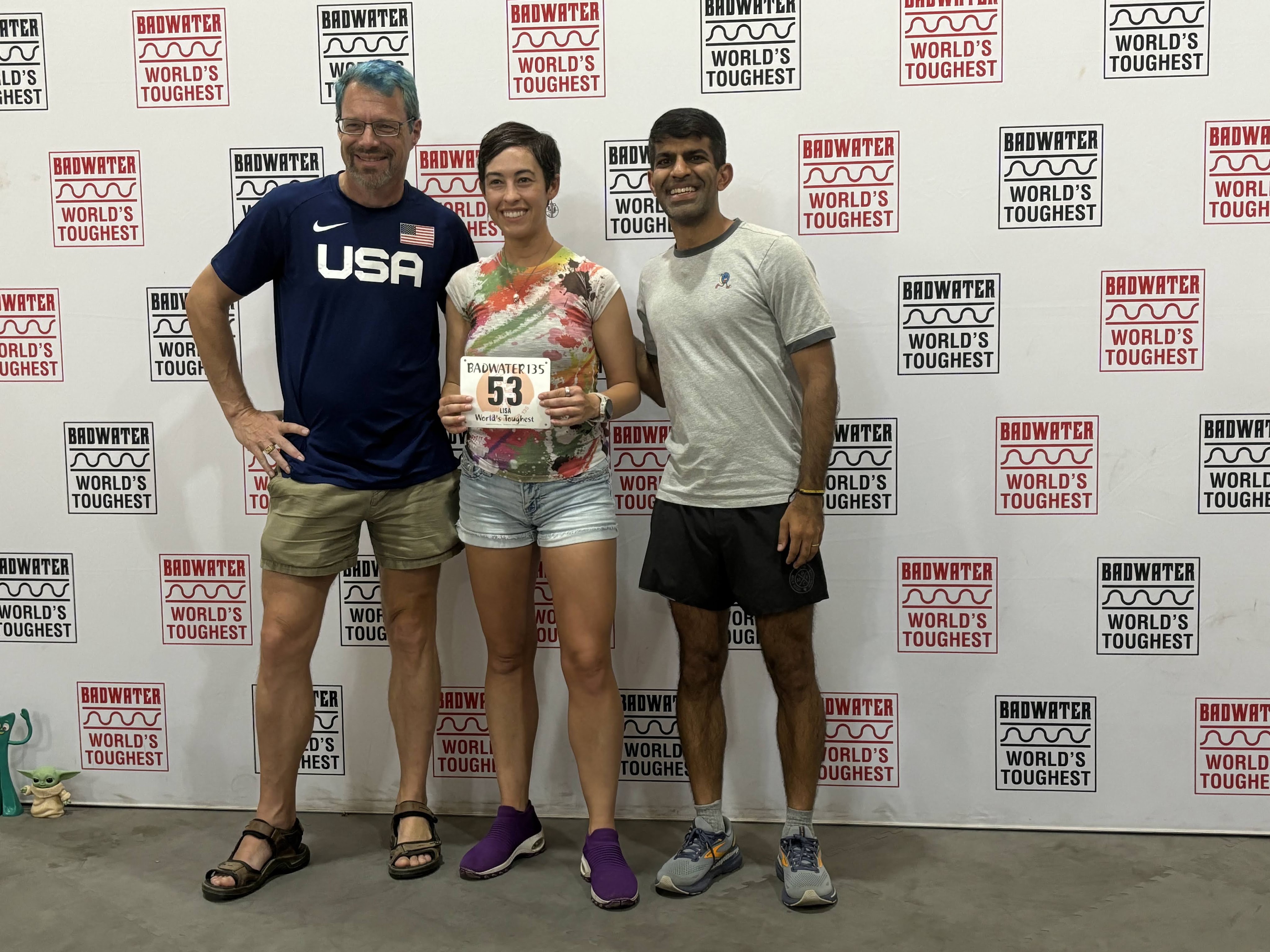
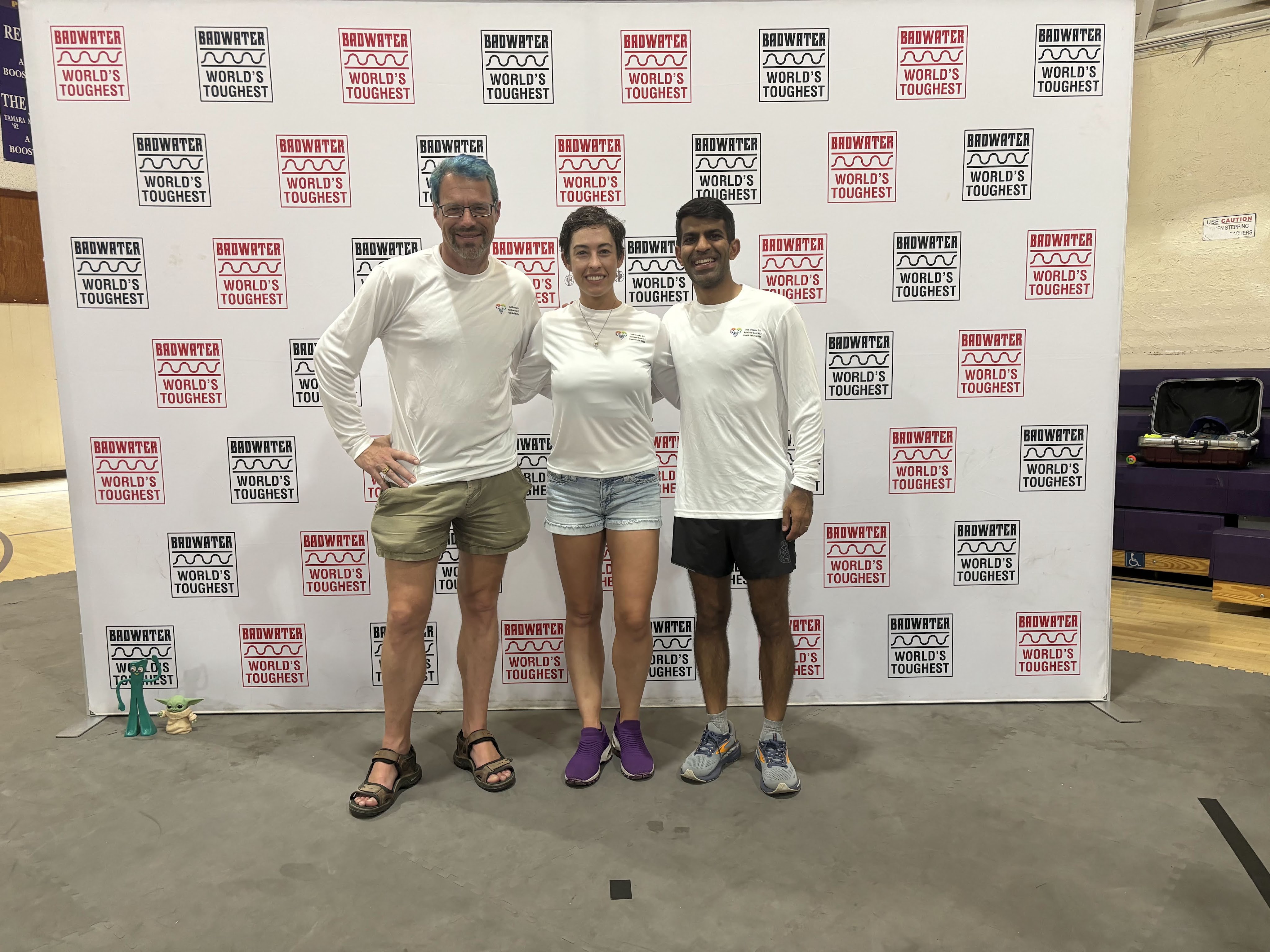
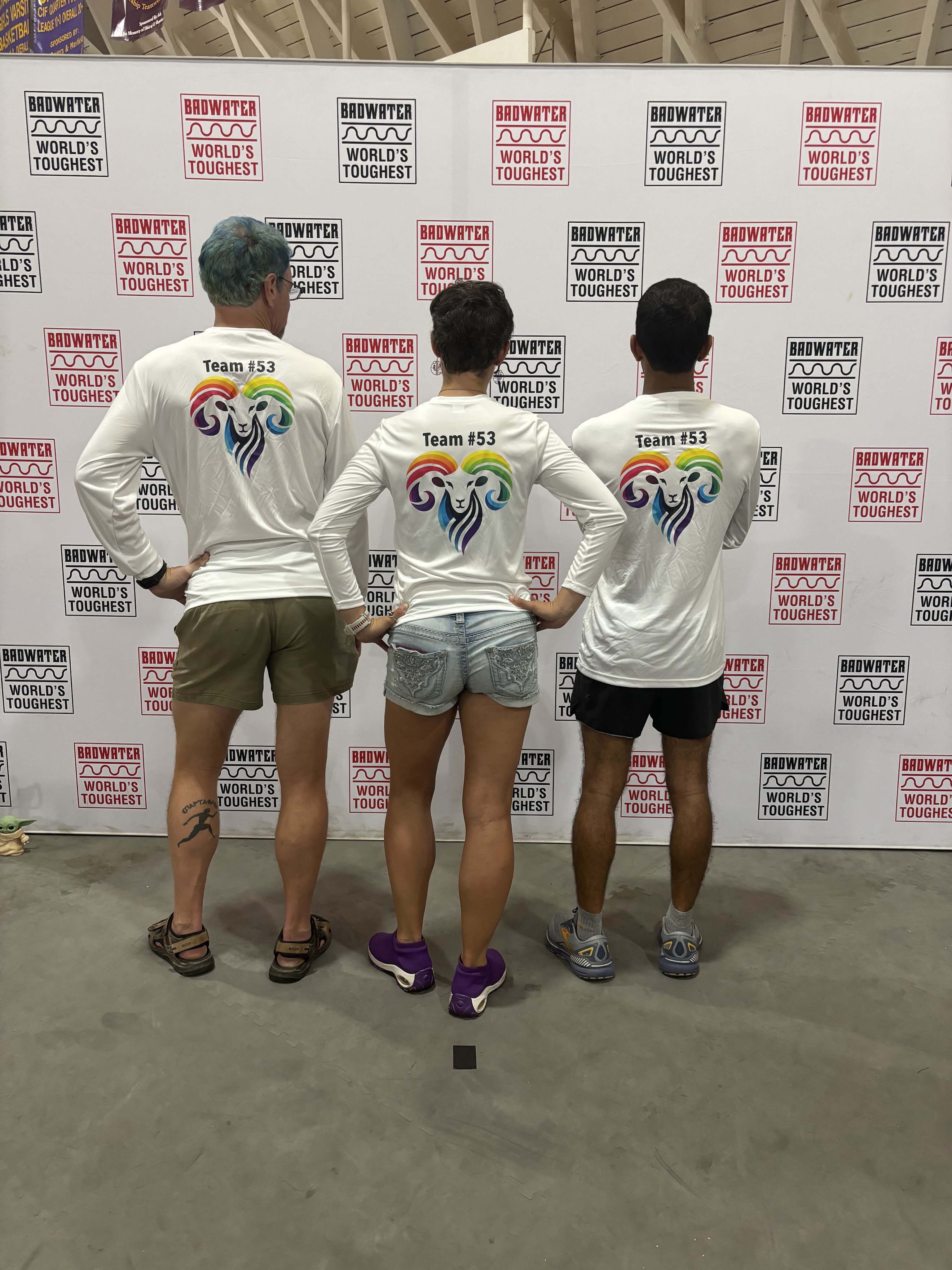
Sometime on Sunday, my friends from swimming shared a video from their Sunday morning swim, of all 40 of them saying “Stay cool, Lisa!” ahead of jumping in the water. It was SO motivating to get that video and know that all these random people were supporting me in this race.
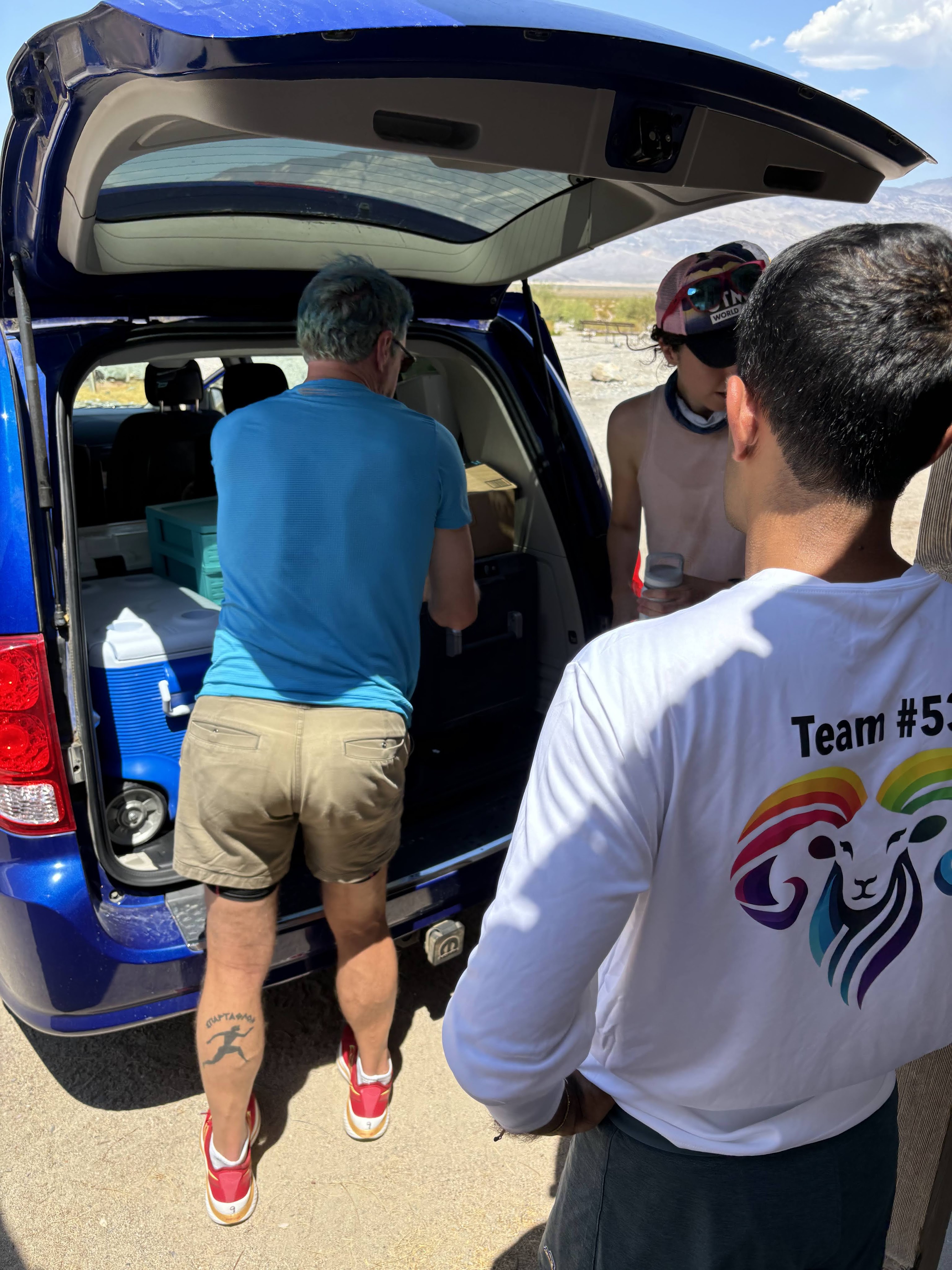
On Monday morning, Bob picked up Eric and Kate from Lone Pine and drove back to Panamint. They loaded the car – Bob, who was crew chief, made it very clear to me that I, the runner, would have zero input into the organization of the car, since I wouldn’t really be in there for any reason. Because Bob is also a puzzle expert, I had high confidence that he would have a great answer for van packing orientation.
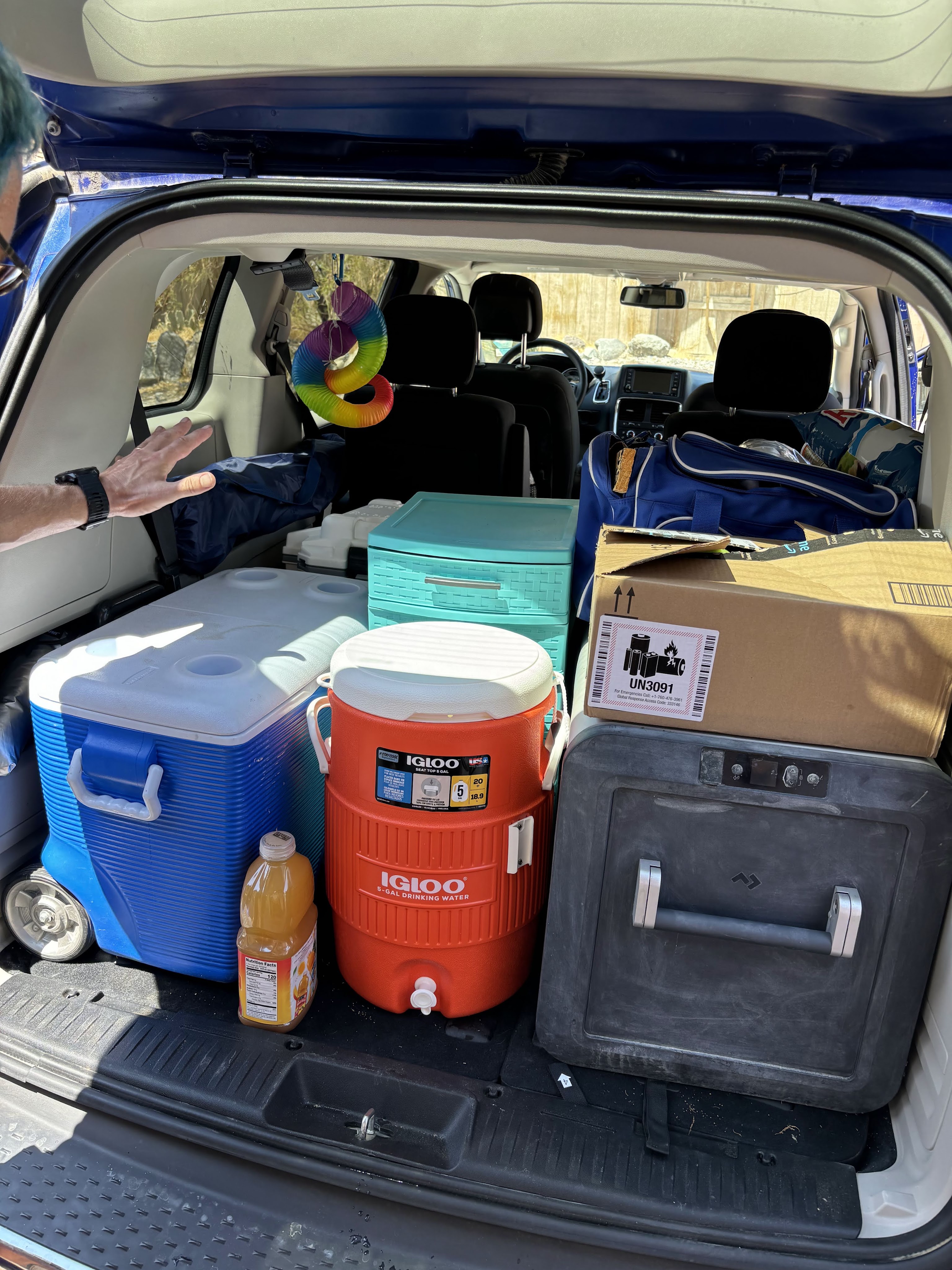

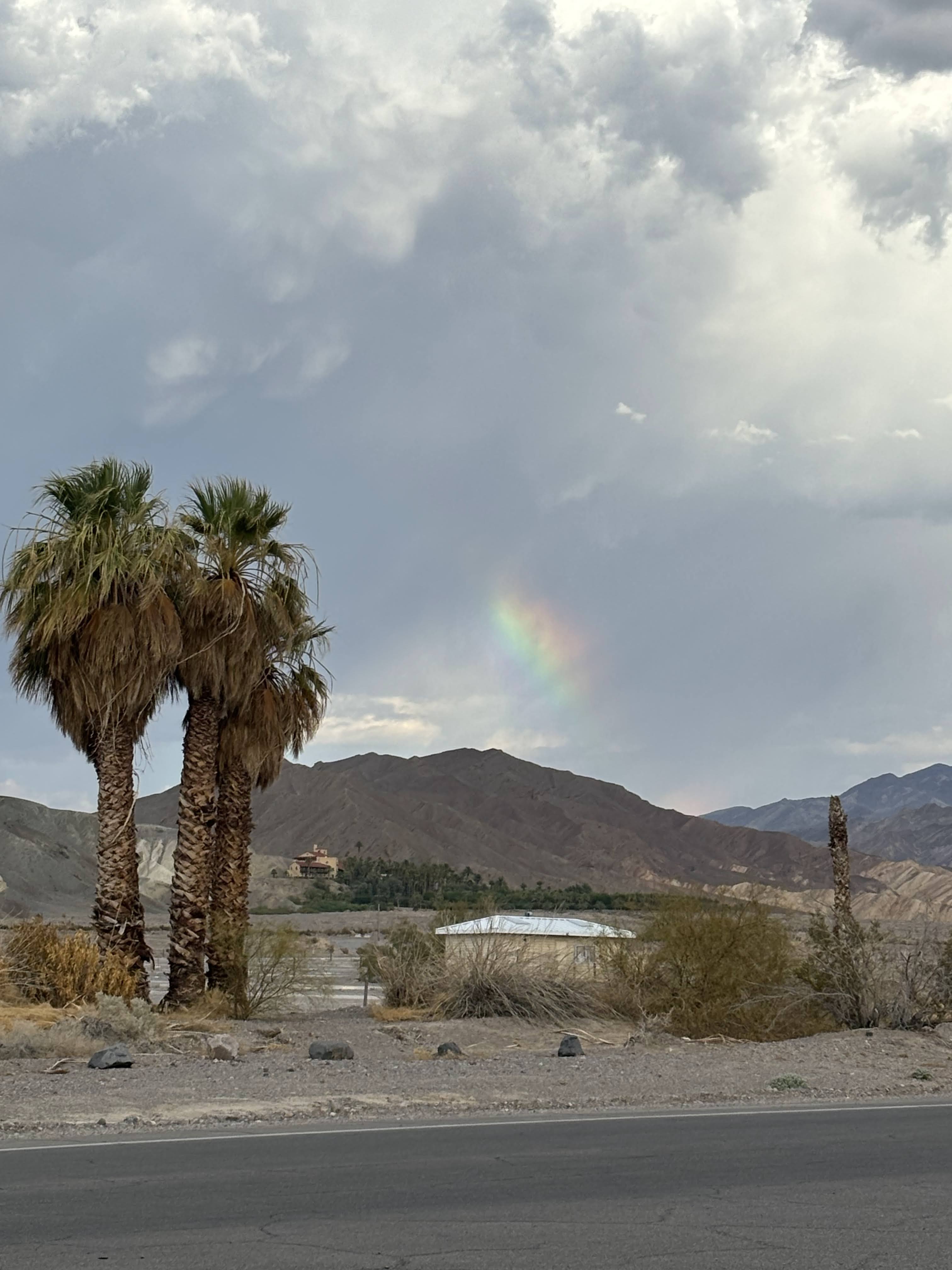
Around 4pm, we drove to Furnace Creek for dinner. We saw a bat on the way to the restaurant (very cool!) and a rainbow after we picked up ice. Then we headed to the start.
Logistically, I am not sure I would choose hotels in Panamint if I were to do this again – either Lone Pine or Stovepipe for Sunday night is the play. We did a lot of extra driving on Monday to pick up Kate and Eric in Lone Pine (where they needed to leave their car).

Start to Furnace Creek (17.5)
Time: 3:40 (4.77 mph)
Predicted time: 3:24 (16 minutes behind)
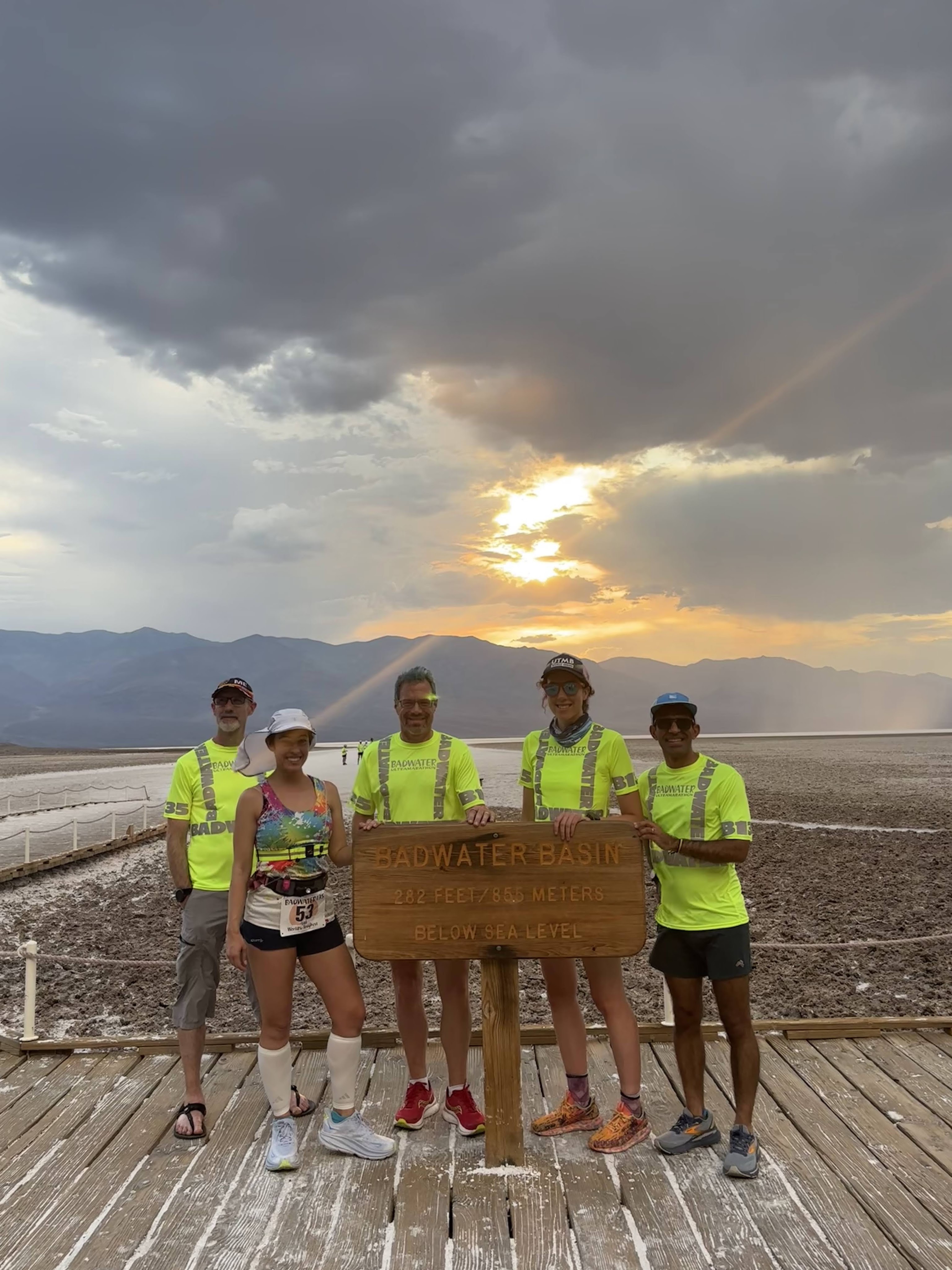
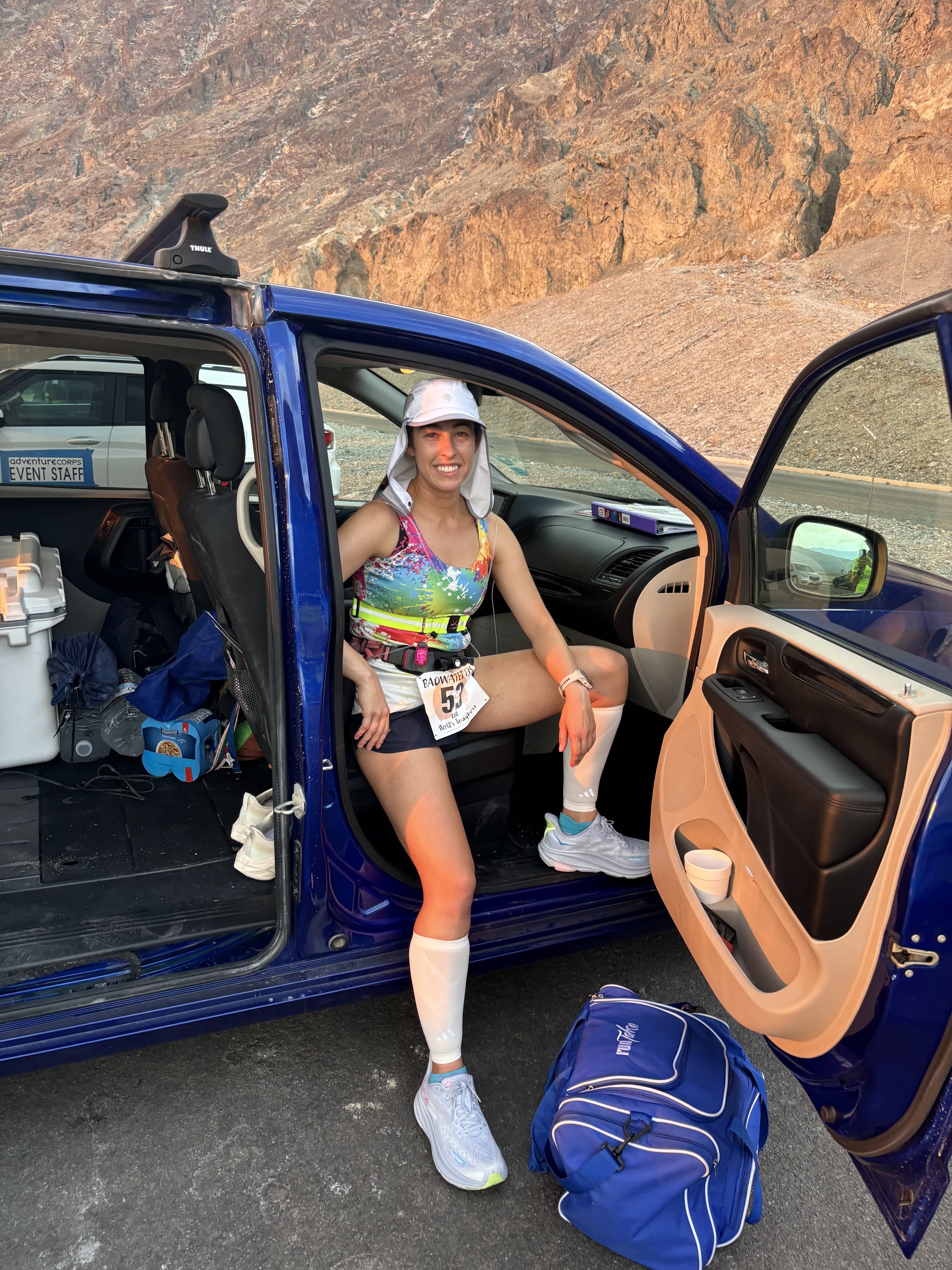
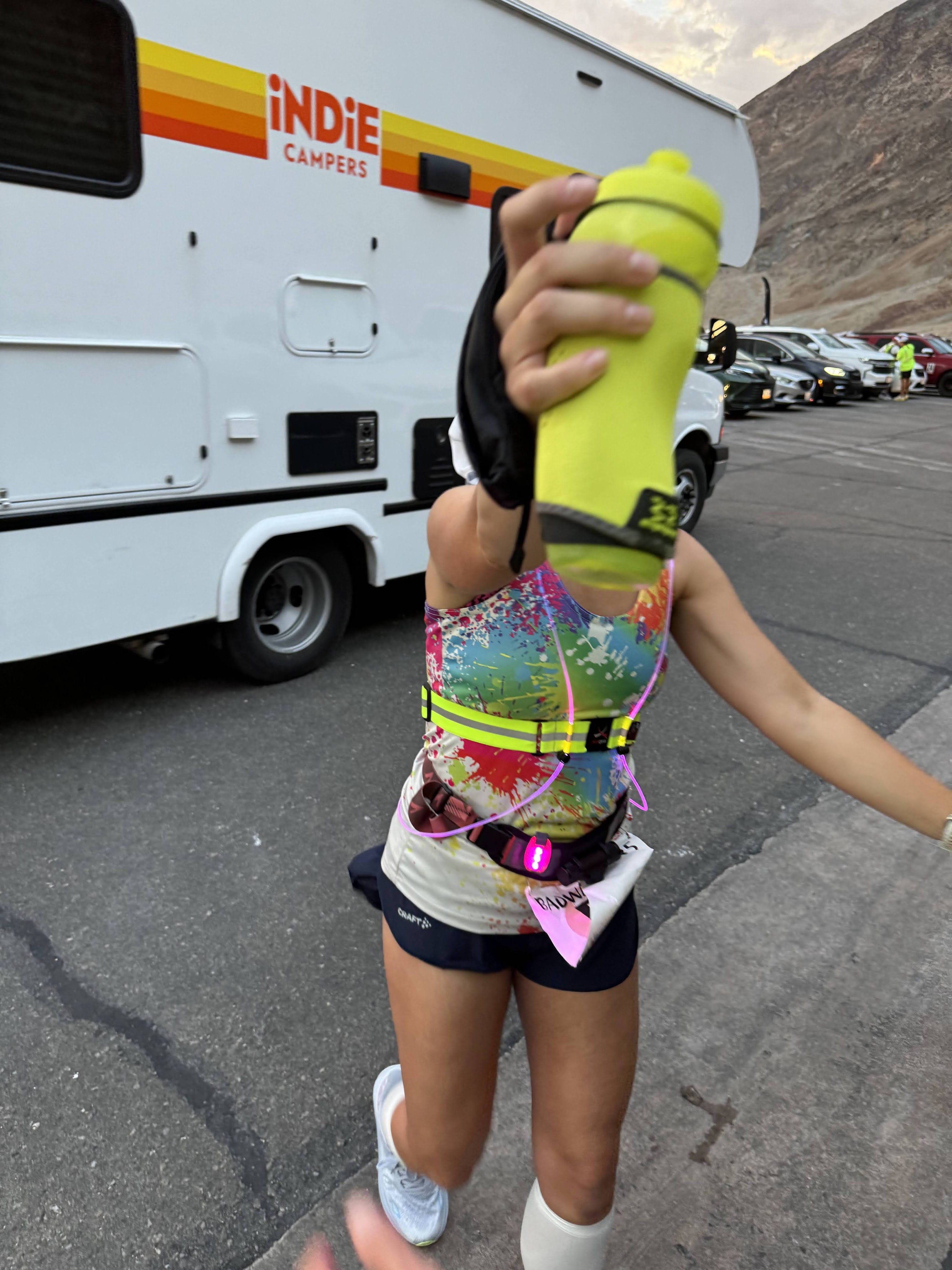
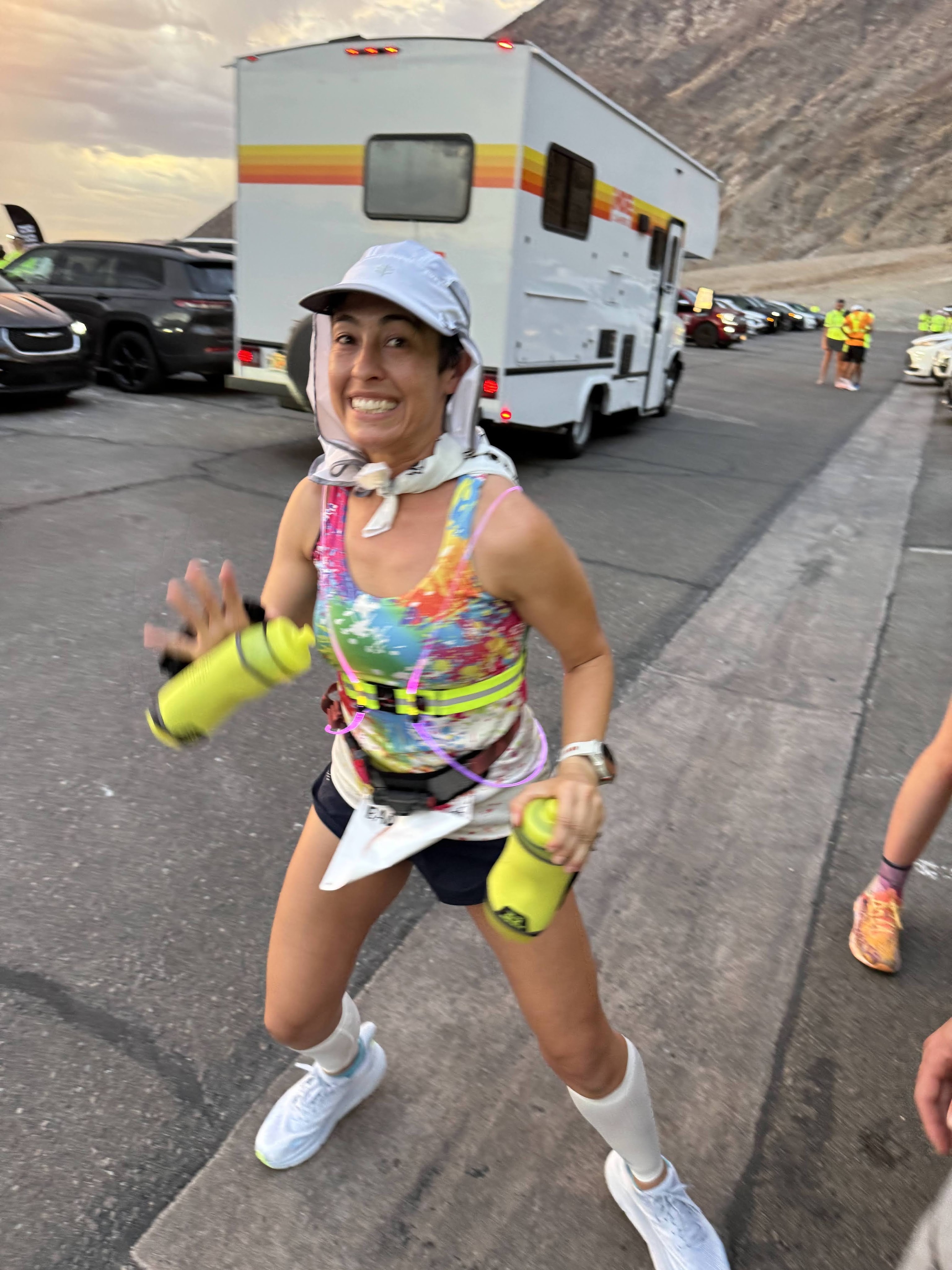
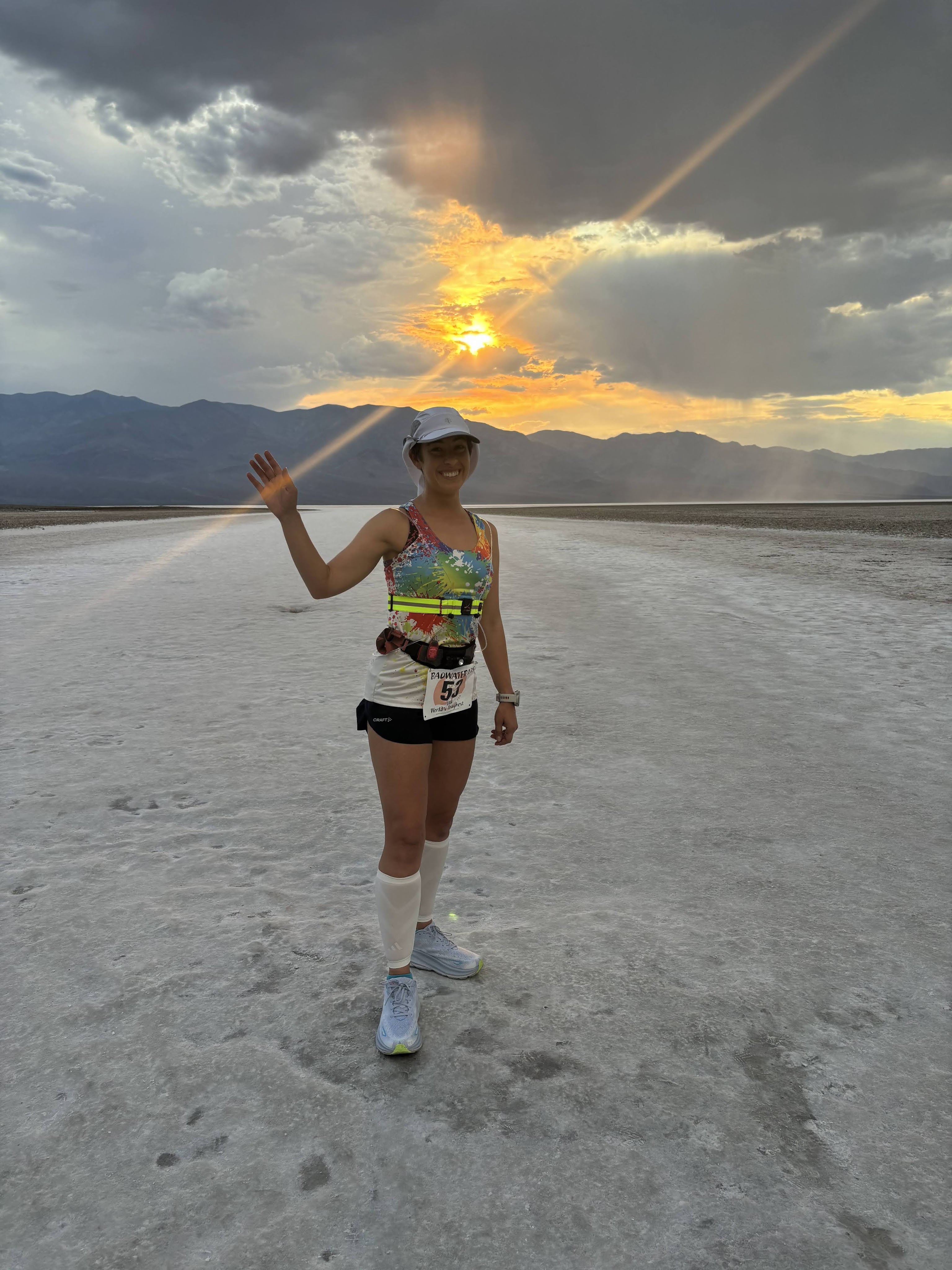
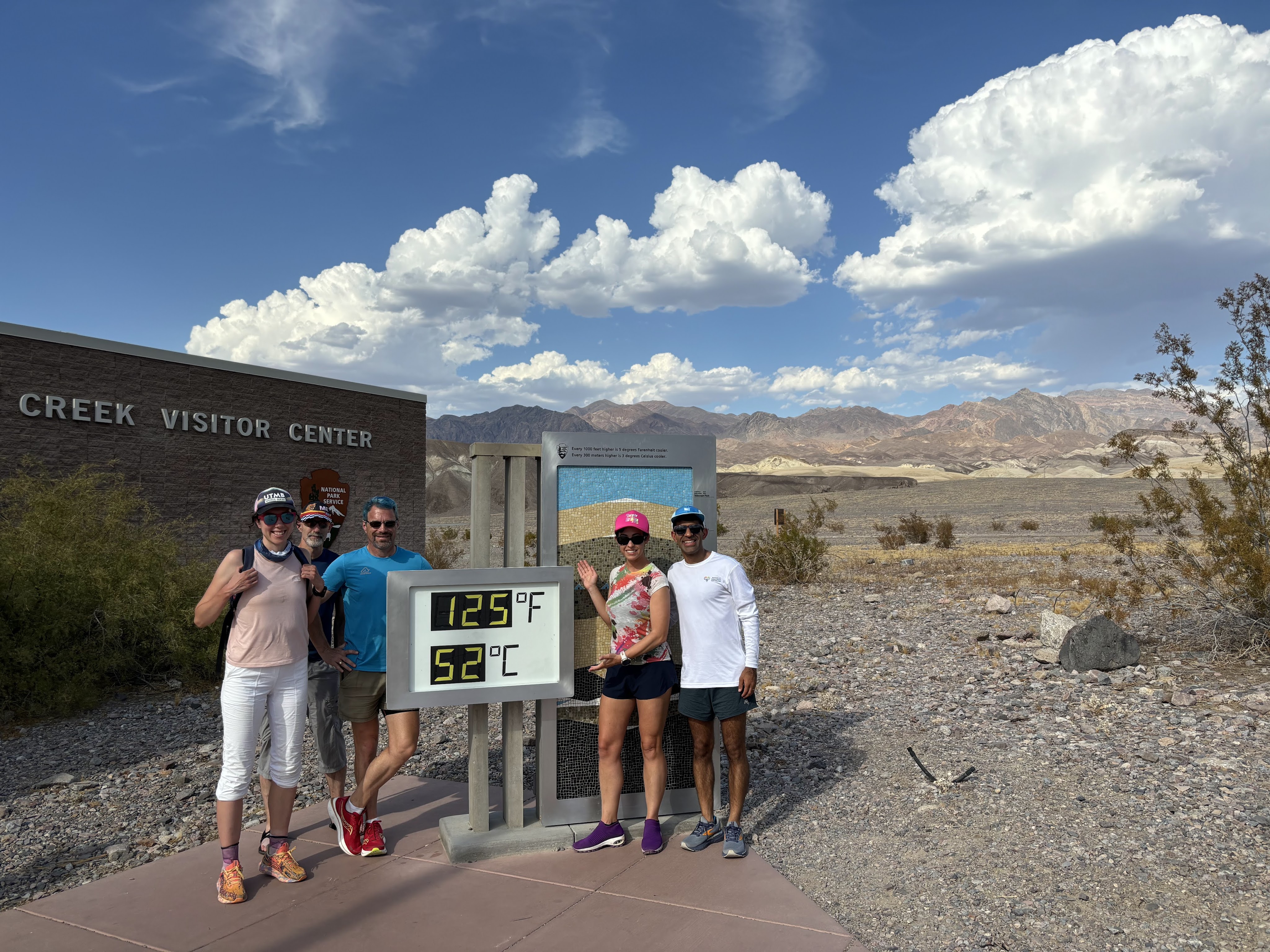
We arrived at the start line about an hour early. I was in the slow wave – 8pm start (there are also 9pm and 10pm waves) – so there was still some light outside as we got ready. We took some pictures, I got changed, and the crew re-packed the van.
Around 7:50, I headed down to the boardwalk. Chris made a couple of announcements, and my friend Joyce sang the national anthem. All of the crews, including mine, lined up on the railing with their OSHA type 3 neon yellow reflective vests & blinky lights to watch. It was a very cool sight. I hope someone got a photo of this. Then we counted down and were off.
The start of the race was very emotional for me. I was so happy to finally be toeing the line, running down the salty boardwalk, waving to my crew, and weaving through the parking lot onto the white line.
In addition to awe, amazement, and excitement, what was going through my head was that, at the pre-race briefing, Chris mentioned that one runner twisted his ankle coming out of the parking lot and DNFd – so I was definitely watching my step here. Most of the race was spent thinking about how to not DNF.
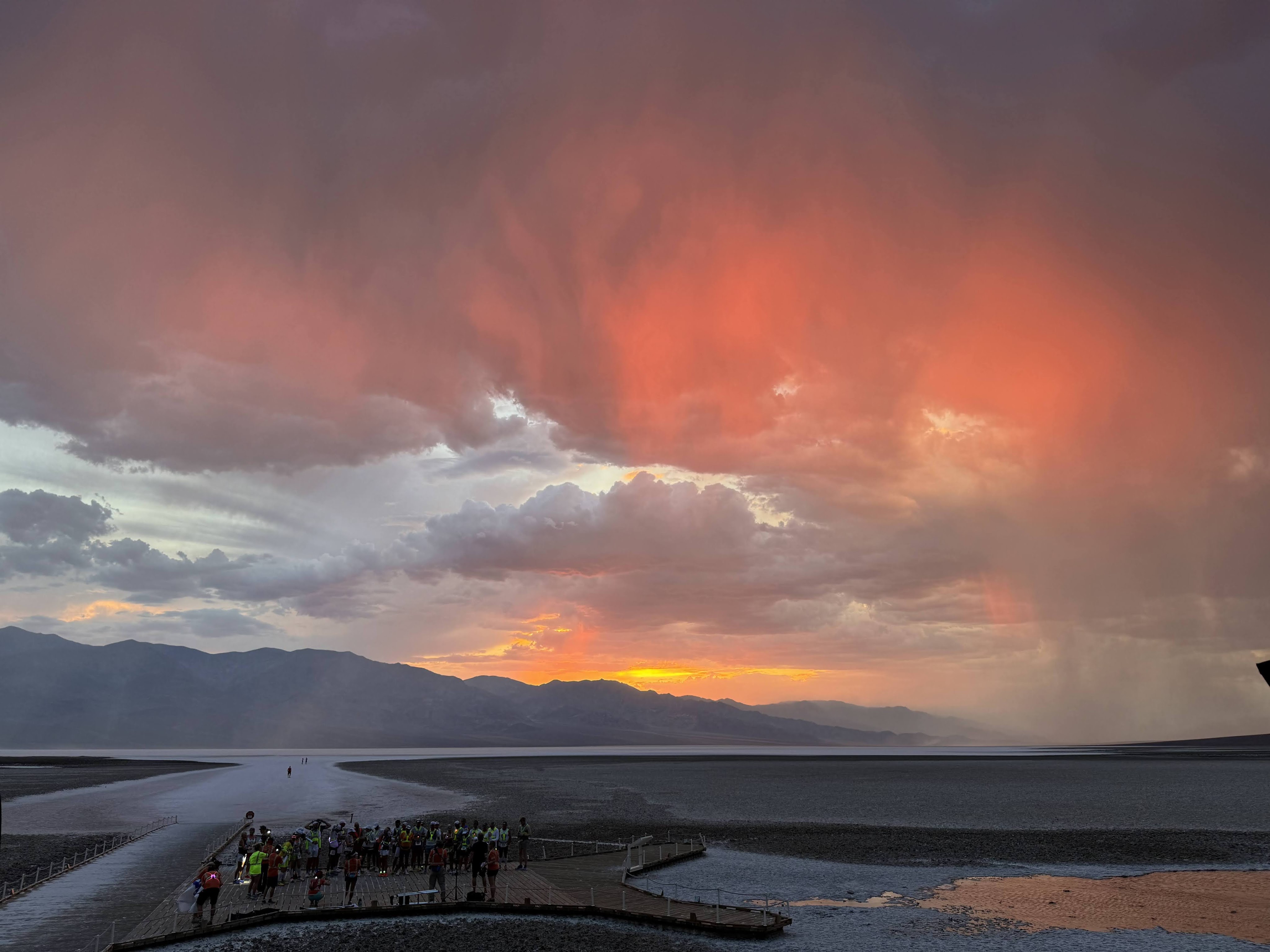
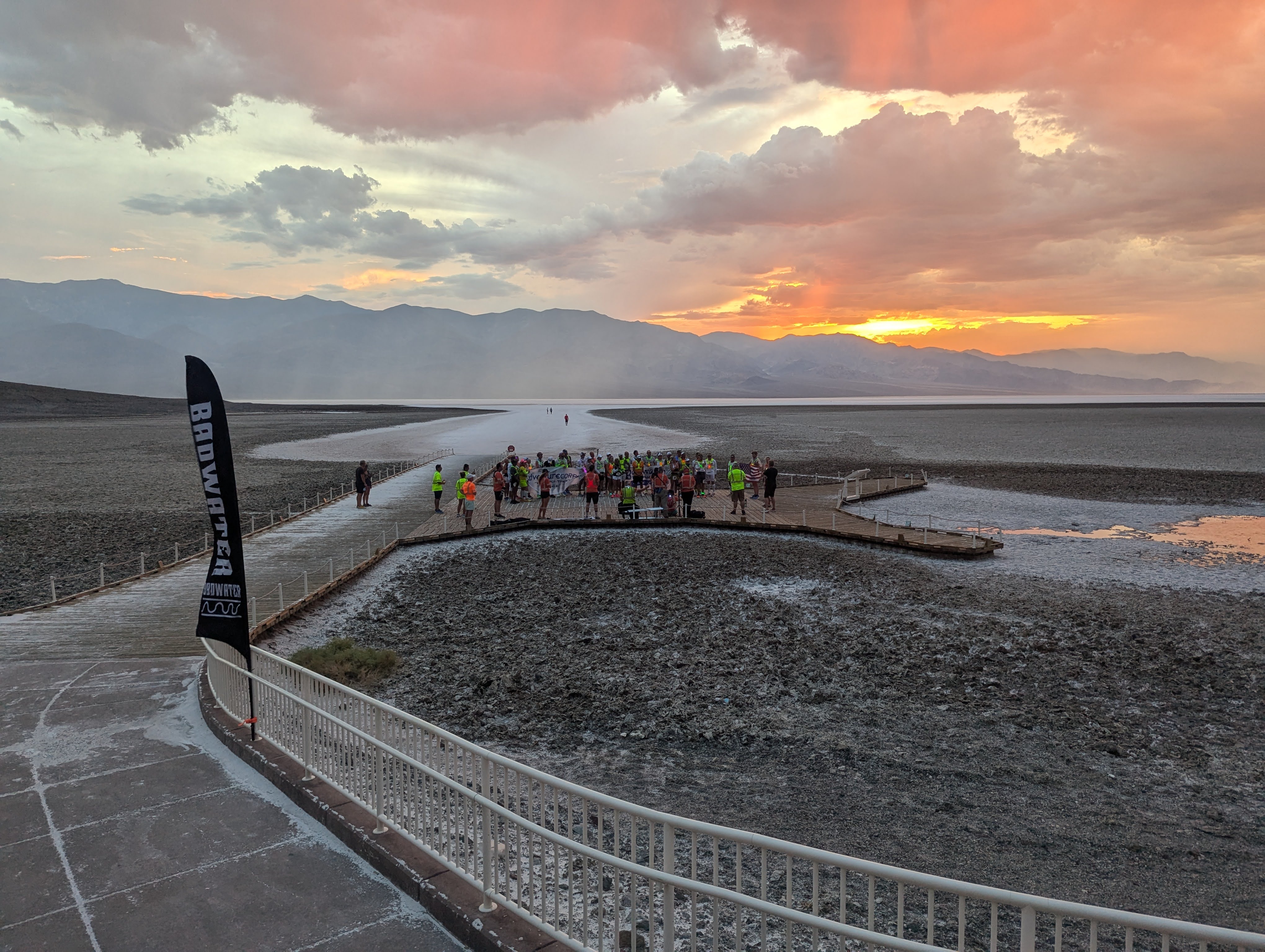
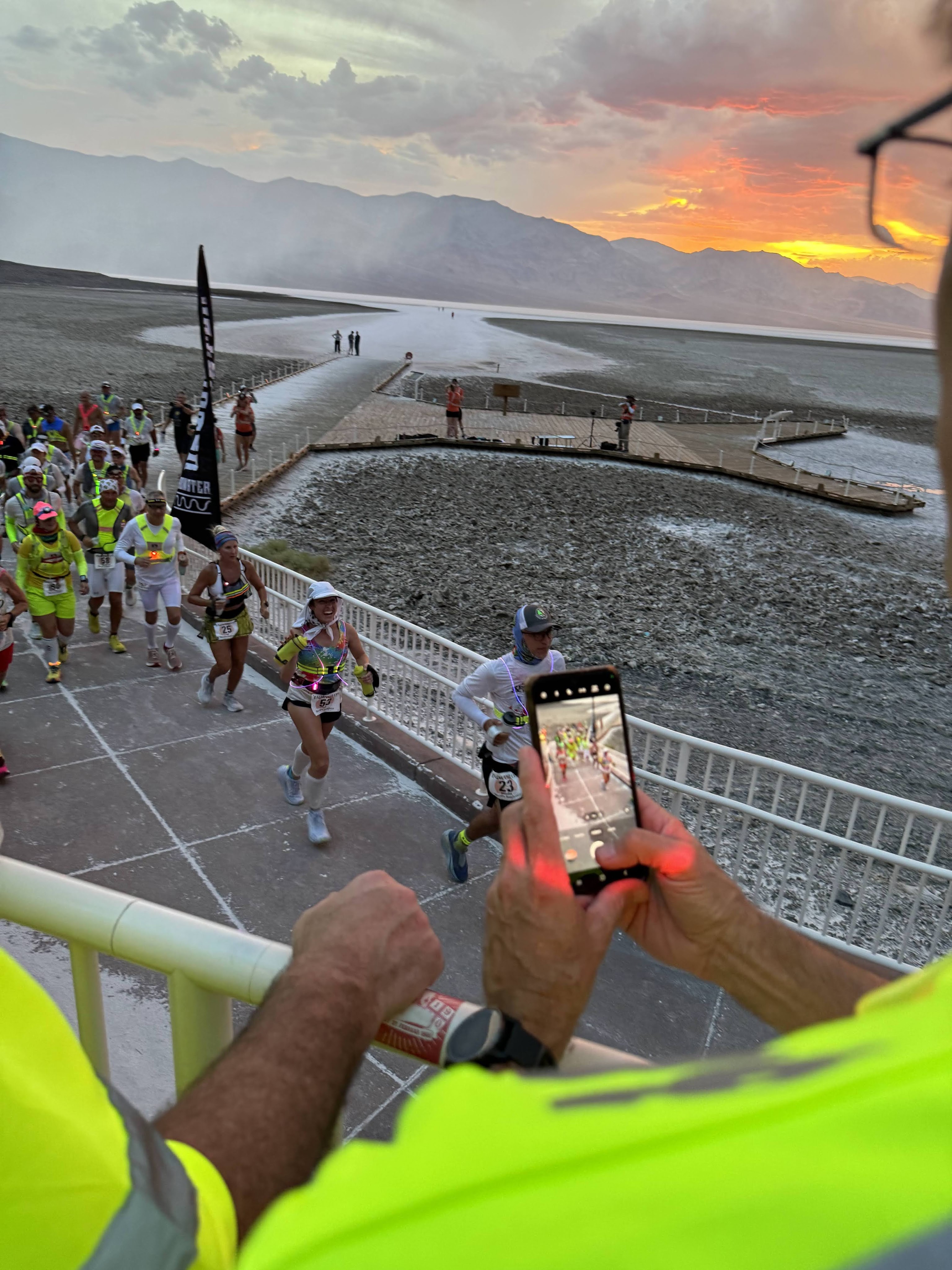
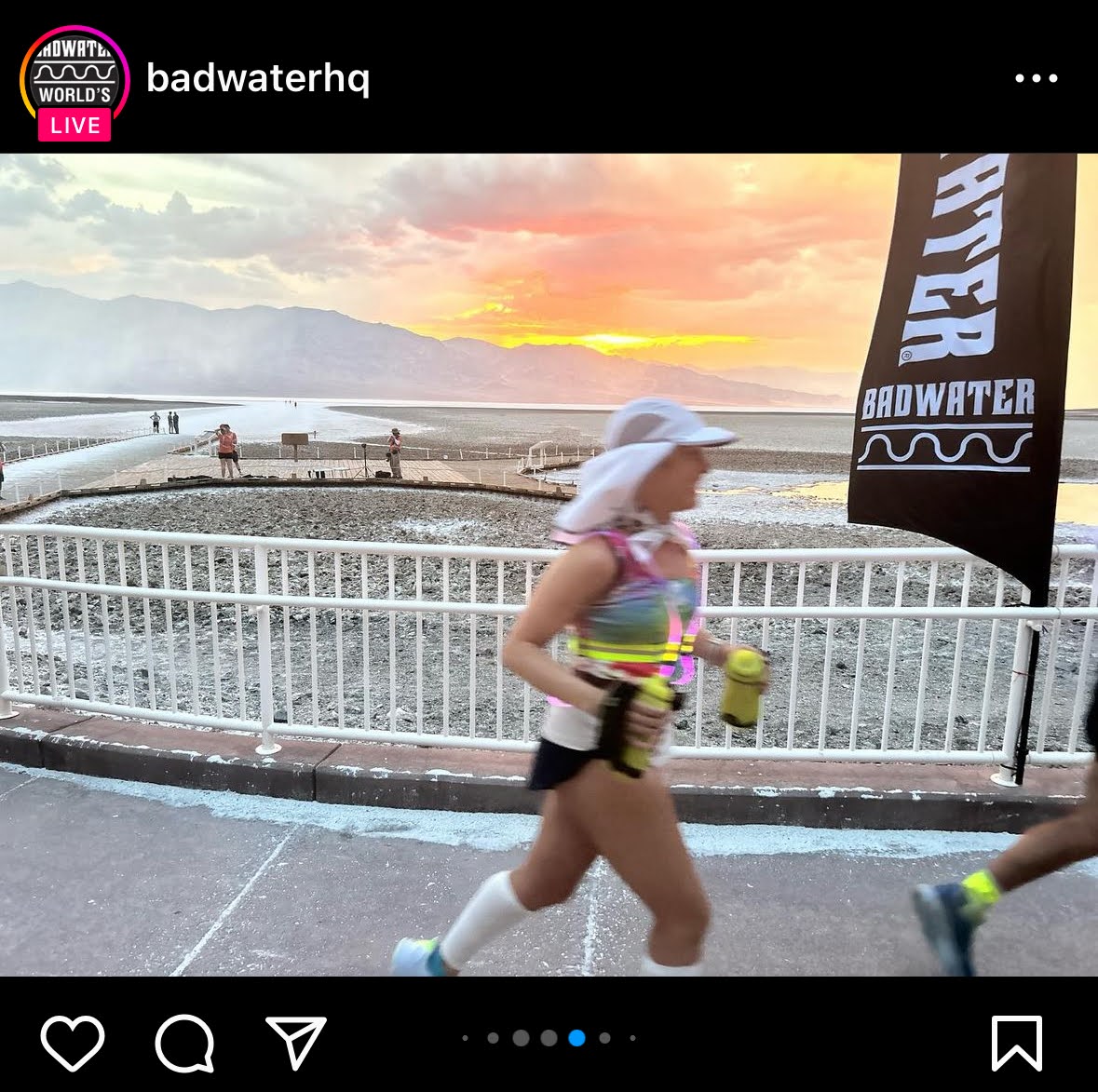
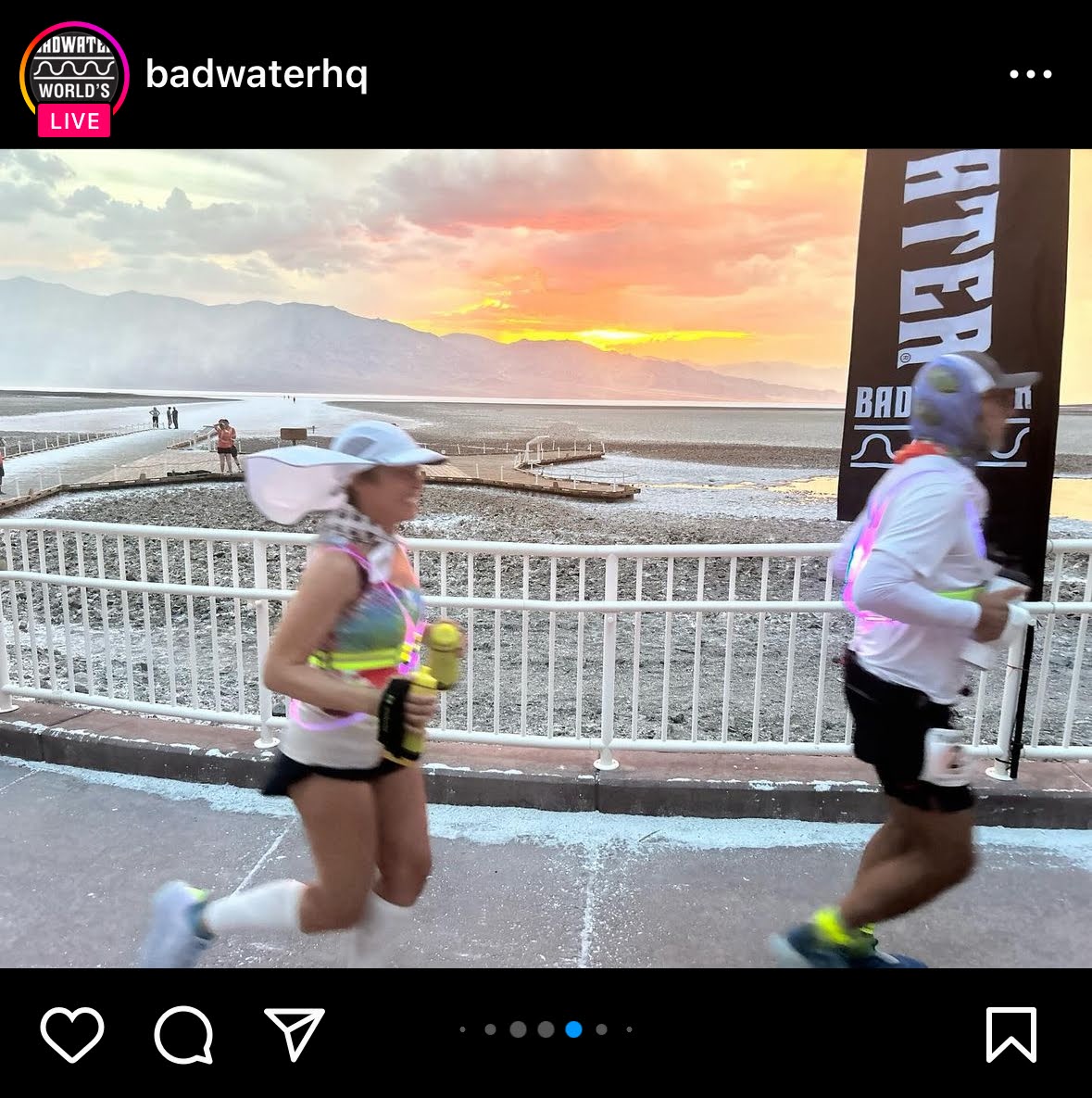
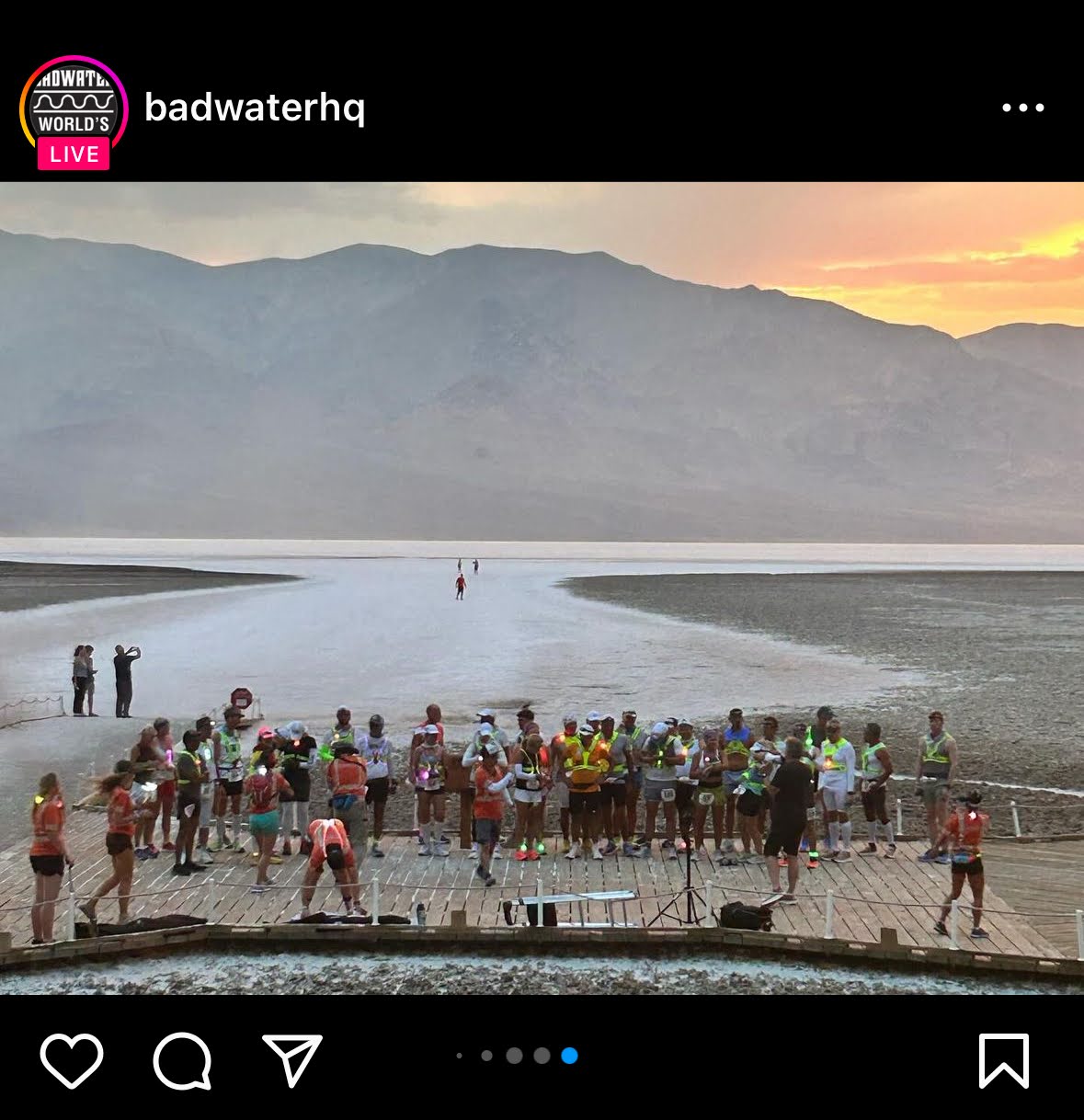
Within minutes of hitting the iconic white line, a monsoon hit. It was incredibly windy – perhaps 30 mph – and rainy. There was a stretch where I had my head down, hand on my hat, and was just focused on staying to the left of the white line. There was no way to look at anything else. I felt like a horse with blinders on. It was impossible to see ahead. I just had to trust that no cars would hit us. I had a thought that the weather would be this bad for the next 135 miles, but I was so hopped up on adrenaline and enthusiasm that I thought “sure, I can do this for 135 miles.” Fortunately, it cleared up pretty quickly.
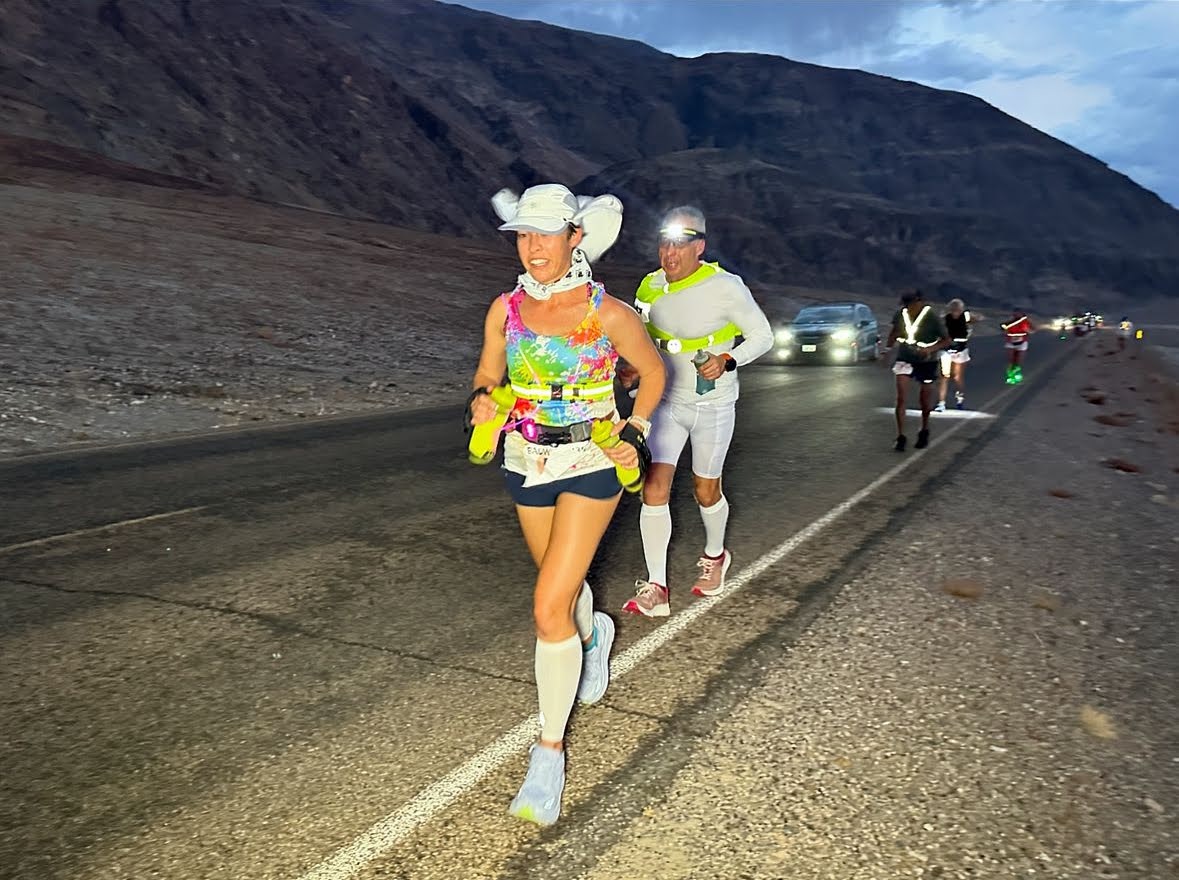
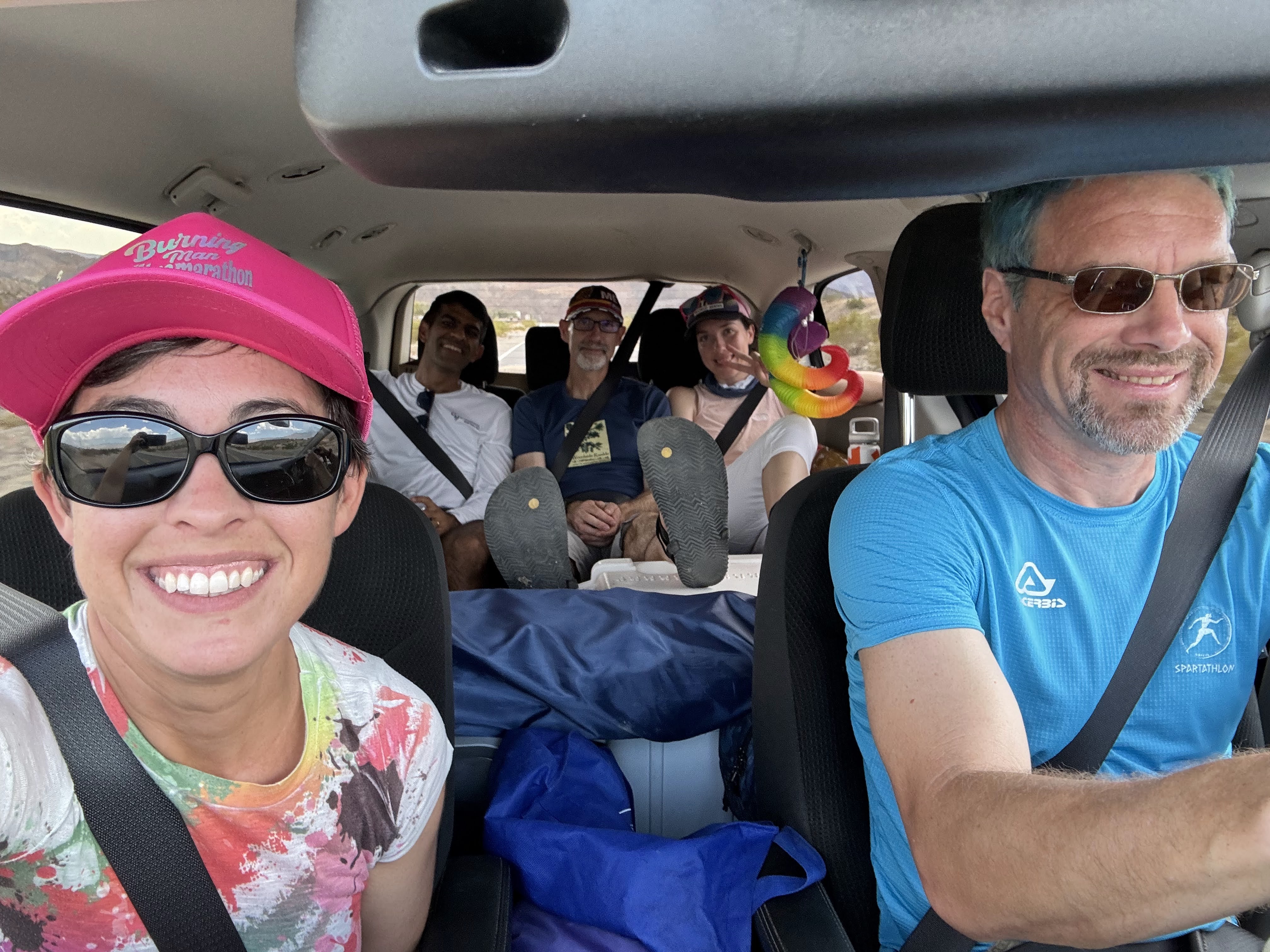
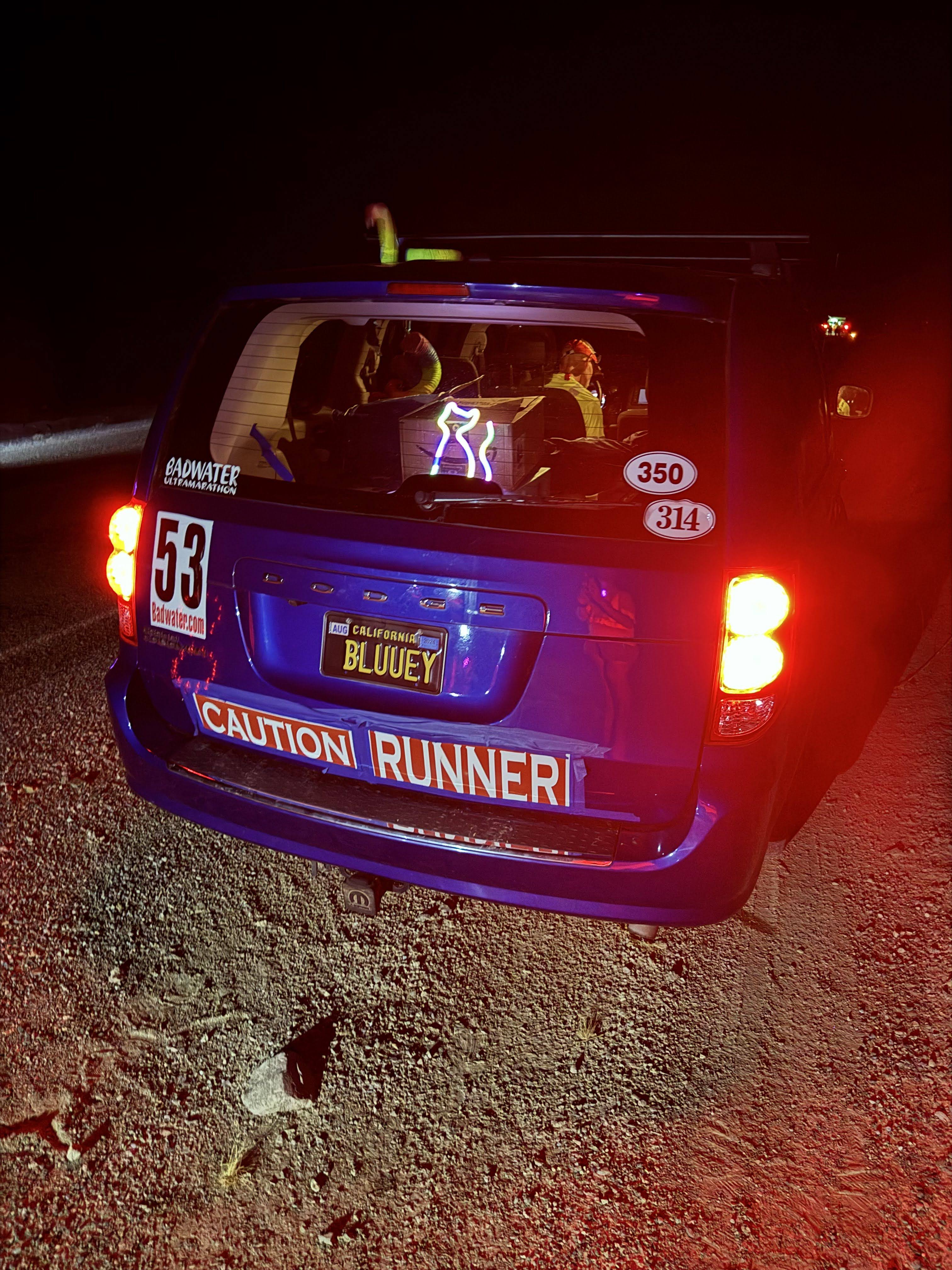
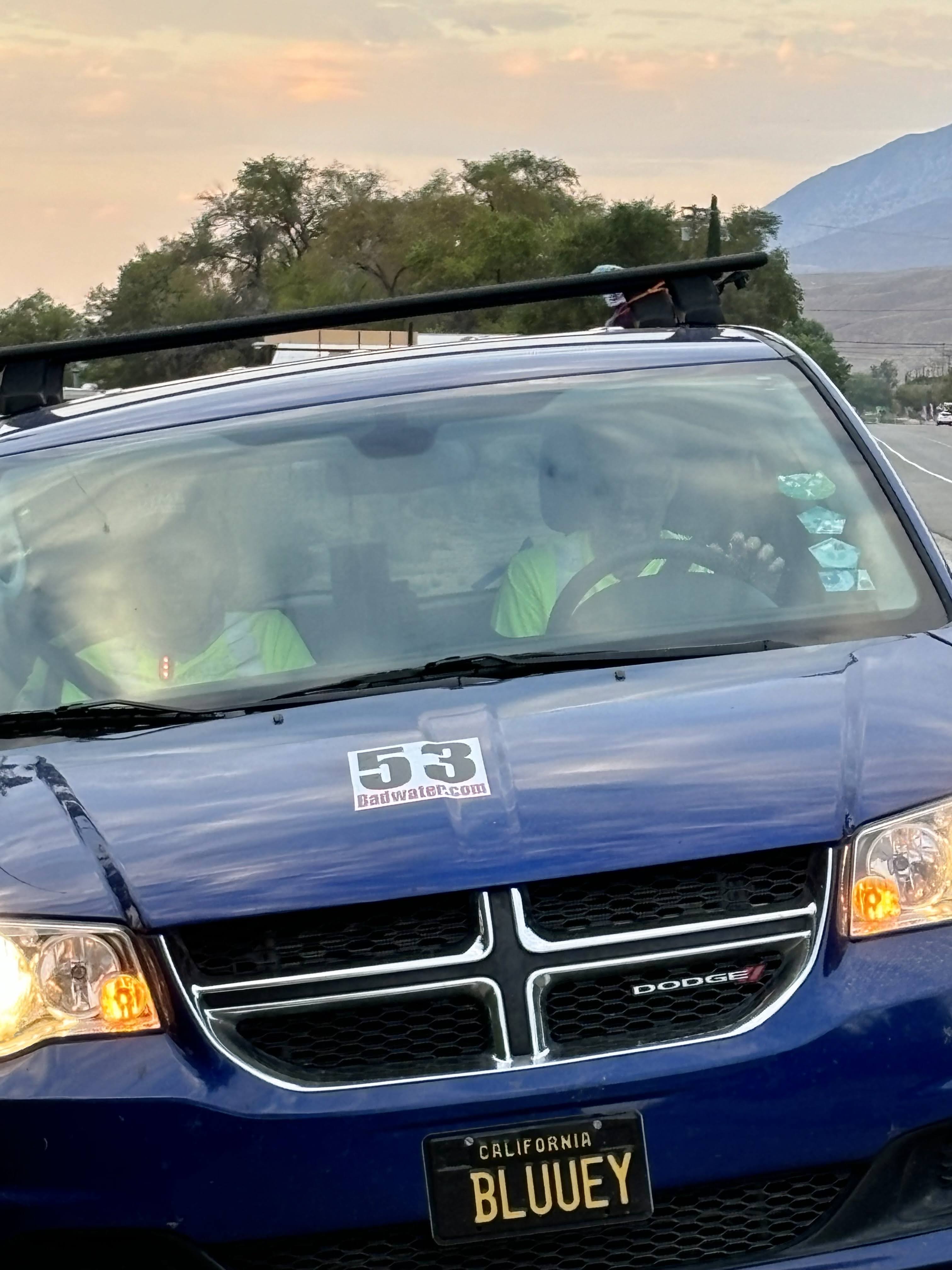
One difficult aspect of this section is finding your crew car for the first time. Runners look vaguely the same in the dark, and crew cars also look vaguely the same due to the restrictions about what cars can be brought. My crew said that they were able to identify me by the white compression socks, the multi-color light up running vest that I had set to purple, and the people who were running ahead of me. I was able to identify the van by the rainbow neon cat they put in the back window, as well as the fact that it was a dark blue (most vans are white). We were also one of the (surprisingly few) cars who put our number sticker in the correct location – on the lower left of the back of the car – so that helped (unexpected benefits of reading the rules closely, esp when others don’t!).
It was really neat to see all the cars lined up on the side of the road during this section. For several hours into the night, cars would slowly roll by and park on the side of the road, creating a long line of lights into the dark desert. It didn’t feel like a party, because we were all pretty focused, but it did feel like something was happening out there.
The temperature at this time was pretty warm – my watch recorded easily over 100*F, although it was likely higher as the watch usually underestimates air temperature (I spoke to a wearables engineer who focuses on temperature sensors and he confirmed this is true, since the wearable sensor usually conflates air vs skin temperature, and is often placed in a random location in the wearable). I was wearing my neck buff with ice and swapping it out every time I saw my crew, and this worked pretty well for this section. A lot of veterans had emphasized the need to stay cool in this section, so even though I didn’t feel like I needed body ice, I used it.
Furnace Creek to Stovepipe Wells (42.2)
Time: 9:29 (4.55 mph); Time from last aid: 5:49 (4.25 mph)
Predicted time: 8:24 (65 minutes behind)
We faced some challenges in this section, which didn’t feel great so early in the race. I still ended this section feeling very strong.
First challenge: My body was ready to go to sleep. I had been up since 6:30am and it was now past midnight. I have a very hard time staying awake between 1am and 4am, so this issue was something I should have known and predicted. I was weaving around the white line and into the road, which is dangerous because there are still cars on the road. In other races, I have been on trails (e.g, no cars) and have had pacers at night, but neither of those things were true here. I took a couple of naps – totaling about 20-25 minutes. This was really making my crew nervous because it was so early in the race, but there was really nothing to be done about it – I didn’t want to get hit by a car.
After these naps, my body woke up and felt really good. It was around this time that I was pretty sure I could finish this race. I was moving pretty well, and there were some nice downhill sections that I felt quite fast on. I also ran into Kaylee Frederick, the youngest ever Badwater finisher at 18 years old last year; we ran a bit together on a downhill section before I met up with my crew van.
Second challenge: I came up to the van around mile 38, and Kate opaquely said “we have a glitch.” The van was stuck in the sand on the side of the road. Because each crew is only allowed one car, and the car has to stay with the runner, if we hadn’t been able to get the car out, my race would have been over. With some great team problem solving and help from the rangers, we got un-stuck, but it was a very harrowing 15 minutes. I will never forget seeing the front left tire roll out of its hole in the sand. That said, it was the best possible outcome for this issue – we only lost 15-20 minutes, and the burst of adrenaline gave me a good push into Stovepipe Wells.
Ultrarunners have been known to make up songs while running. I made one up during this section, which reflected how great I was feeling:
Hype train: going to Whitney
Hype train: better get on
Hype train: running real fast*
Hype trail: feeling pretty strong
* When I made up this lyric, I looked at my watch, and it said I was doing 11:30 pace. So, not very fast.
In any case, I am not a musician, but I made up a lot of lyrics to this song over the rest of the race.
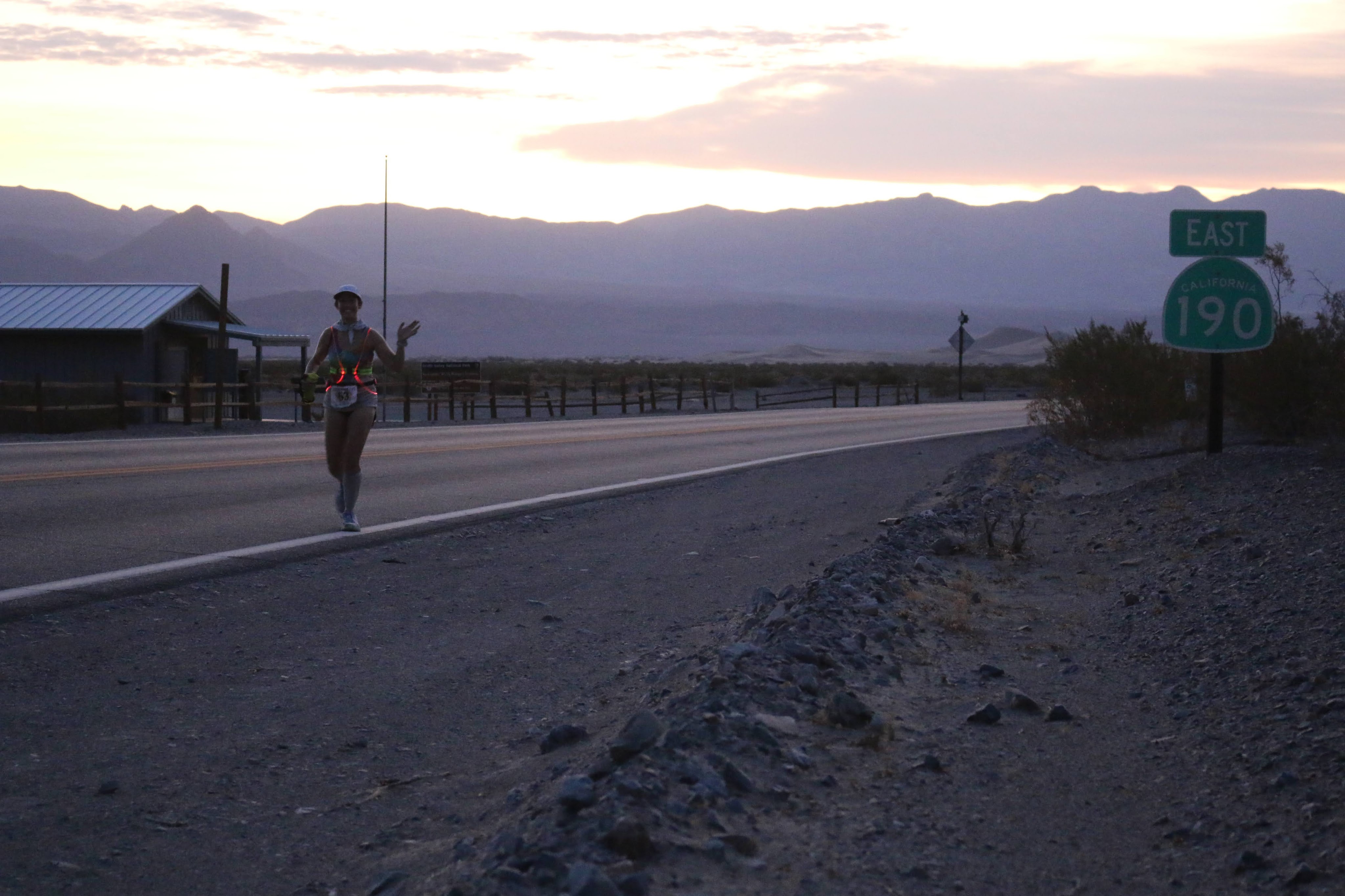
The sun was just about to come up as I entered Stovepipe Wells, and I was feeling positive.
Stovepipe Wells to Towne Pass (58.7)
Time: 14:38 (4.01 mph); Time from last aid: 5:09 (3.2 mph)
Predicted time: 13:30 (68 minutes behind)
I moved quickly through the checkpoint here. There was another crew who knew Bob, so they said hi to him as he was filling up gas.
Pacers are allowed starting at Stovepipe, but I was feeling pretty good and wanted to run a few more miles, so I picked up Bob about two miles later, around 44. I was focused on getting to the 50 mile cutoff before 10am, which I was in very good shape to do, but I was pretty anchored on that as the next waypoint.
The Towne Pass climb is about 16 miles of climbing, and I was planning to walk most of it. Bob had an injury that prevented him from running, so he was on the schedule to pace me up the first two (out of three) hills, including this one. Bob is an amazing athlete; he has won Vol State, run Spartathlon several times, and set the 24 hour course record on the New Years One Day course that I run most years. He and I met at Burning Man in 2021 and hadn’t really had an opportunity to get to know each other deeply; the chance to chat for several hours was really special.
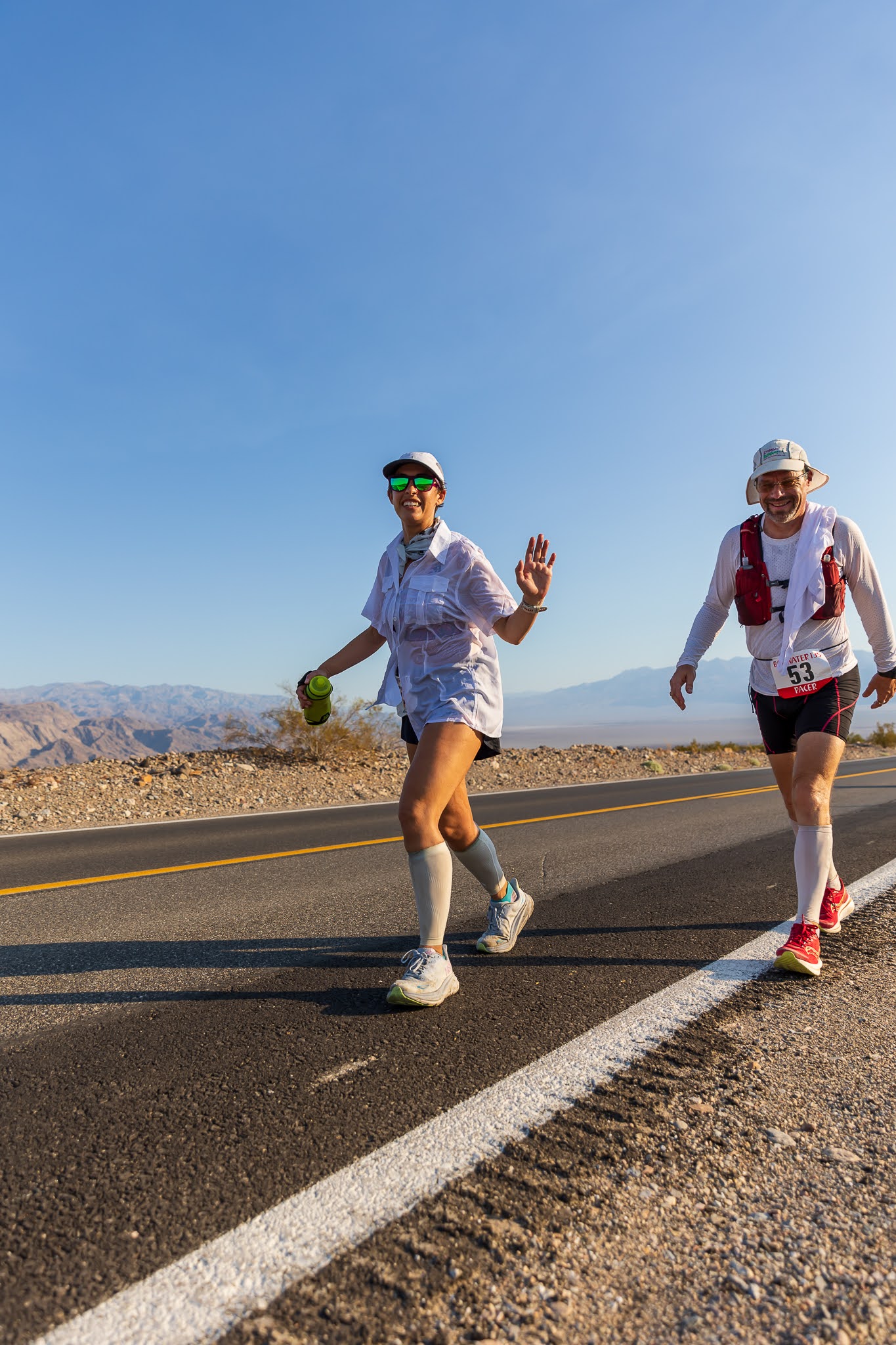
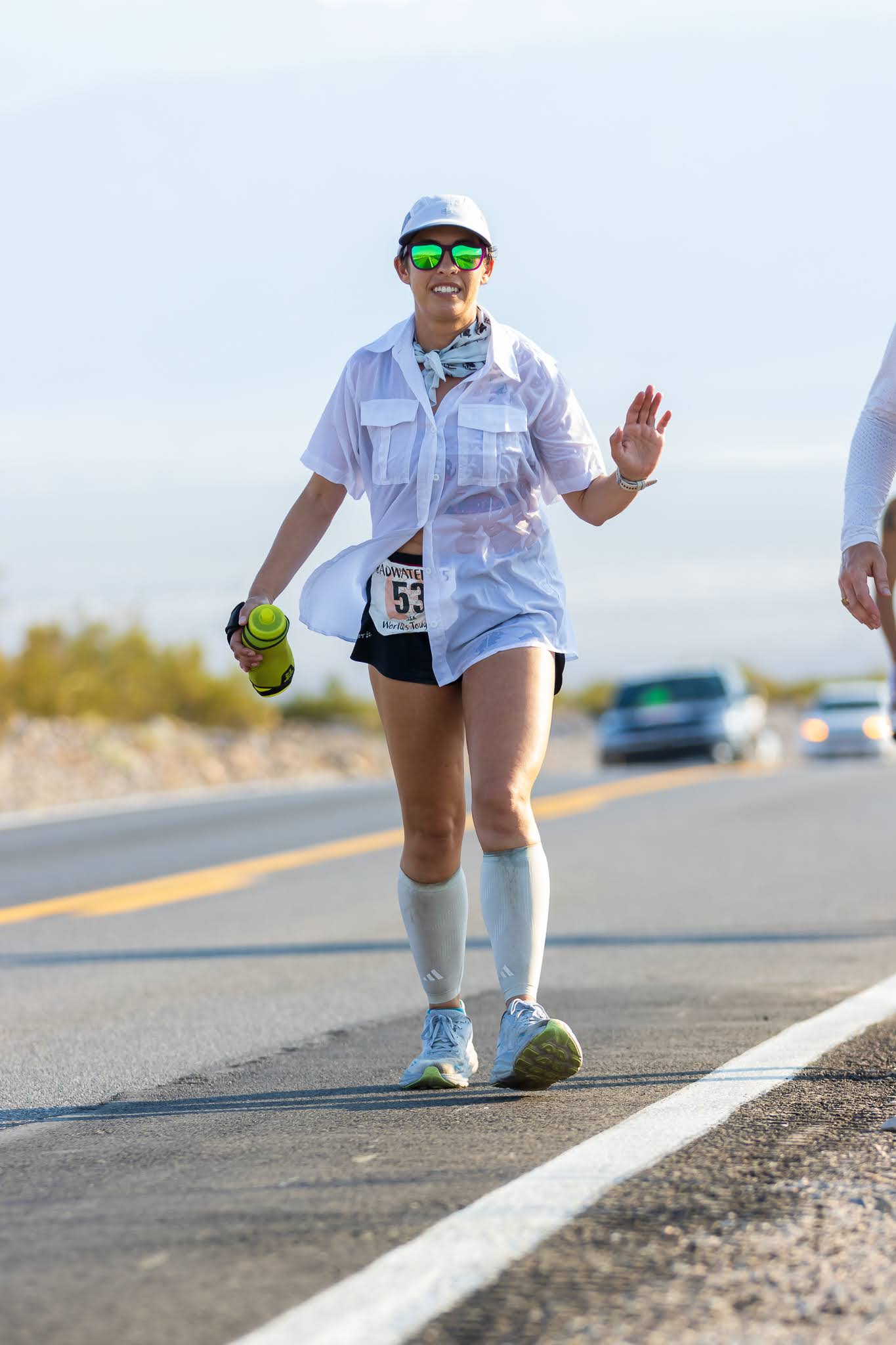
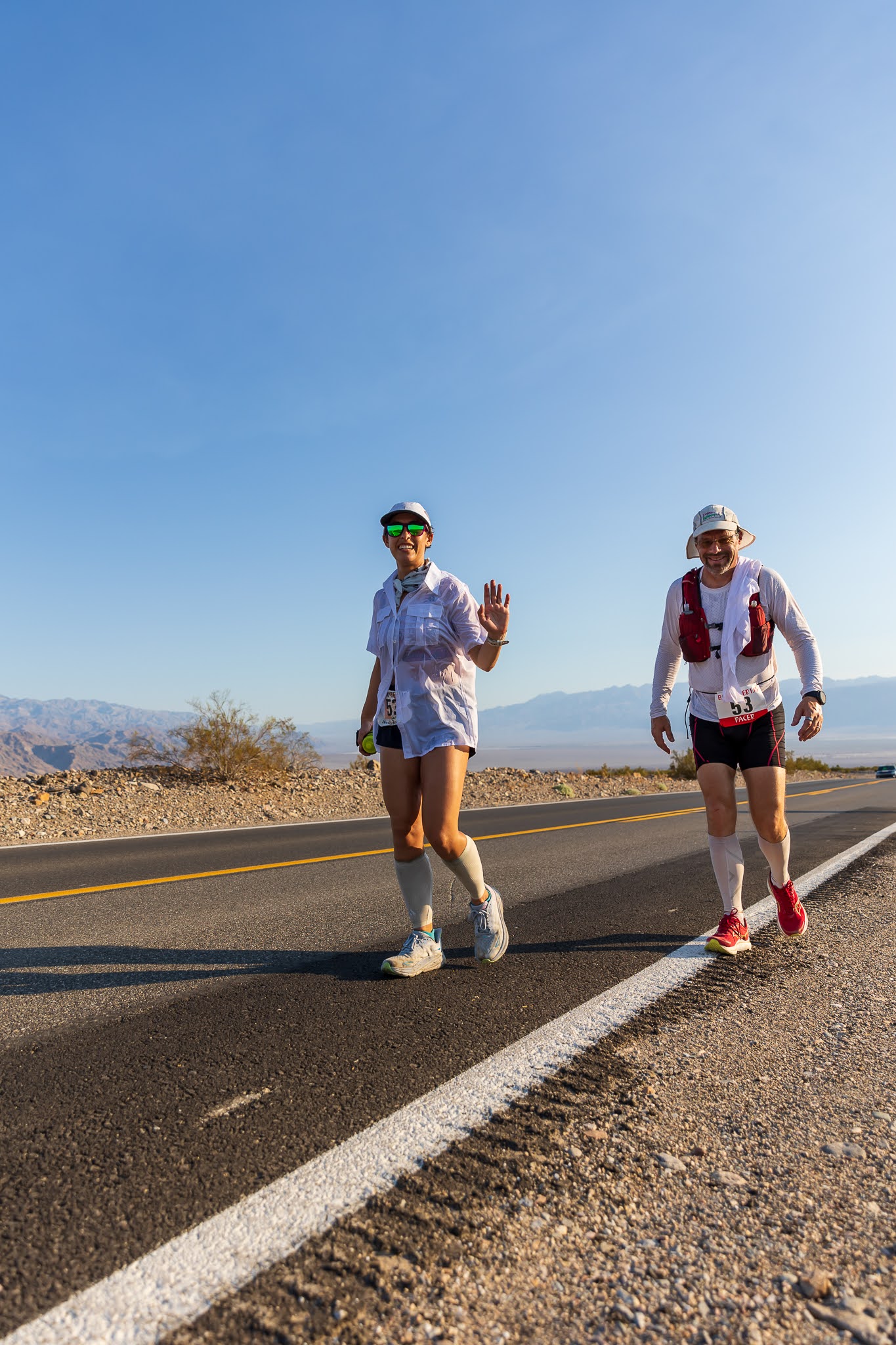
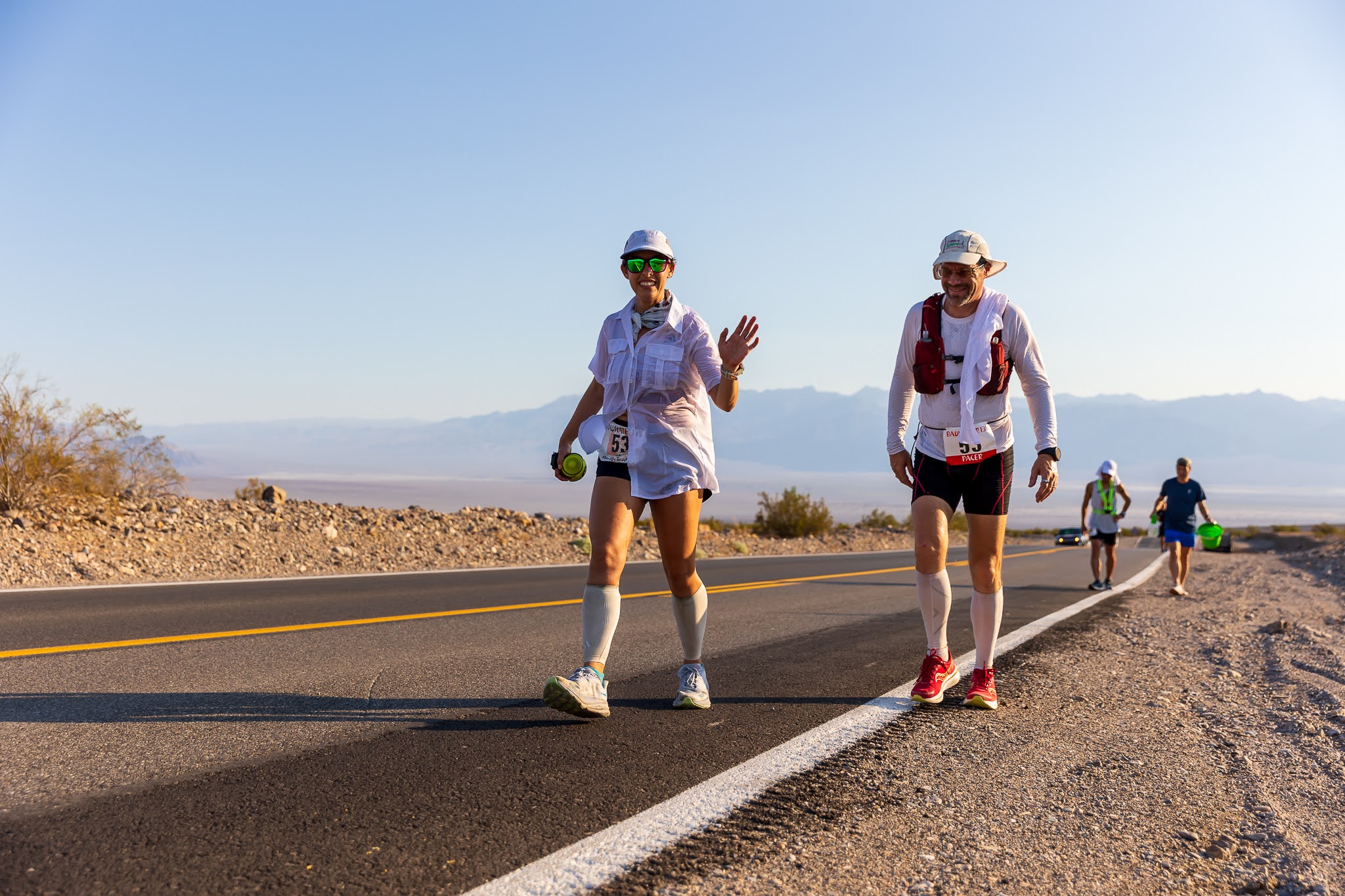
Raj swapped in partway up the hill and got me to the top of Towne Pass. There were swarms of bees there, so we had to move quite quickly through it. I also had grabbed a Biffy bag and was trying to sneak behind a bush to use it, but the bees kept following – given I didn’t want a sting on my posterior, I tried to outrun them to a safer area, and did avoid getting stung.
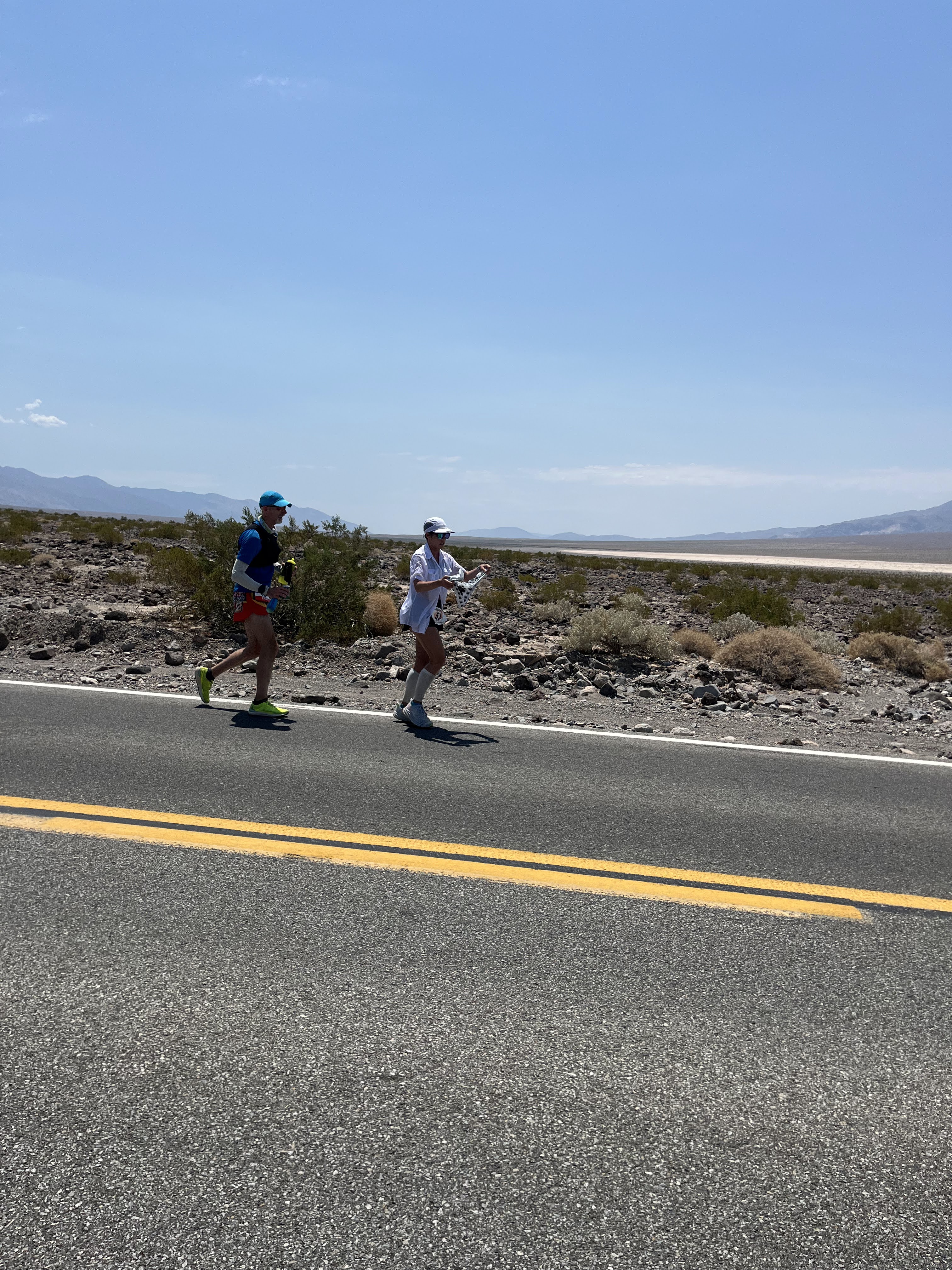
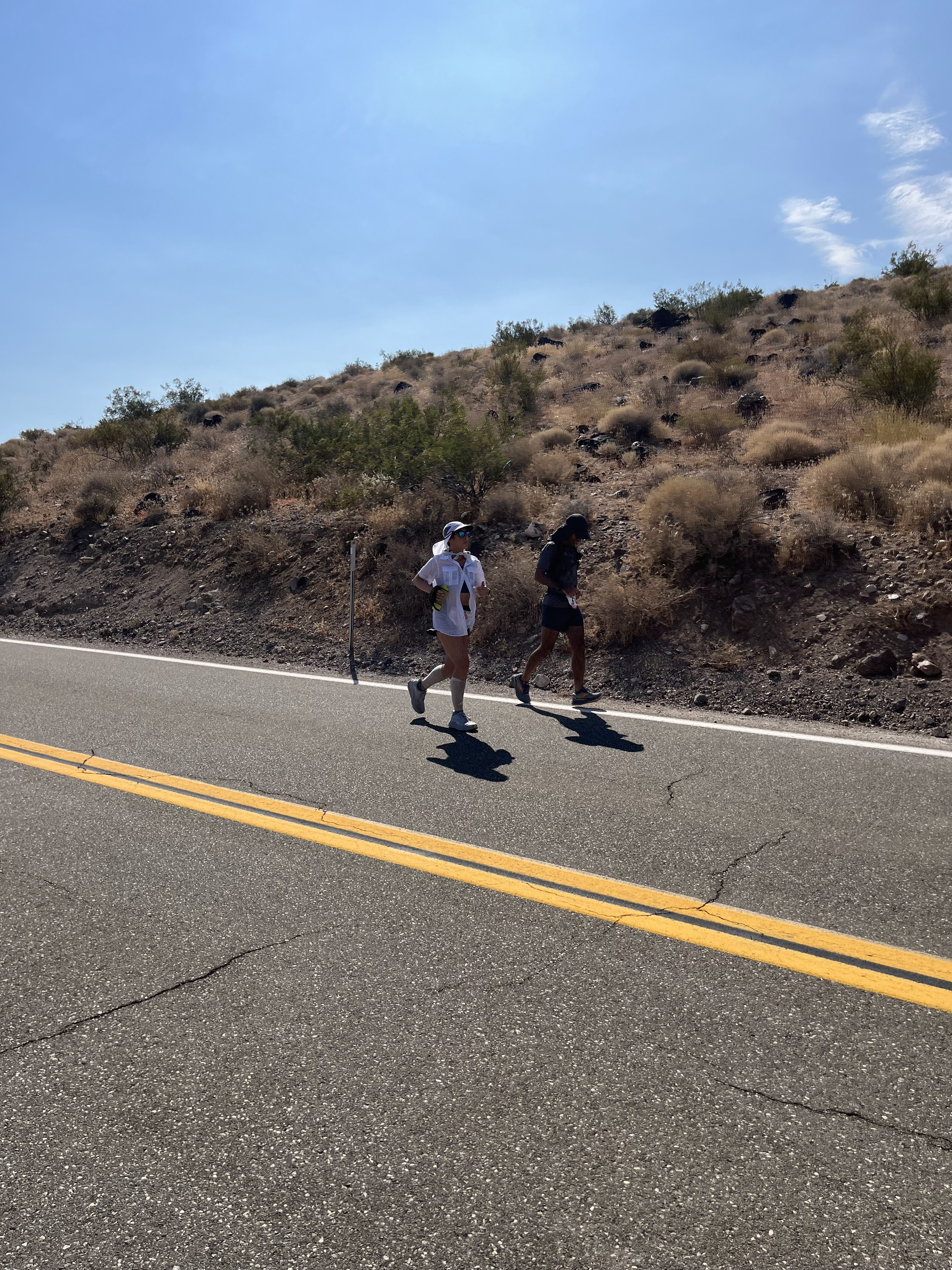
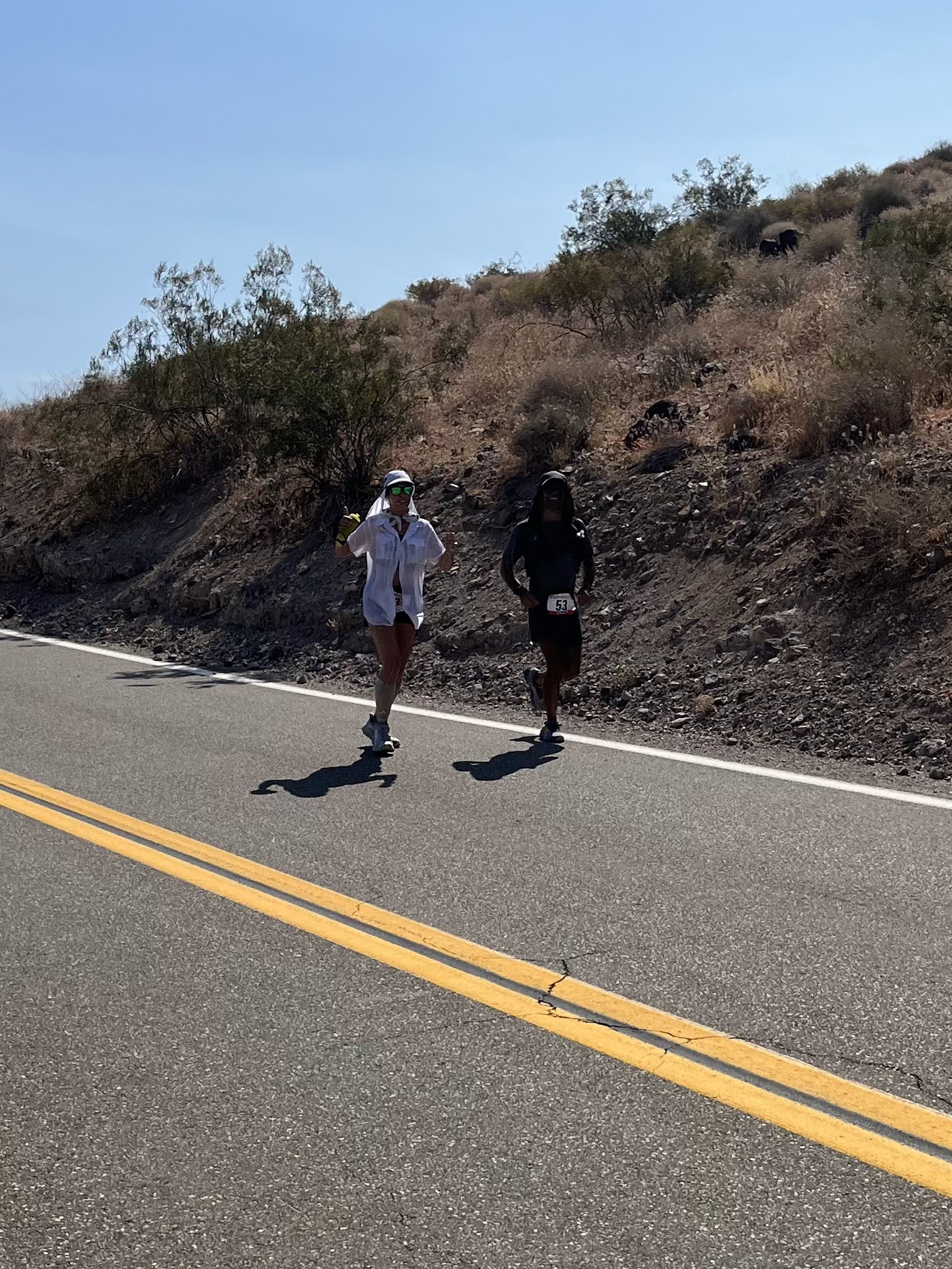
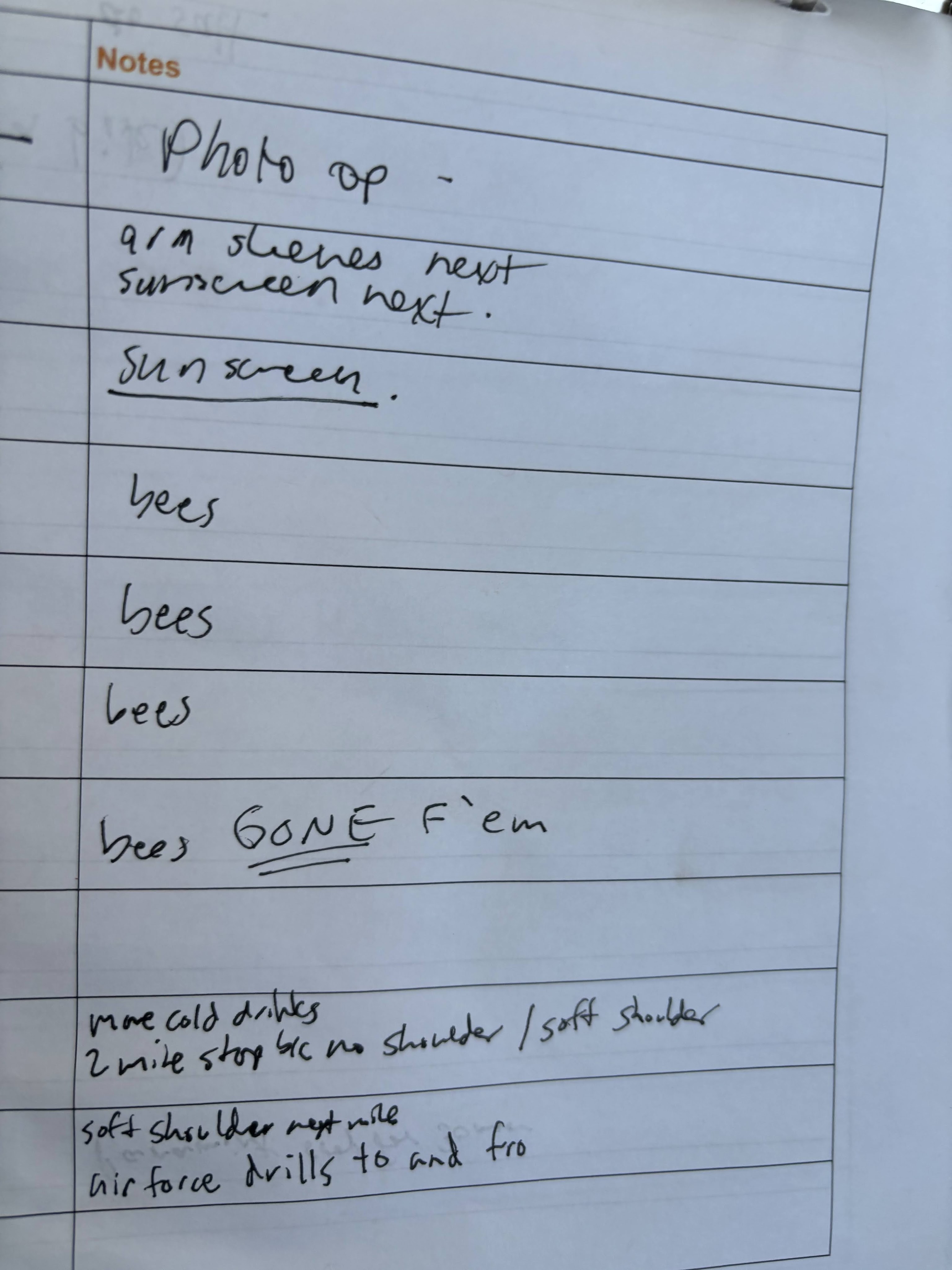
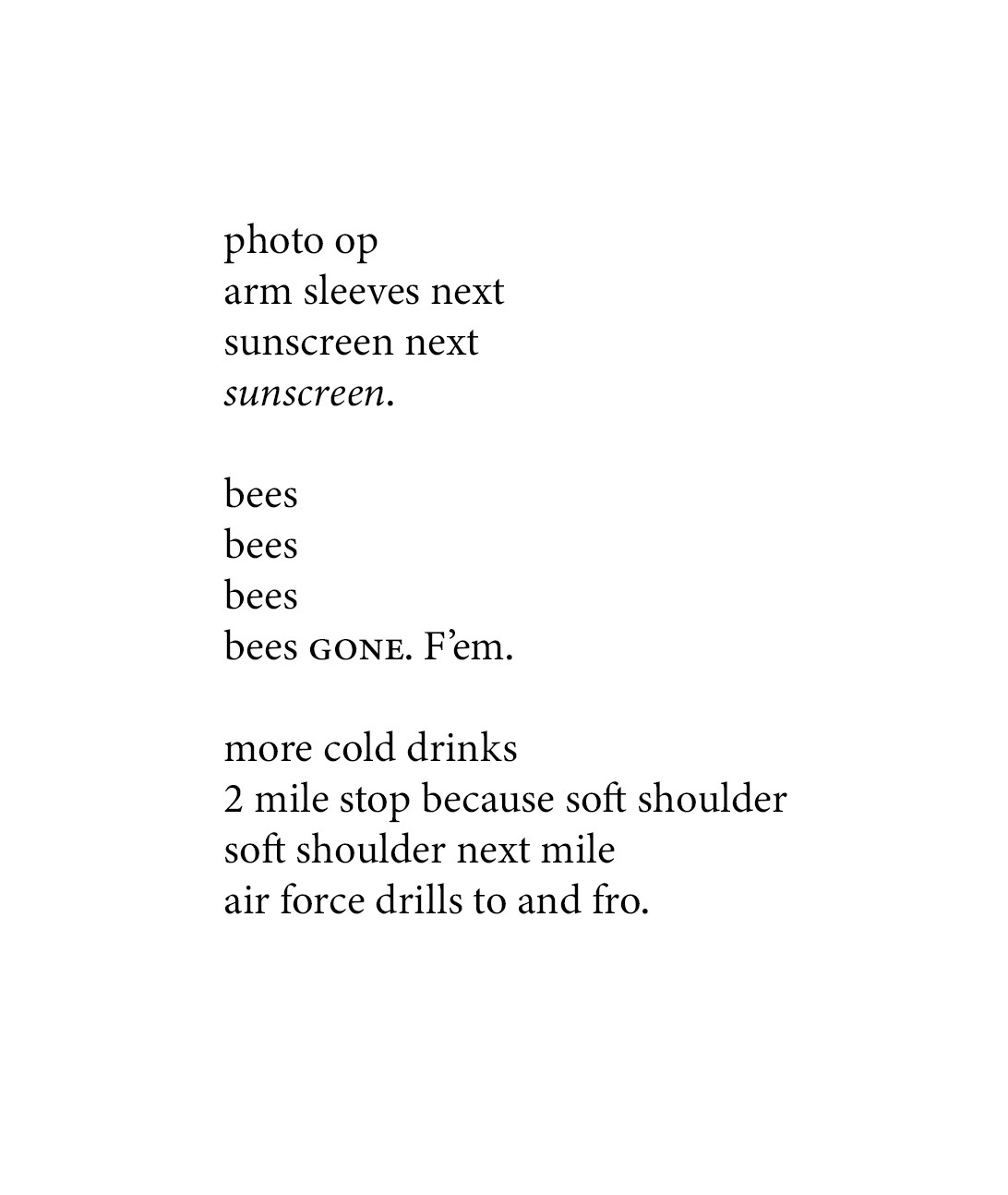
Towne Pass to Panamint Springs (72.2)
Time: 17:48 (4.08 mph); Time from last aid: 3:10 (4.42 mph)
Predicted time: 16:47 (61 minutes ahead)
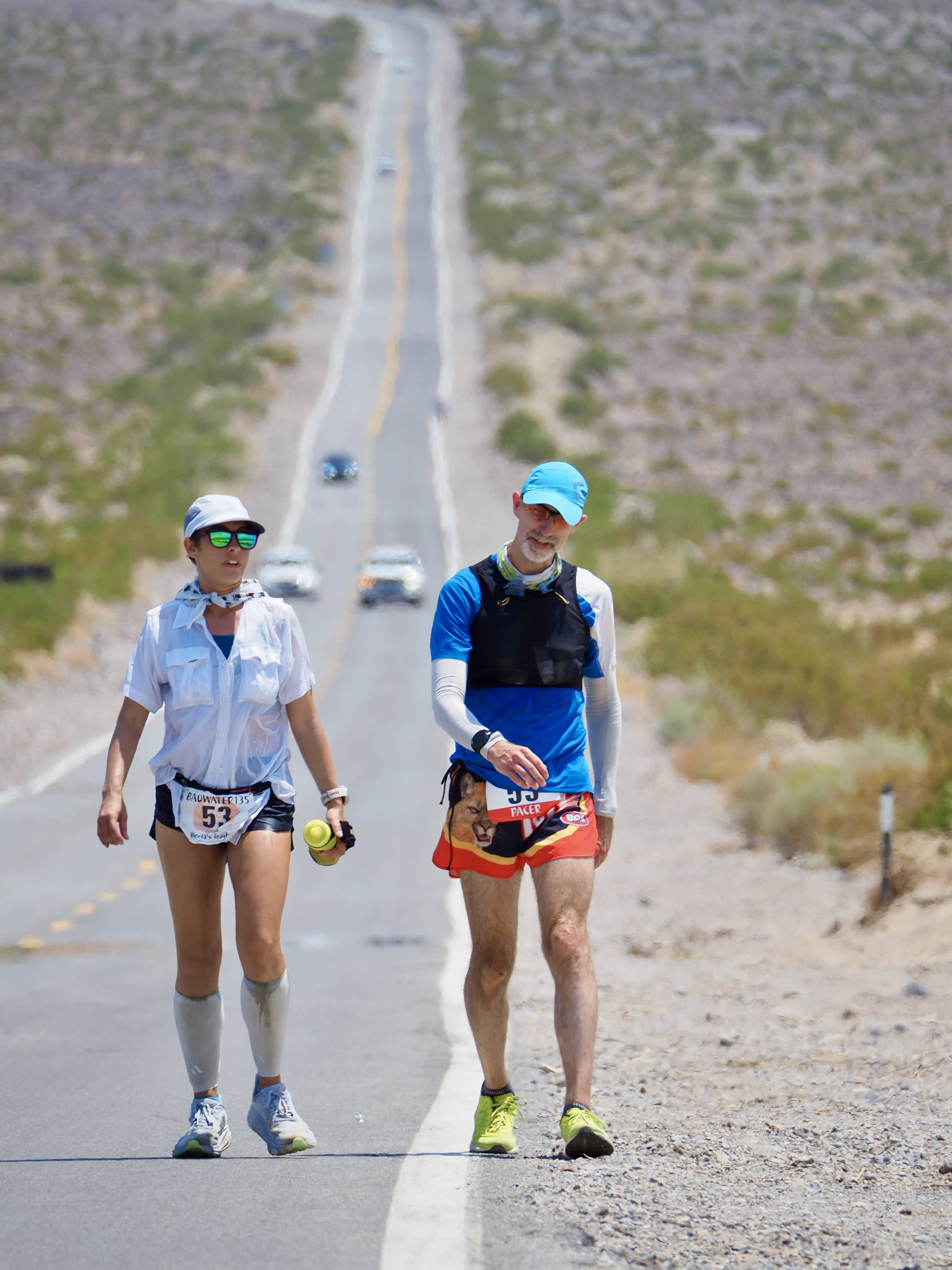
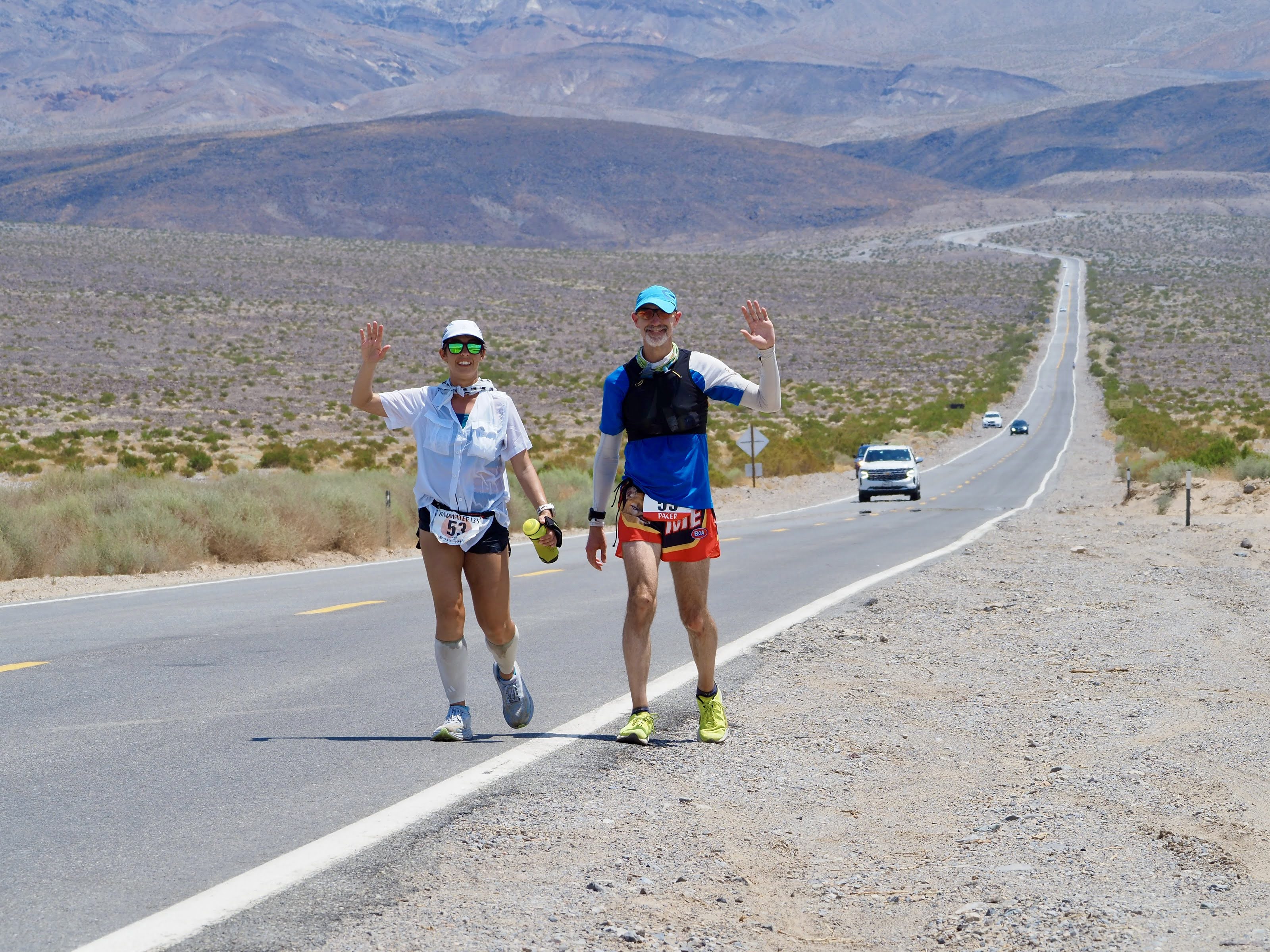
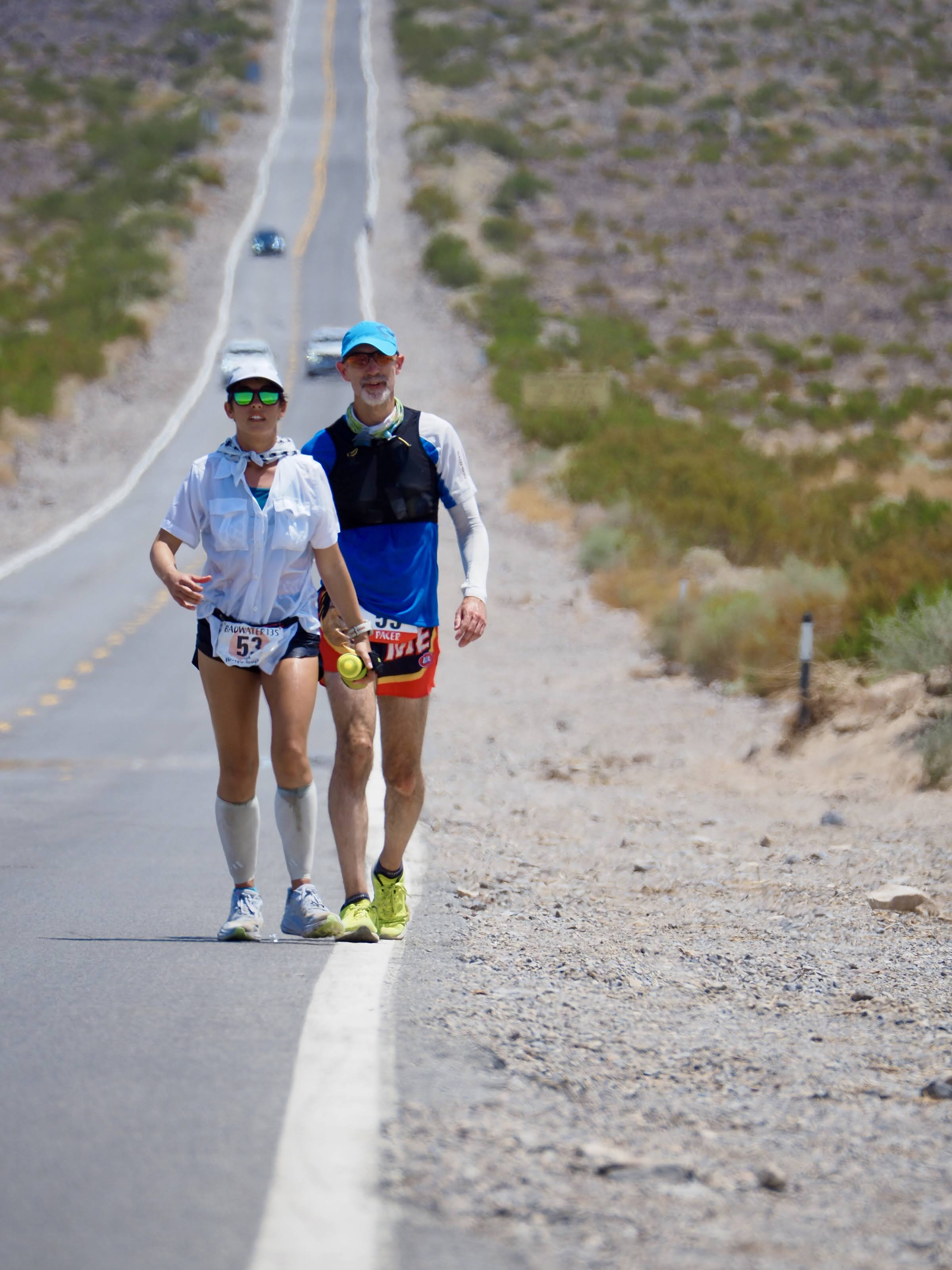
Eric joined me for the downhill miles into Panamint Springs. This was a fun section – it was about 9 miles of easy downhill, and I felt pretty fast and pretty fresh. When Bob ran it, he was doing 6:30s down this section, and advised me to not do that – which is comical, because I can’t do 6:30s ever, much less 50 miles into a race. But these were fast miles for me – somewhere in the 10-10:30 range.
At the bottom of the hill, there were several miles along the floor of Panamint Valley before getting to Panamint Springs itself. This was probably the hottest section of the course – I think it got up to 115*F (although I would love verification; watch only said 109*F but I think that’s low). I was using most of my cooling levers during this section:
- Ice in the neck buff, switched out for a new neck buff every 15 minutes
- Cold hydration
- New shirt every 15 minutes, straight from the ice cooler and with ice in the chest pockets
I did not feel too warm at any point during the race, including this one. The shirt swap was a bit of a hassle, but it really kept me cool. I had other levers (ice in the hat, ice in arm sleeves) that I did not use during this section because I didn’t feel like I was overheating, but those were options to add on.
There were a couple of planes that buzzed us along the highway as we were running – amazing to see them so close. They were loud.
This was also the first time where the scale of Death Valley was really apparent. At some point I looked at my watch (huge mistake, as usual), and it indicated we were four miles out from the Panamint Springs hotel, our next checkpoint. I could literally see the hotel with my eyes, and I would have guessed it was only a mile away. After this mis-estimation, I refused to trust my eyes to gauge distance for the rest of the race.

Panamint Springs to Darwin (90.7)
Time: 24:26 (3.71 mph); Time from last aid: 6:38 ( 2.71 mph)
Predicted time: 25:07 (41 minutes ahead)
When I was training for this race, I was really unsure if I was going to be able to finish it. I had a bit of a crisis moment and called my good friend Ray for help. Ray has done 600+ ultras, including some very long, hot, road ultras. He framed the race for me as two days of 100k each, and suggested I could nap for four hours at Panamint and still easily make the cutoffs. I was incredulous, because napping for four hours during a race seemed absurd. However, that framing both helped me put the distances into perspective and gave me a plan for Panamint.
In the prediction model, I had added two hours of napping into the Panamint stop. I also wanted to stop for a bit so the crew could get real food, restock at the gas station, and check out of the hotel. However, I was feeling pretty good, so I only napped for 30 minutes, then changed clothes and fueled for 15 before taking off again.
Bob jumped in to pace me up the next climb, to the top of Father Crowley. I was a bit confused and disoriented from having just woken up, and had had some very weird dreams in the 30 minutes I was out. Specifically, I had a dream that an AI had generated an image of just fingers, but they were all connected like spaghetti, as if drawn from children’s imaginations. The AI was trying to teach us that it could capture the innocence and unconstrained imagination of children, and therefore AI was a positive force in the world. Bob said that apparently having weird dreams is normal during an ultra, and some of the dreams he had during his six day events were also quite vivid and absurd.
I was very worried about the Father Crowley climb for a couple of reasons:
- It was supposed to be really hot at this time of day
- There are only eight locations were crew can pull over, because it is a very windy road with no shoulder
- The climb is actually more like 18-19 miles, because after the top of Father Crowley, there’s actually a gradual incline for another many miles to get to the Darwin checkpoint.
Fortunately, all of these issues ended up being non-issues. The weather was overcast with occasional drops of rain. The pull-over locations were very well marked, and the crew was easily able to find them. A lot of the miles going into Darwin were also very runnable. So this ended up being the best possible outcome for this section.
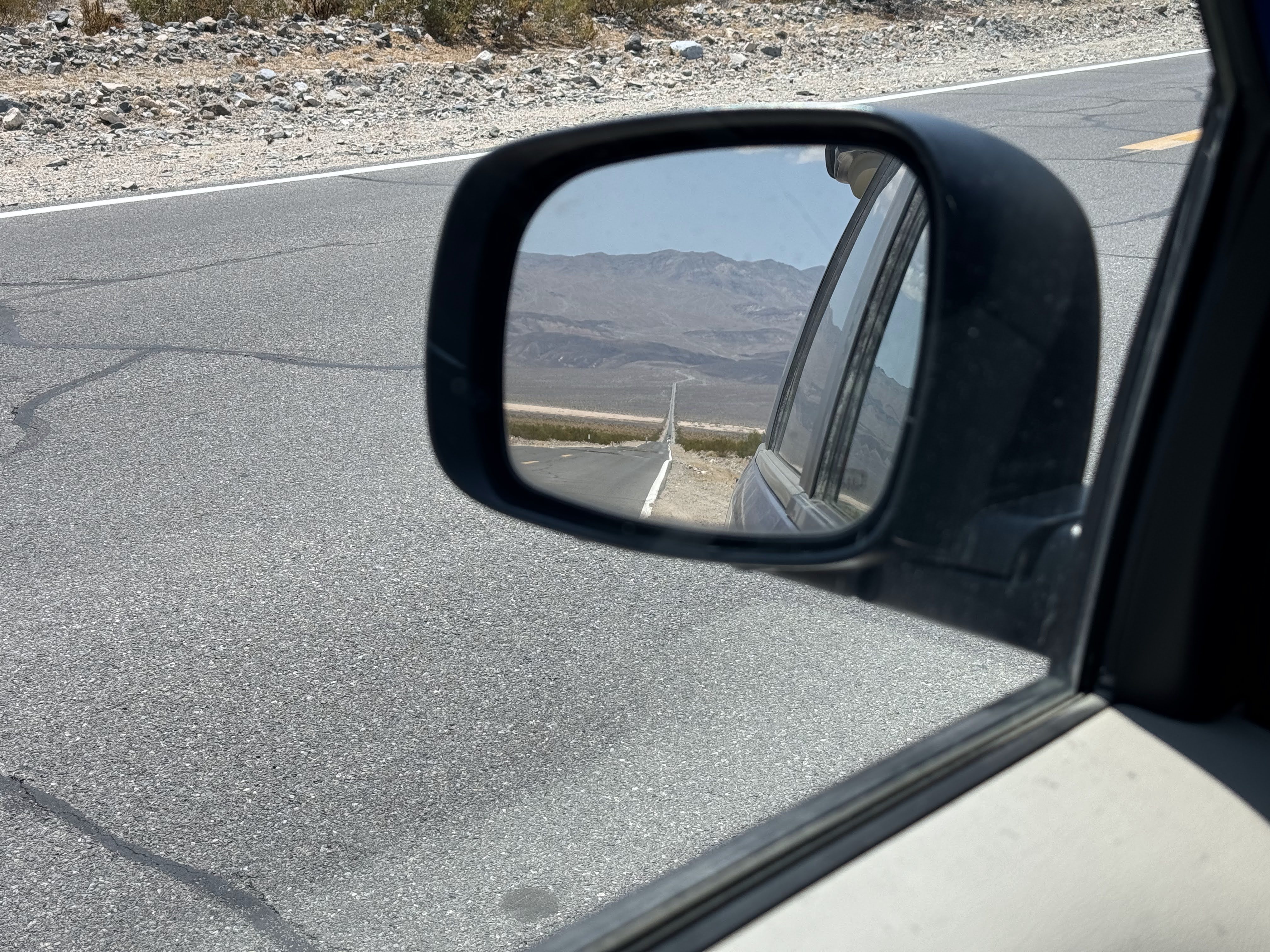
Bob and I chatted about one of the other races he’s done – Spartathlon. It’s a 153-mile race in Greece that traces the original route of Pheidippides, from Athens to Sparta. It’s a very hard race, with a 36-hour cutoff, and a lot of interim cutoffs as well. One of those cutoffs is completing the first 50 miles in 9 hours and 30 minutes, which is a pretty brisk pace for a longer ultra. When Bob wrapped up pacing me, I had about 50 miles to go, so we just started shouting “9 hour 50!” as the pretend (and completely impossible) target for the rest of the race.
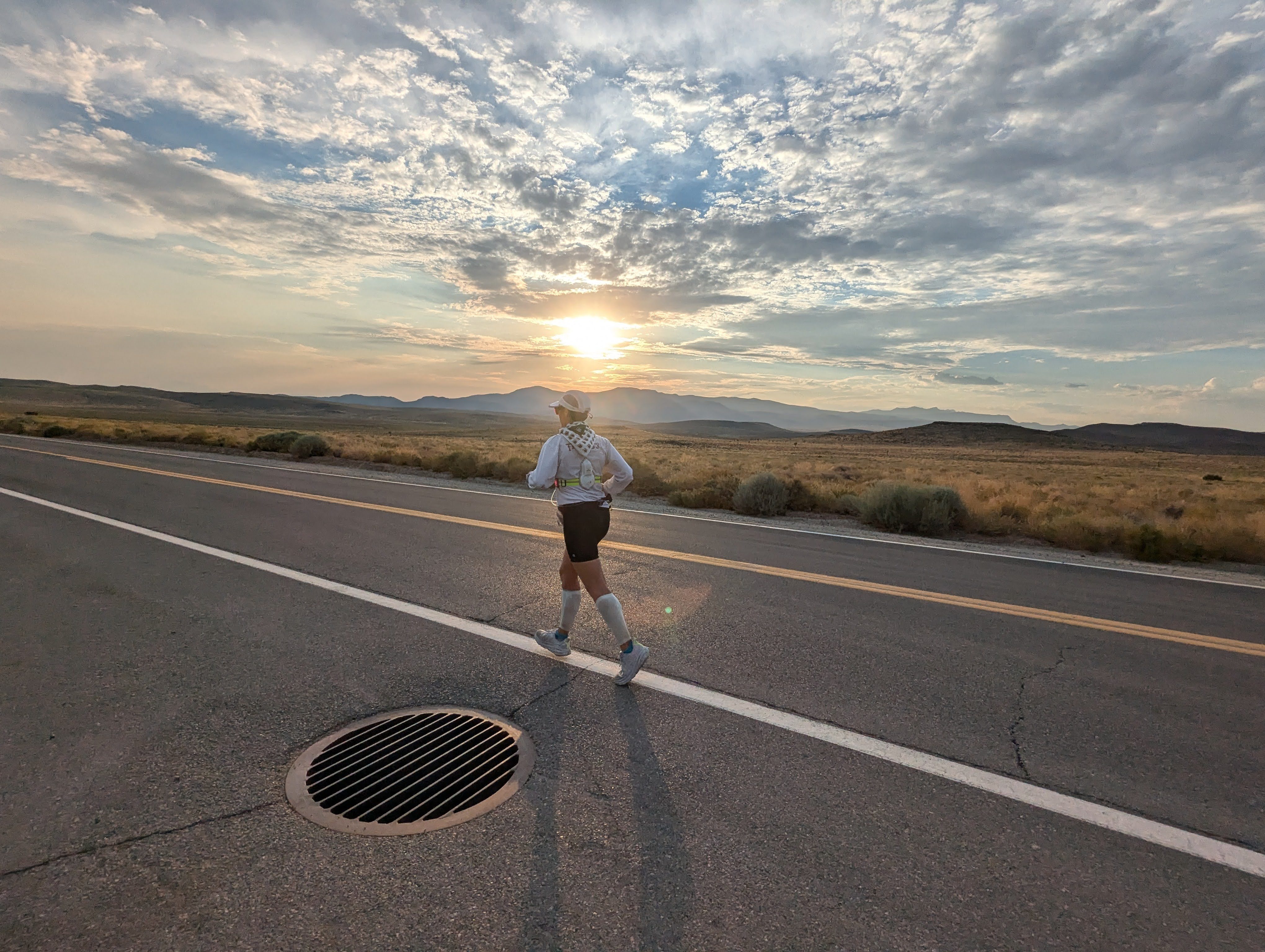
The next section into Darwin, with Raj, was a really fun section:
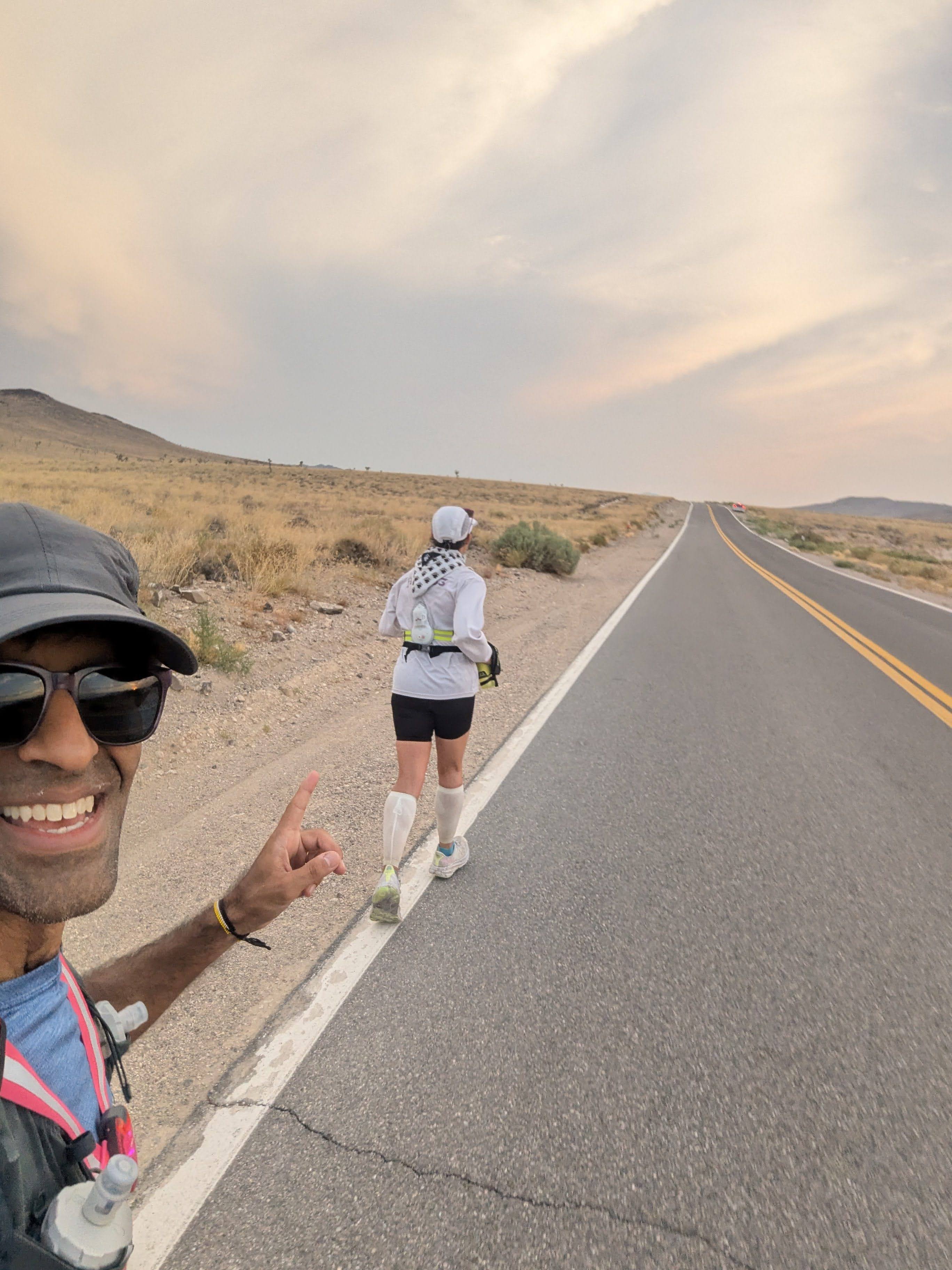
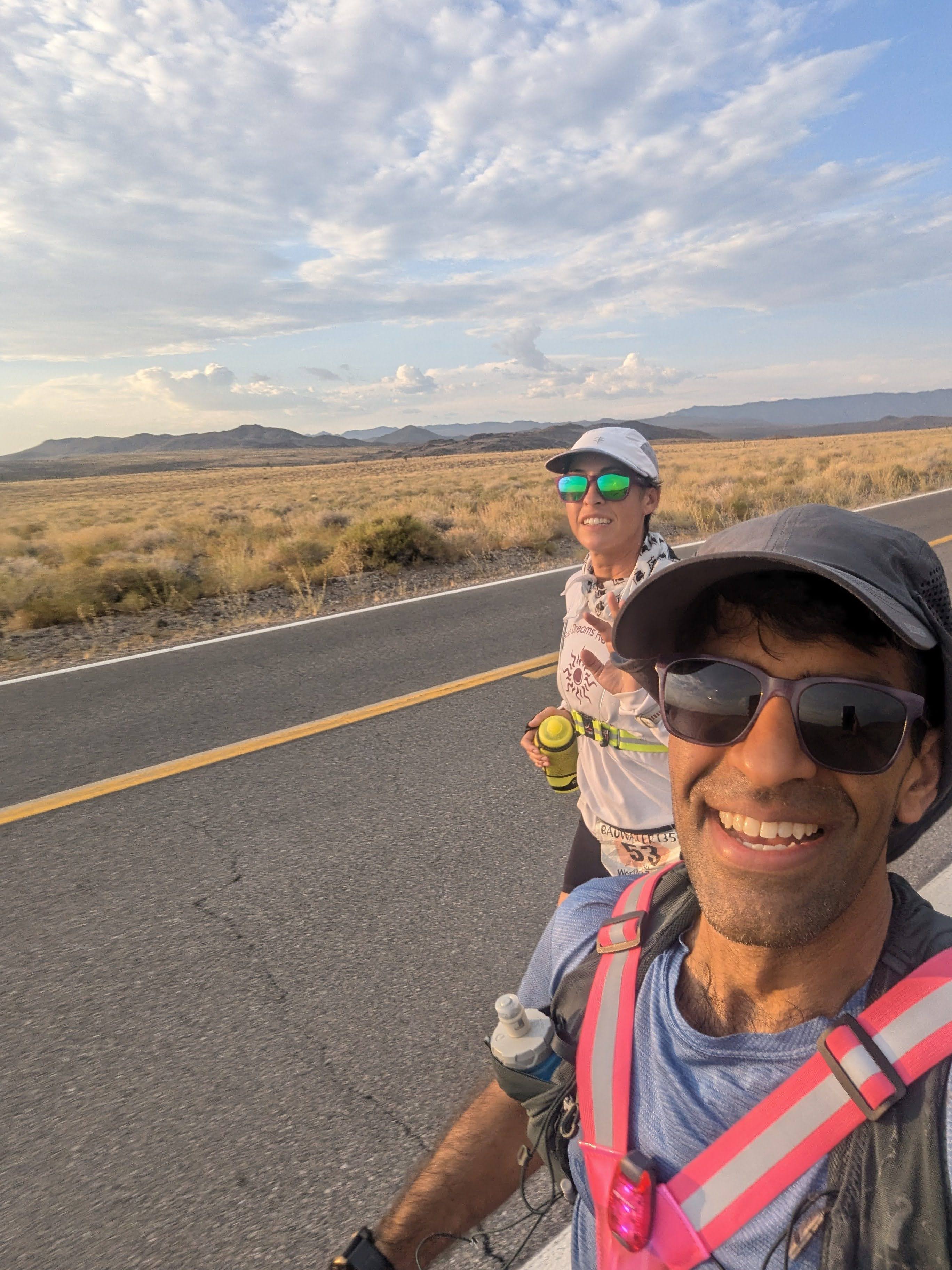
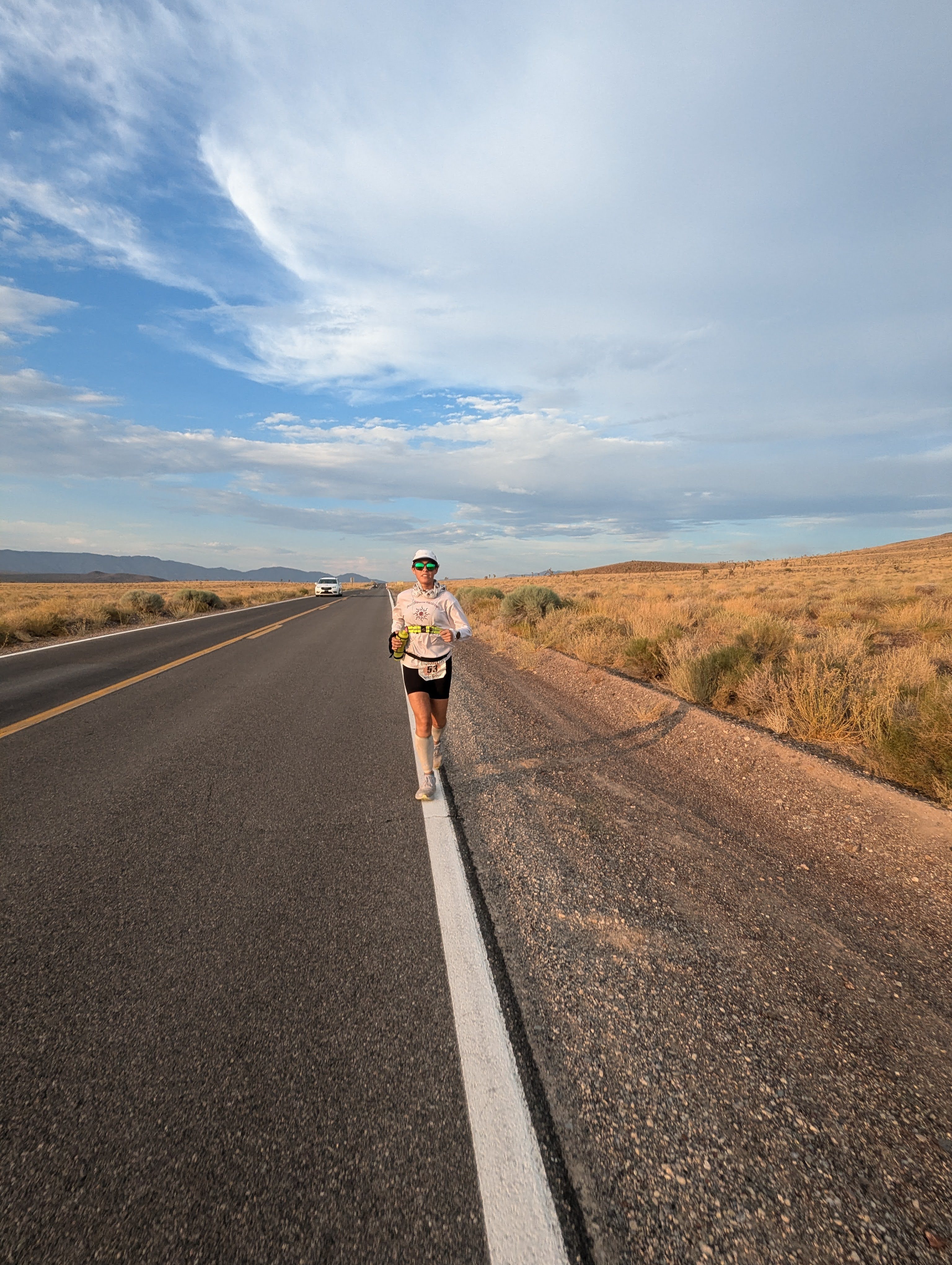
- Raj gave me great coaching advice on form. Specifically, he said to loosen up my arms, which for some reason really helped with my overall stride. Someone on the crew later said “your form looks better now than it did at the beginning of the race – what happened?!”
- He brought his phone and took some great pictures
- He narrated the competitive saga of Me vs Ravioli, our nickname for another runner who was taking slightly longer breaks at his crew car and really did not like it when I passed him on the crew stops. (He did finish the race, and I don’t know his name – so great job to whoever this guy was, and thanks for pushing me during this section!)


Darwin to Keeler (108.4) + Keeler to Lone Pine (122.7)
Darwin to Keeler:
Time: 29:36 (3.66 mph); Time from last aid: 5:10 (3.43 mph)
Predicted time: 29:01 (35 minutes behind)
Keeler to Lone Pine:
Time: 34:42 (3.54 mph); Time from last aid: 5:06 (2.8 mph)
Predicted time: 33:41 (61 minutes behind)
This section was brutal. I knew that it would be, and it was. There were no redeeming features of this section, other than I got to run with Kate, I knew I would see my parents at Lone Pin, and maybe I would get a nap or two.
Things that happened:
- It was dark, and there was nothing to see.
- Kate was pacing me (excellent!). We were both exhausted. At one point, we weren’t sure if we were on the right road (spoiler alert: we were – there’s only one road). We couldn’t see any other runners or crew vehicles. I got very nervous, and Kate kept reassuring me that we were probably going the right way. When we got to the van, Bob came over and was like “I heard you are confused about the course. Go straight. That’s the course.” Apparently the crew was making fun of us for having IQs of 75 at this section, which I fully embrace as an optimistic estimate of our mental capabilities in this moment.
- I took two naps on the cot. During the second nap, it started raining and it was cold, but I couldn’t be bothered to find a dry location. So I just lay on the cot and got rained on. I was shivering when I got up because the air temperature was in the low 70s. It was pretty bleak.
Kate really kept me going through this section. She kept talking, and kept me talking, and kept me moving. She pushed me to run where I could so the pace didn’t totally crater. This section was pretty bad psychologically – the lowest point of the race for me – and she made sure I was making forward progress. Unfortunately, none of the boys took photos of us running together, but it was pretty dark anyway so there probably wasn’t much to see.
Kate also did an amazing job of keeping me eating – she pushed calories on me at every opportunity, and aggressively encouraged me throughout the race to try non-soup calories. Her actual enthusiasm when I tried a burrito was strong encouragement to continue eating calories, and that really helped keep me on track from a food consumption perspective.
Really there was nothing else to report here. It was dark and hard. I ran most of the way to Keeler, then ended up walking much of the rest of the section to Lone Pine.
Lone Pine to Portal Road (131.1)
Time: 37:51 (3.46 mph); Time from last aid: 3:00 (2.67 mph)
Predicted time: 38:11 (20 minutes ahead)
The sun was coming up as we reached Lone Pine. Eric was pacing me at this point. As we headed towards turn number 2 (out of 3 turns) on the course, I had another moment of trying to estimate how far away the turn was. It was visible, but an ambiguous distance away. We ran by some cows and could hear the mooing.
The definition of “night” in the rules is 7pm to 7am; this is when certain apparel requirements are in place. Specifically, all runners, pacers, and crew must wear blinky lights in front and back; runners and pacers also have to wear 360* reflectivity. The sun actually didn’t set until 8pm, and it rose at 6am, which meant there were a lot of twilight hours where the safety apparel was required but perhaps not strictly needed. I was very excited to be able to take off the reflective gear and lights as we approached the turn, and continued to be frustrated that I needed to wear it for another hour and a half, and therefore could not take it off.
As we turned right, the crew told Eric and I that my parents and the checkpoint were on the right side of the road. Eric and I were pretty nervous about running with our back to traffic on an open freeway, so we crossed over to the left (facing traffic), which is also what is written in the rules.
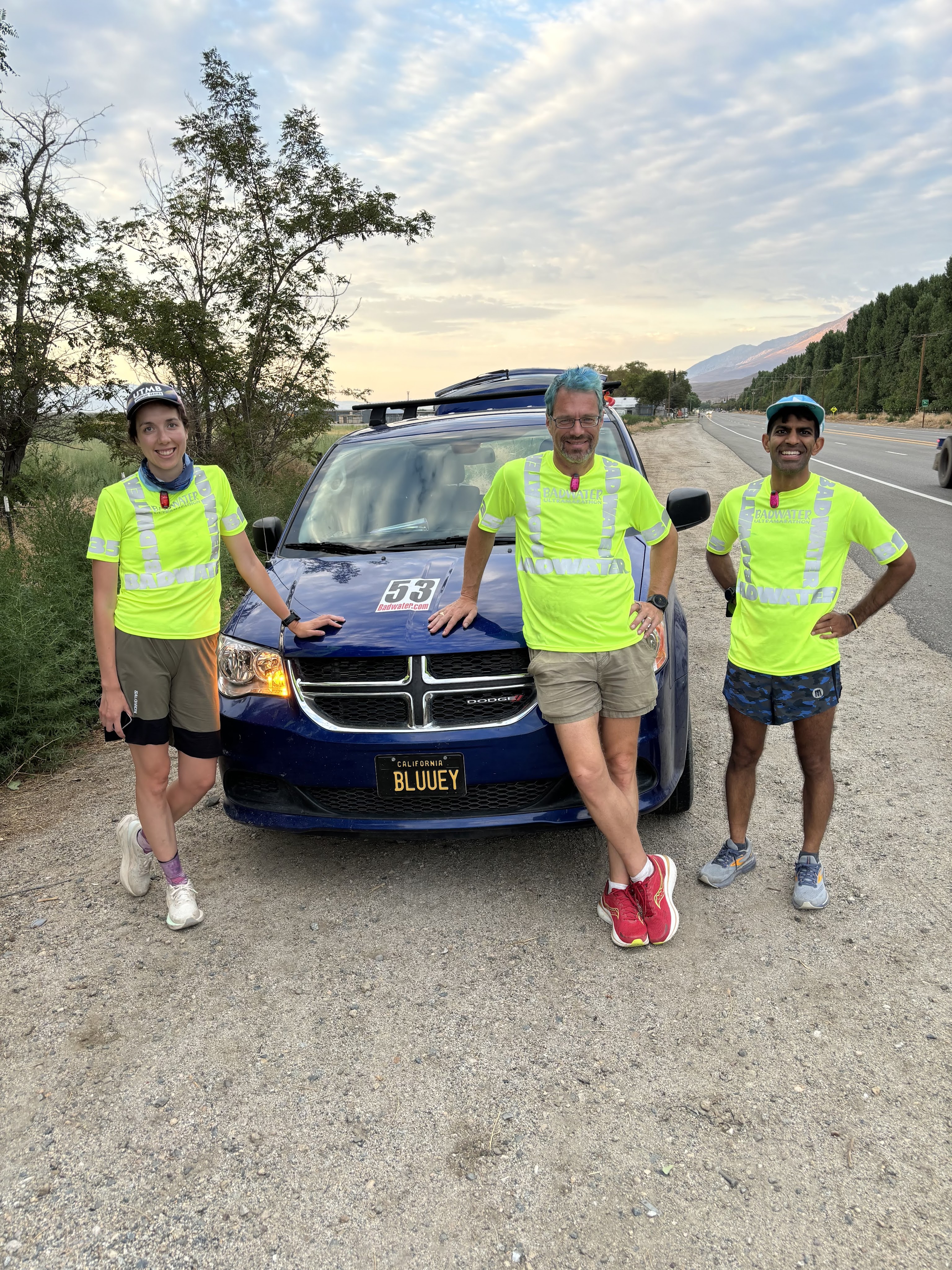
The crew told us that my parents would be at the Best Western, which was probably helpful if you knew where the Best Western was. Fortunately, Lone Pine is basically one road, so we were able to find it pretty easily, and crossed back over to see them.

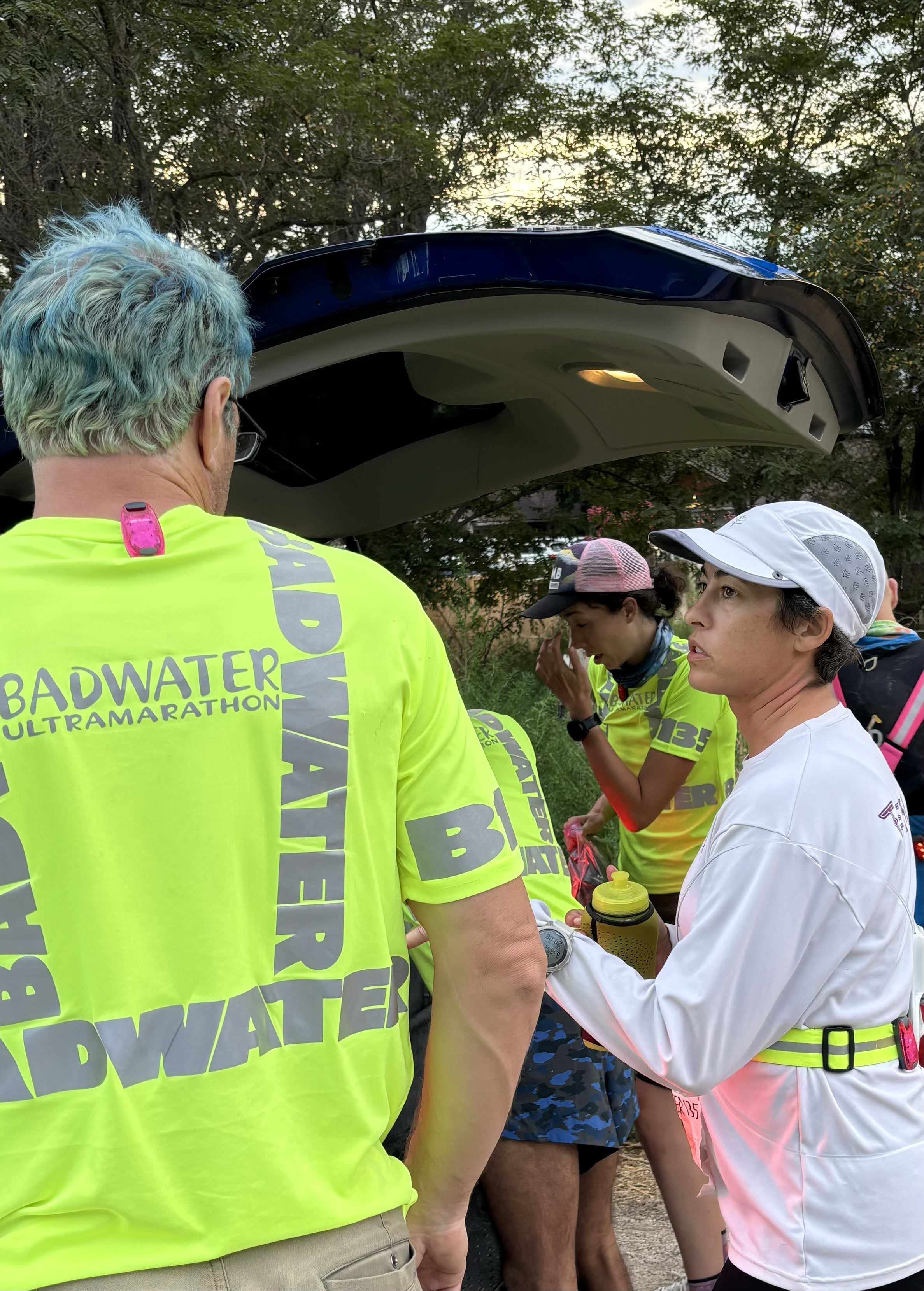

It was great to see my parents – I had been talking about how excited I was to see them for basically the last 50 miles. I did a quick crew stop at the van and then walked about 100 yards with them through the parking lot of the Best Western before continuing on to the checkpoint.
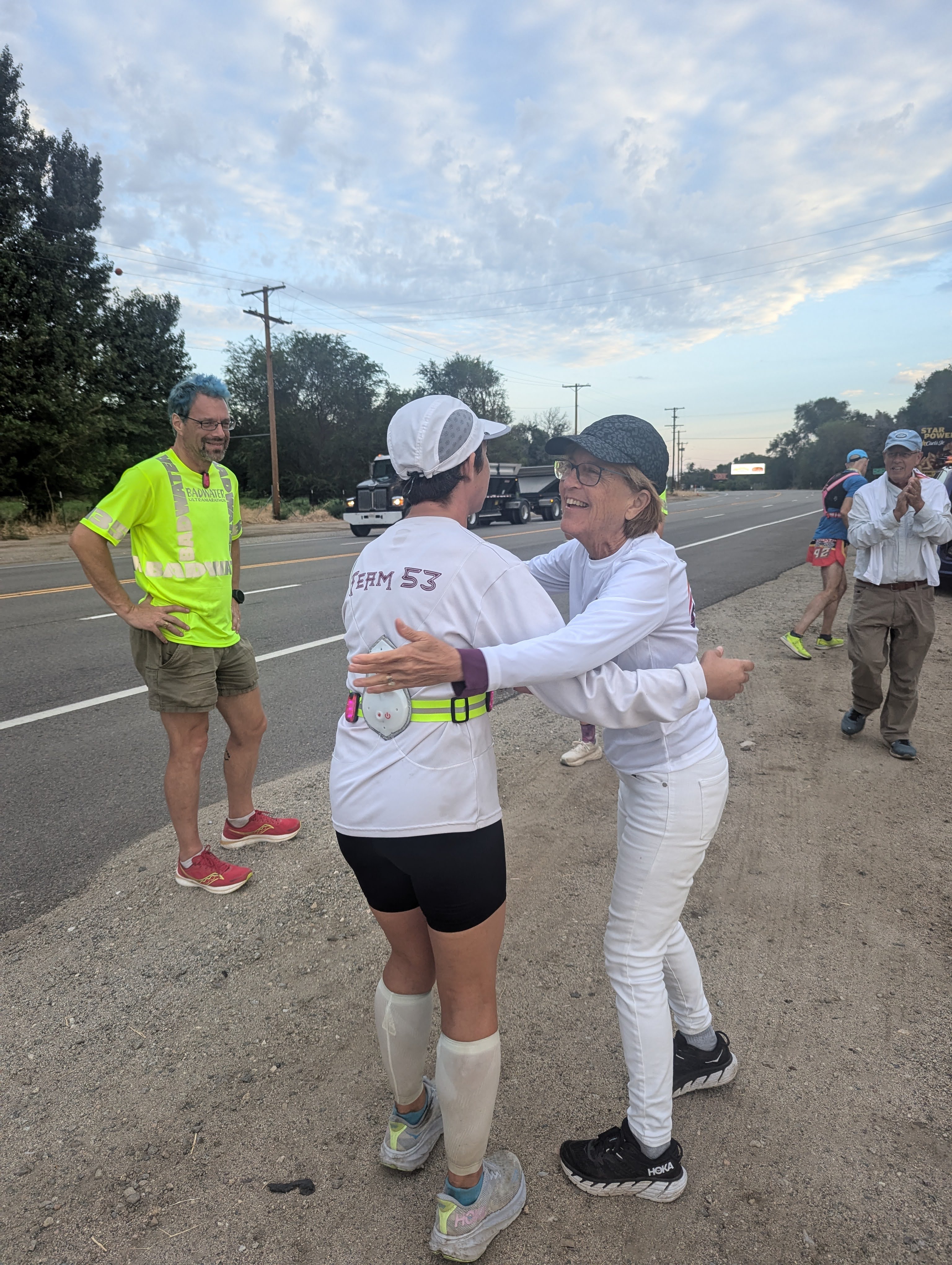

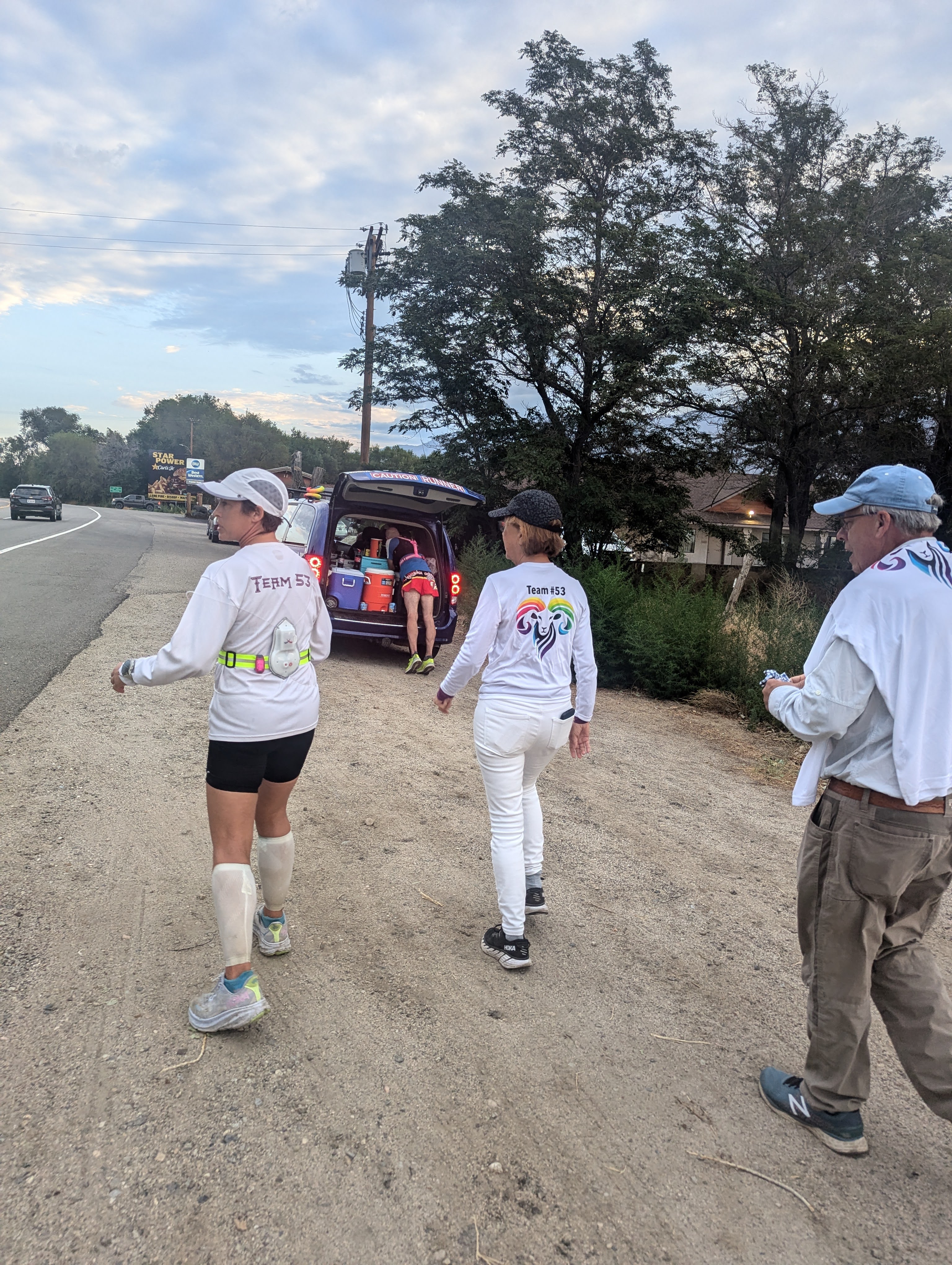
The crew van took off to check into the hotel and get McDonald’s.
Eric and I turned left on Whitney Portal Road – the third turn out of three on the course.
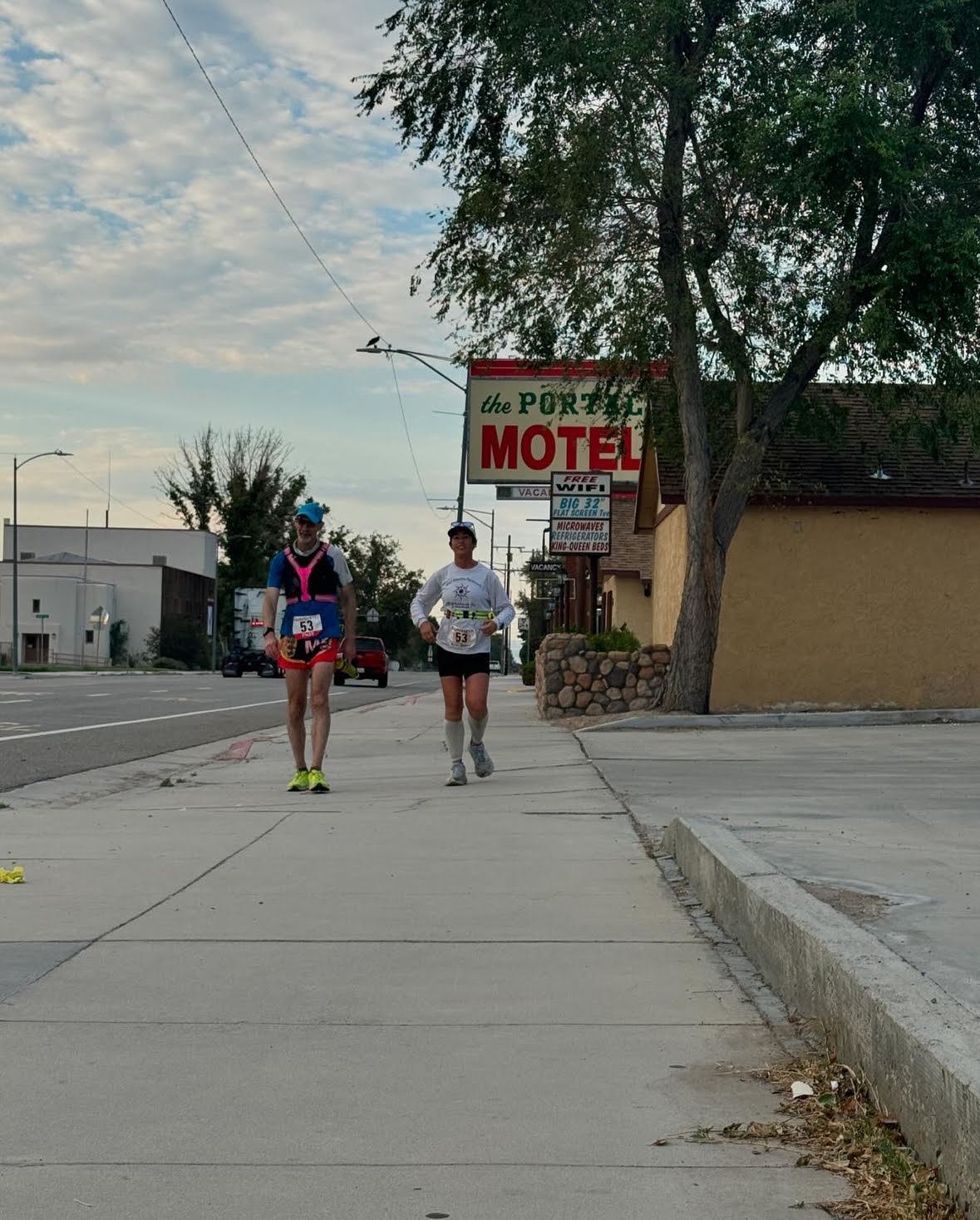
The next section – the 1.5 mile trail detour – was really awful. There was some construction on Whitney Portal Road, so the course re-routed to go around it, and the re-route was on a trail. It is unlikely that future Badwaters will have this detour, so if you’re reading this in order to plan for your race, you can skip this.
Going into the race, I felt pretty good about my ability to successfully navigate the trail, because:
- It was short – only 1.5 miles, adding only 0.3 to the course
- It looked EXTREMELY runnable, based on the research I did and the Instagram posts, such as this post, this post (which I later figured out was a marketing/advertising post for a shoe company), and this post
- I’m a pretty okay trail runner and have done most of my races on trails
In fact, the trail section was pretty rough, and I underestimated how frustrating it would be. There were a lot of sections of it that were not very runnable – very steep both up and down. I wasn’t sure if I was just tired, but Eric, who has done UTMB, validated that it was pretty rough. I didn’t trust him either, because maybe he was just being nice to me to keep my spirits up, but his running coach later validated that it was a tough section, and she used to live there.
The course markings on this trail section were also not the best. I can’t really describe it, but you could tell that the markings were not placed by a trail runner. The markers got the job done, but they weren’t very intuitive.
Anyway, we got to the end of the trail section and met up with the crew.
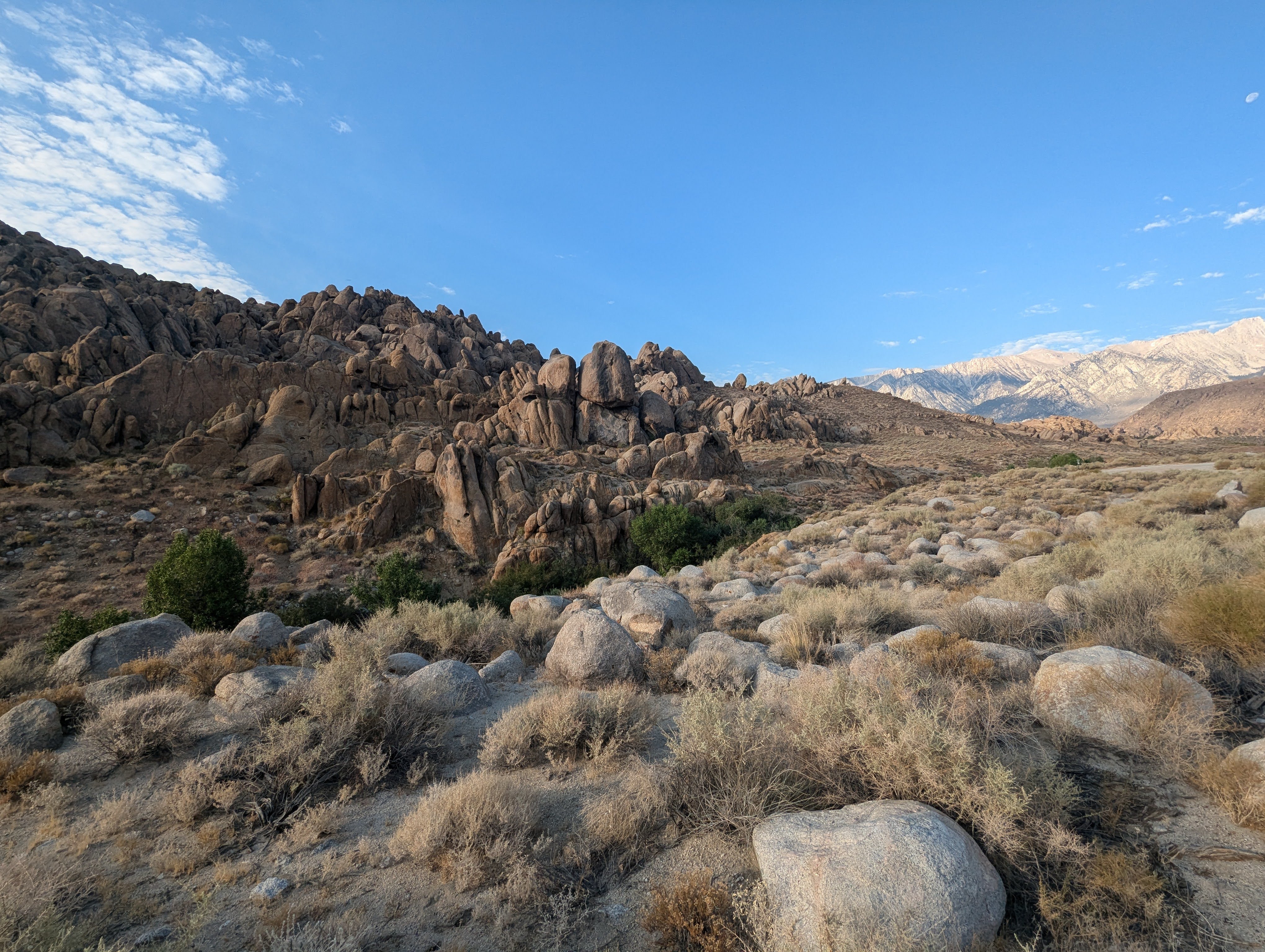
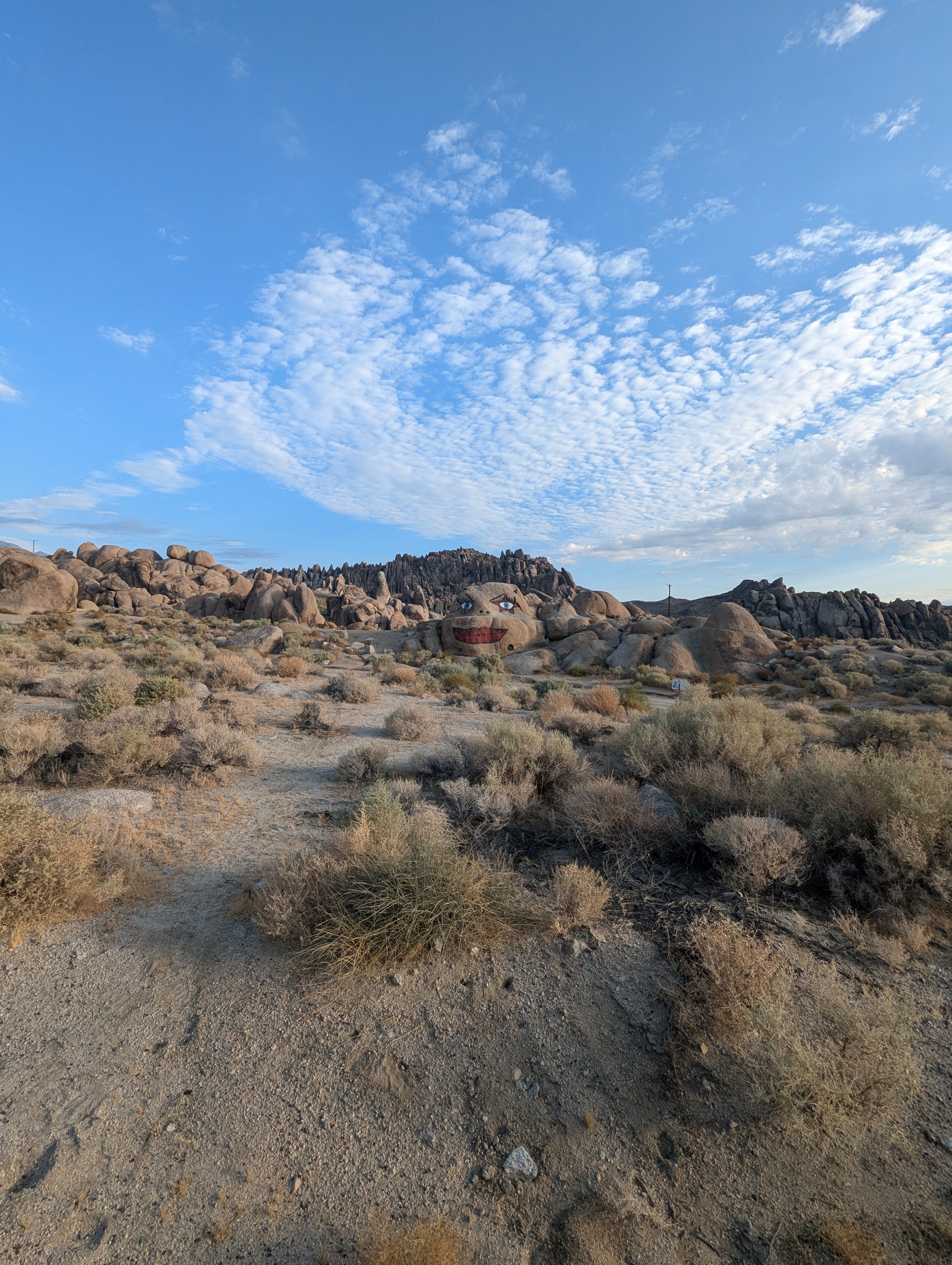
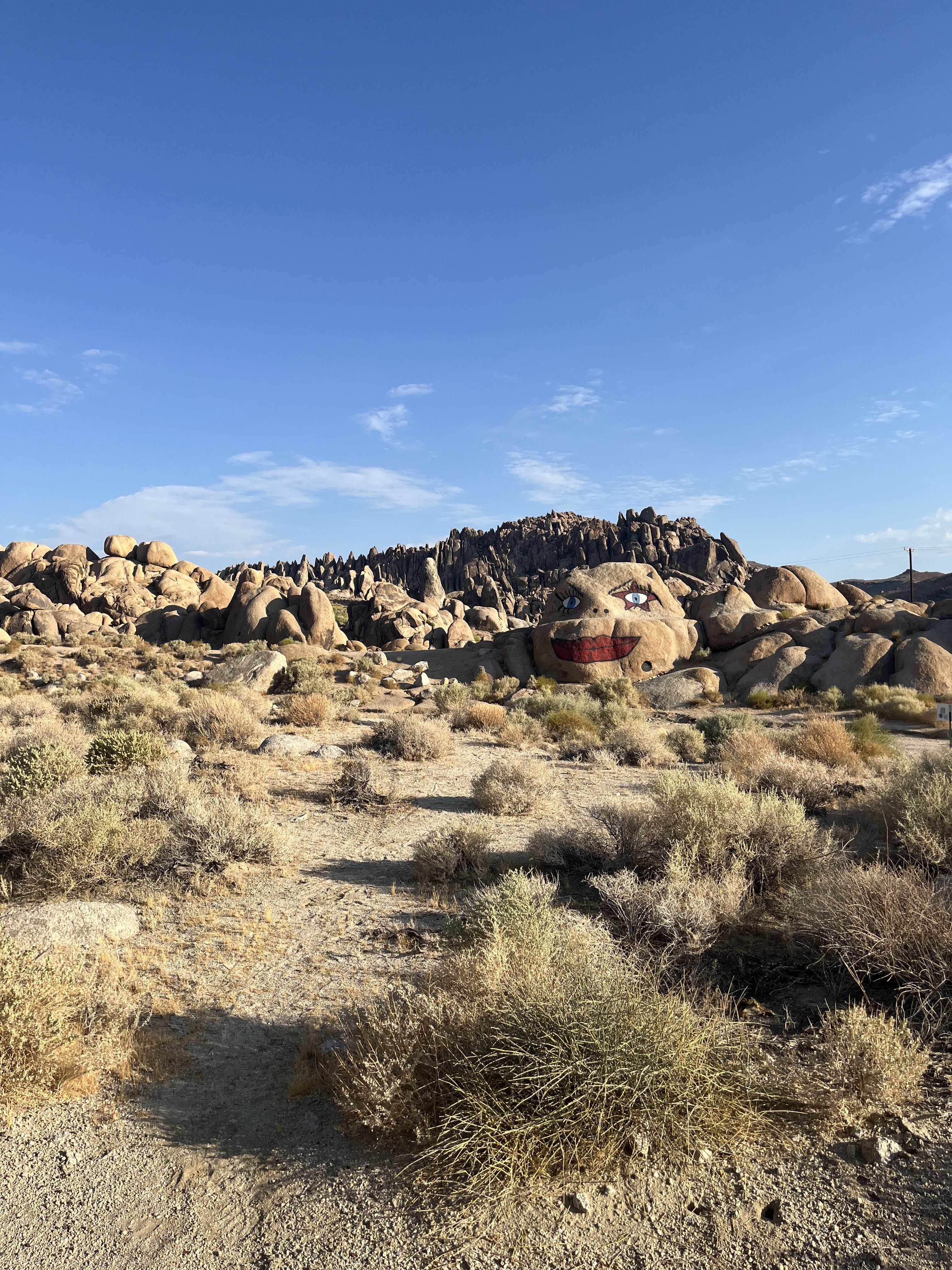
I was ready to charge up the hill. The next couple of miles felt very fast for an uphill section – around 17-18 minutes per mile when I was moving, plus some stops with the crew, so closer to 19-20 minutes per mile. It was getting warm, so the crew brought back the neck buff with ice.
Then we got to the last checkpoint.
Portal Road to Finish (135.0)
Time: 39:14 (3.46 mph); Time from last aid: 1:23 (2.8 mph)
Predicted time: 39:41 (27 minutes ahead)
This section was very tough. The last four miles are very steep – about 500 feet per mile – and this was the slowest I was going the entire race. I was demoralized because I wanted to be done and wanted to push hard, but the vert-per-mile was really prohibitive.
This was the only section where I knew what pace I had written in my model: 30 minutes per mile. I was just trying to stay under that. Every time I looked at my watch, it felt like I was going 30 minutes per mile, or, best case, 27 minutes per mile, even though the actual results said 22 minutes per mile. It felt a lot slower.
At some point, another crew car came up behind me and shouted, “Harvey is going to pass you!” I was pretty mad about this, because (1) I wasn’t competing for time, (2) I definitely wasn’t competing with a guy, because we are in different categories, and (3) it was really steep and I was going slow and was grumpy. I also didn’t realize who Harvey was at the time. Then he came up behind me, gave me a side hug, said I was doing a great job, and overall just seemed to be having a great time. Immediately, I was also having a great time. He and his crew really seemed to be enjoying themselves. They also knew Bob (of course)!
I figured out later that this was Harvey Lewis, who won Badwater in 2014 with a sub-24 finish, and last year won Big’s Backyard Ultra, running 450 miles. After I saw him, he finished his race, then turned around and ran back to Lone Pine, for a double-Badwater of 270 miles. Pretty amazing.
After we saw Harvey, I still had about three or four miles to go. Eric was doing an excellent job of coaching me to the finish line. He had the GPX on his watch and was telling me how many miles out we were and how much vert was left. Even though this was information I did not want to know during the rest of the race, it was extremely helpful to know with so little of the race left. Eric has now paced me to the finish at my last three major races; he has an amazing handle on what will get me across the finish line, and knew that this information would be helpful in this situation: I would take any motivation I could get.
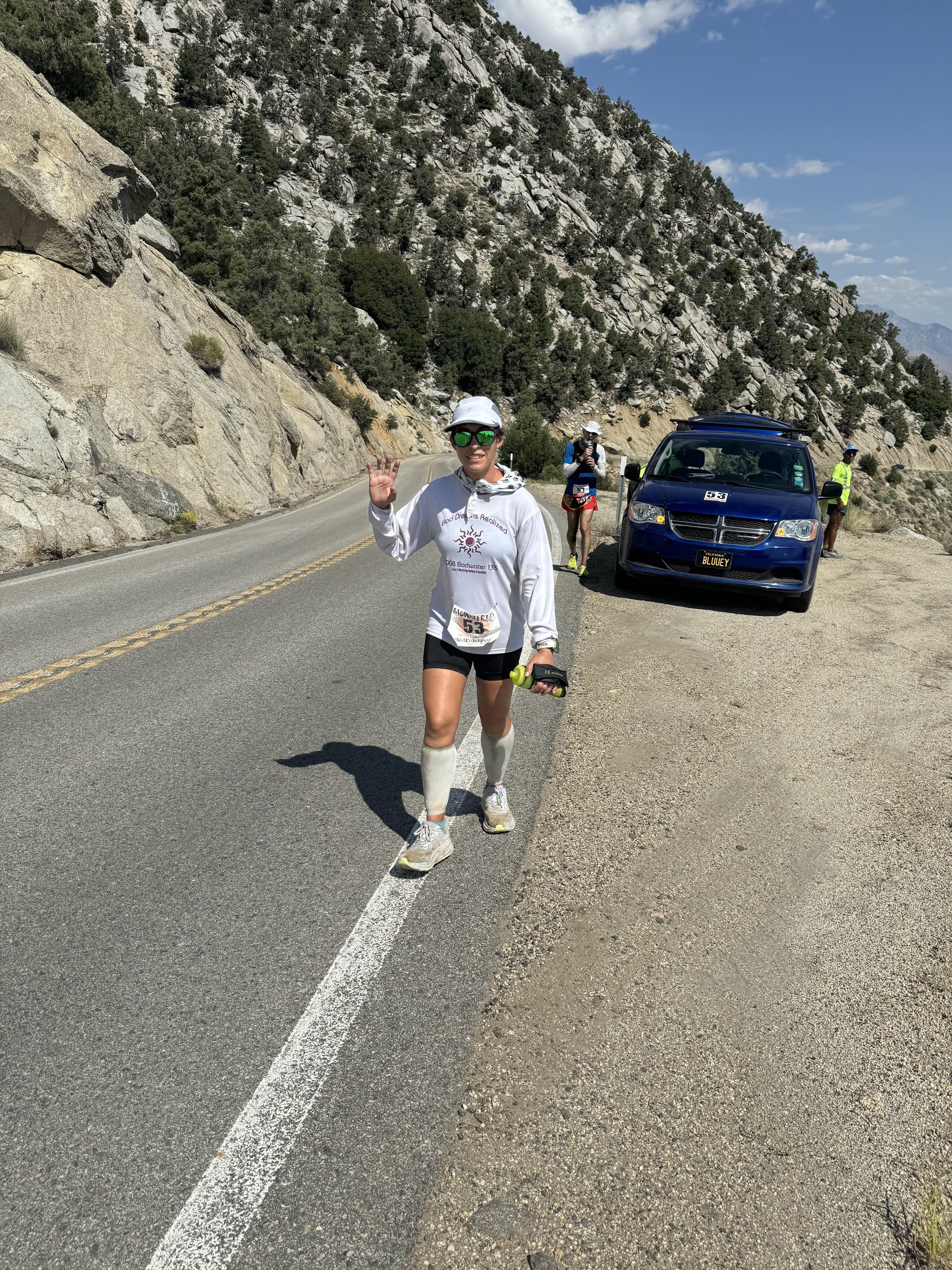
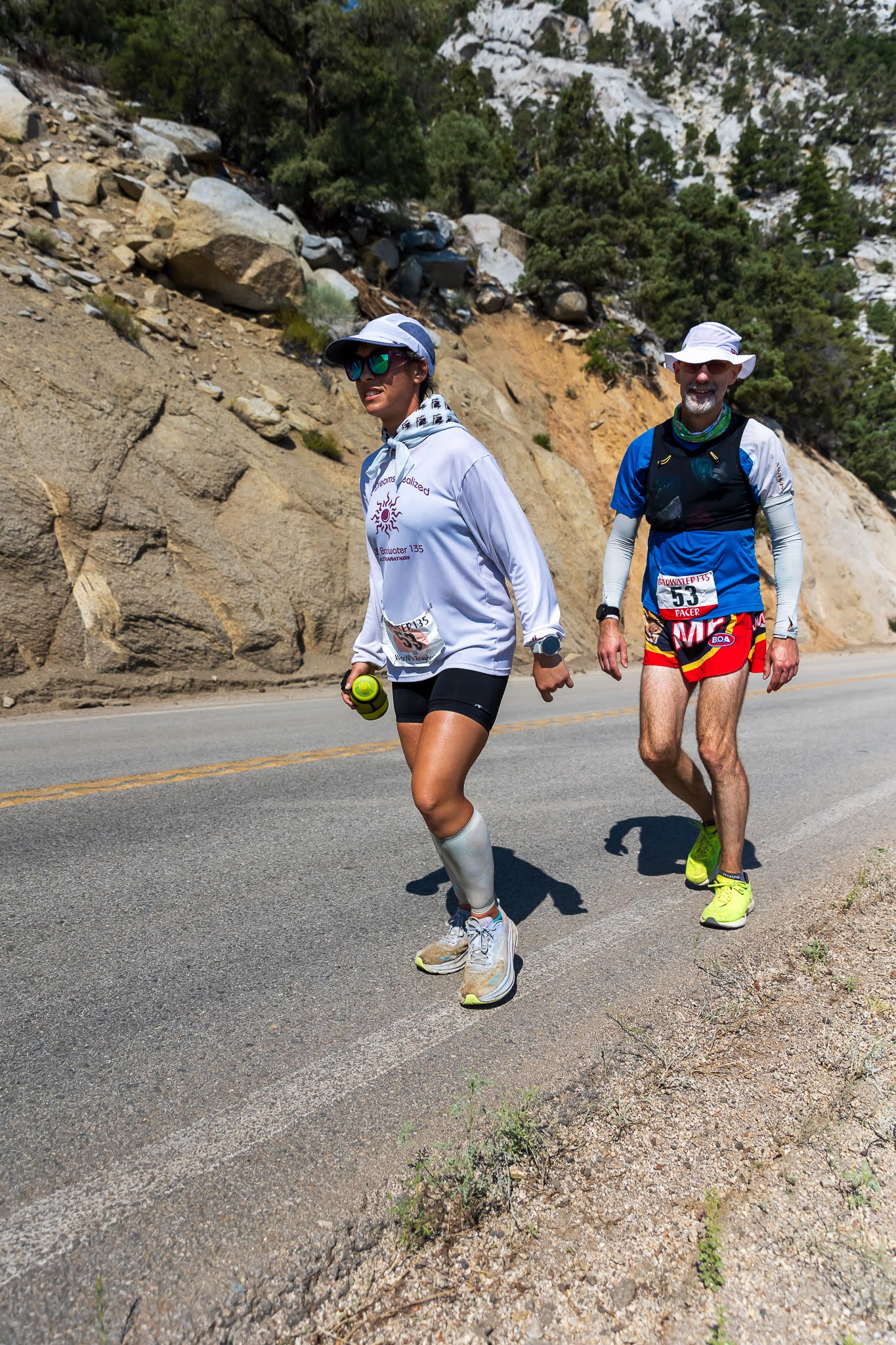
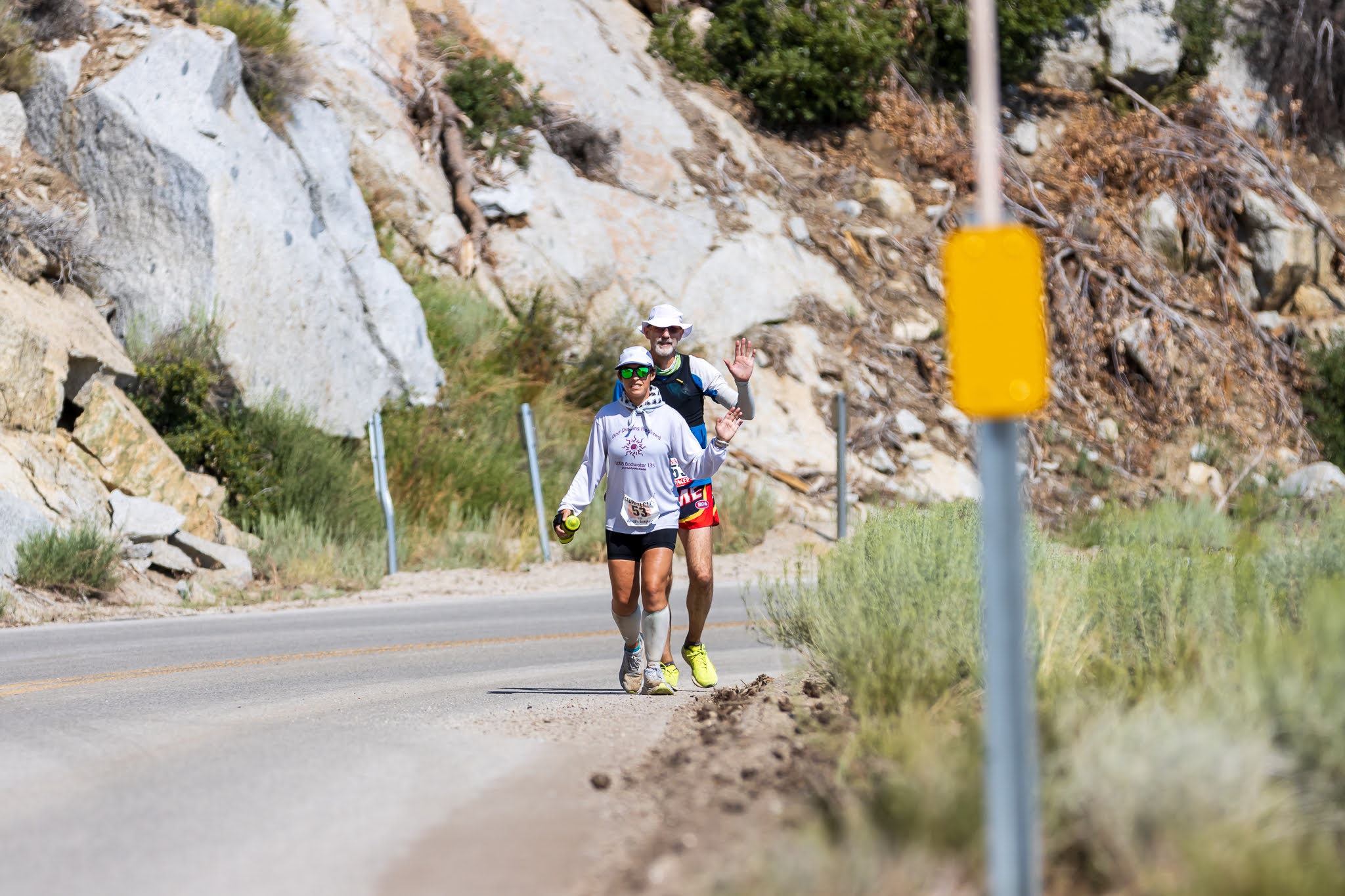
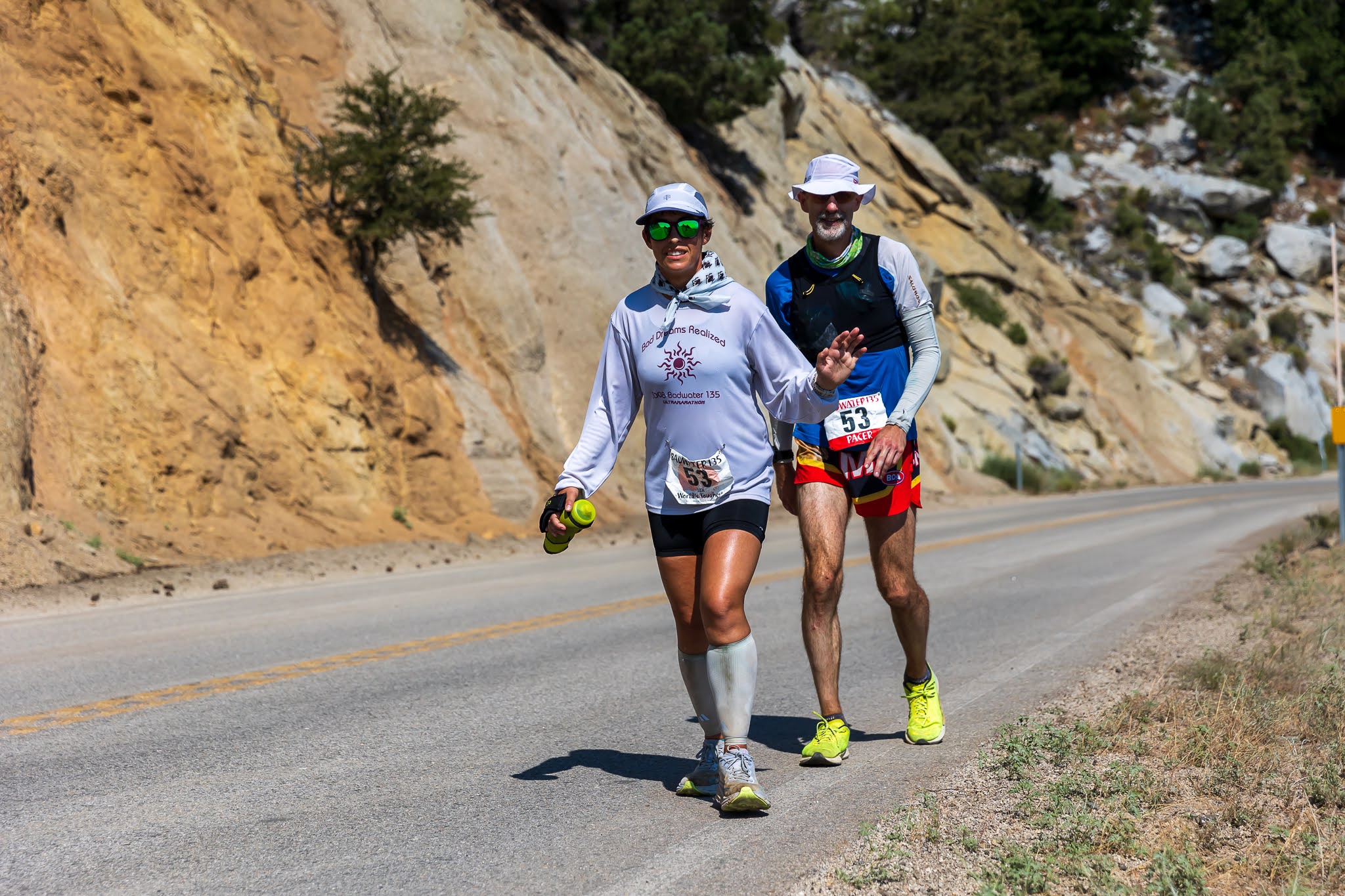
With about a mile to go, I realized there was someone coming up behind me, so I tried to kick it into gear a bit. I didn’t want to get stomped so close to the finish line. This feeling was in direct contradiction to how I felt literally an hour prior, when I didn’t care at all if people were passing me. I can’t explain why it was different so close to the finish line. In any case, we were able to stay ahead of them, although it was a push.
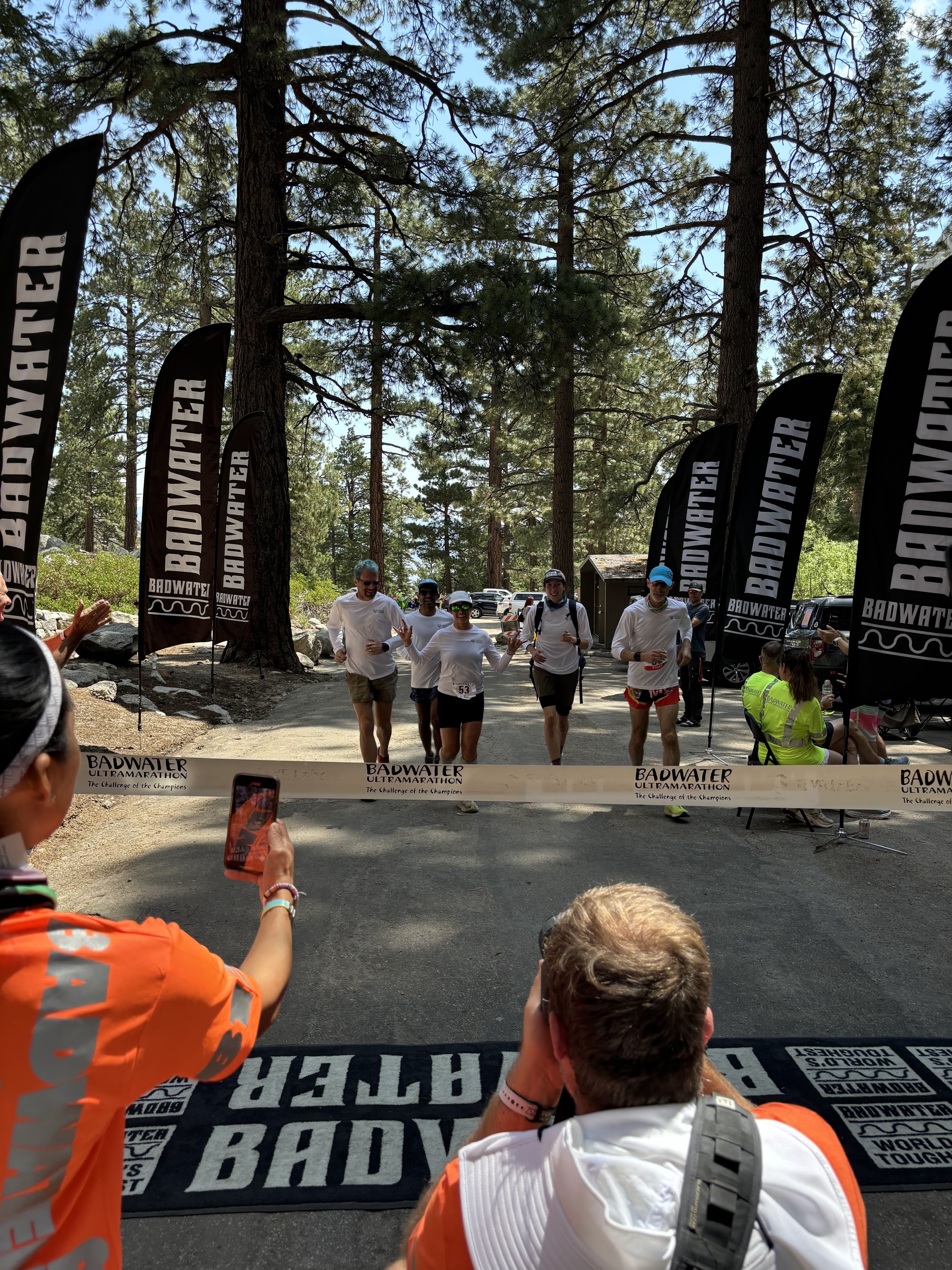
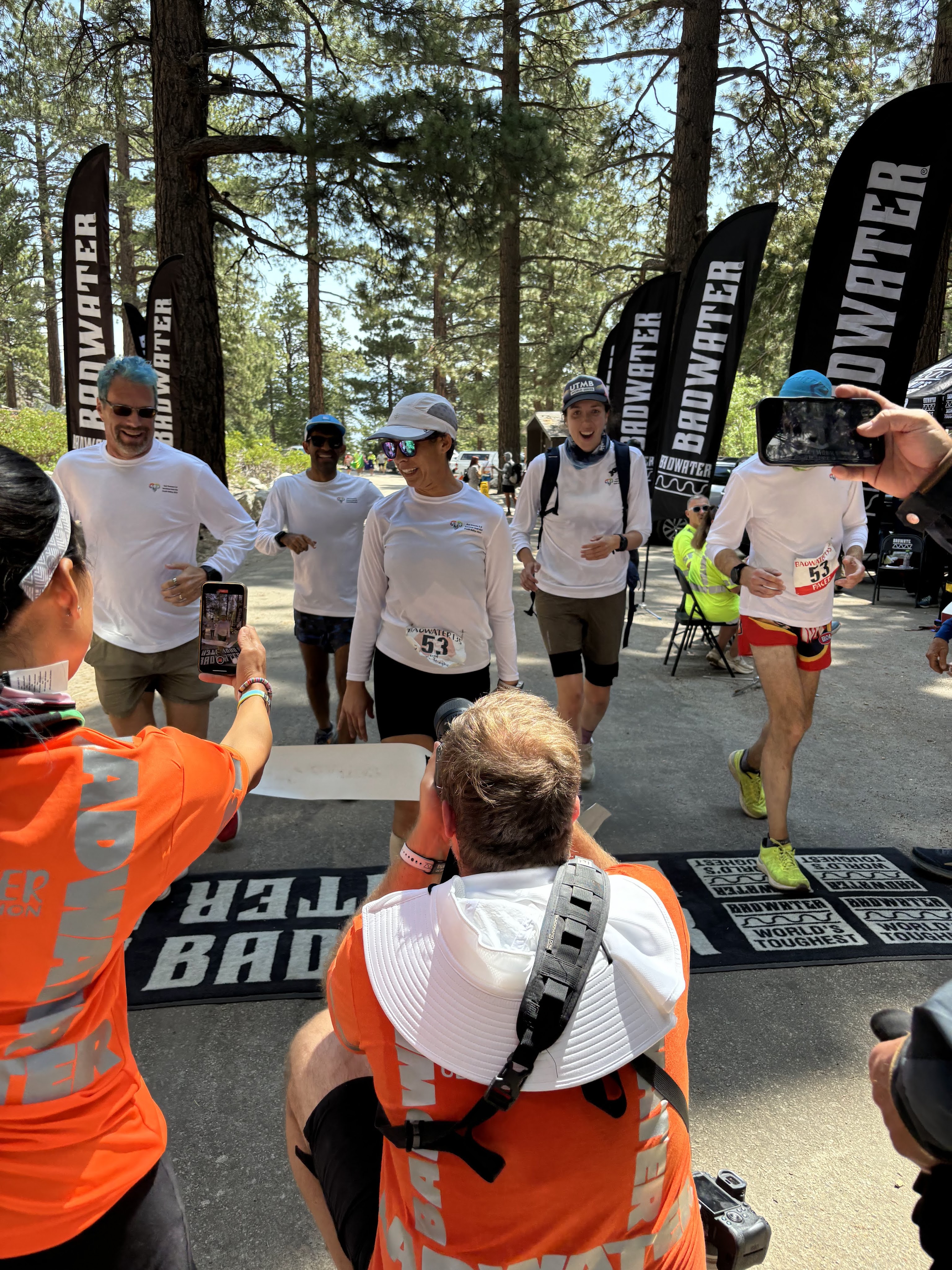
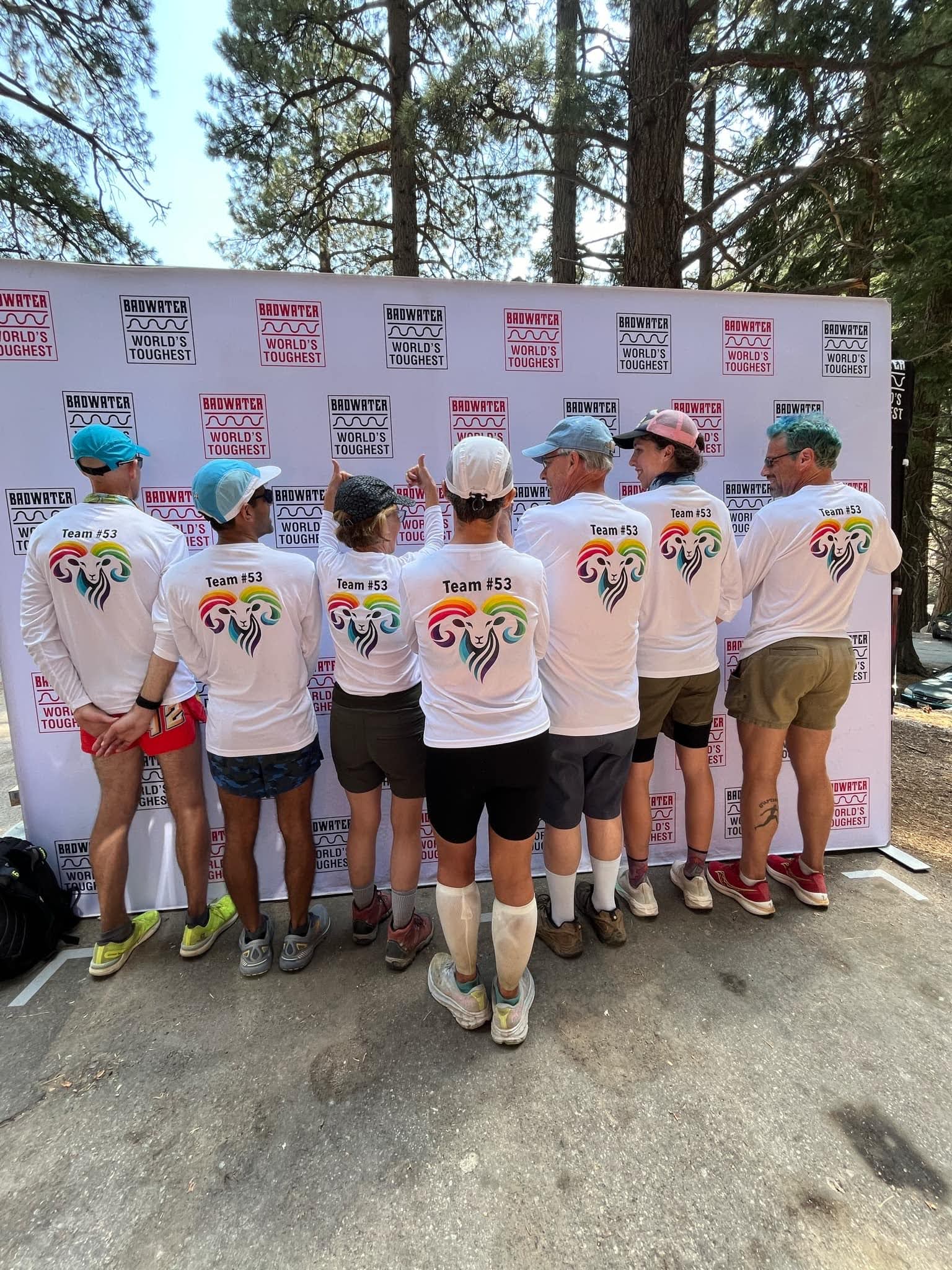
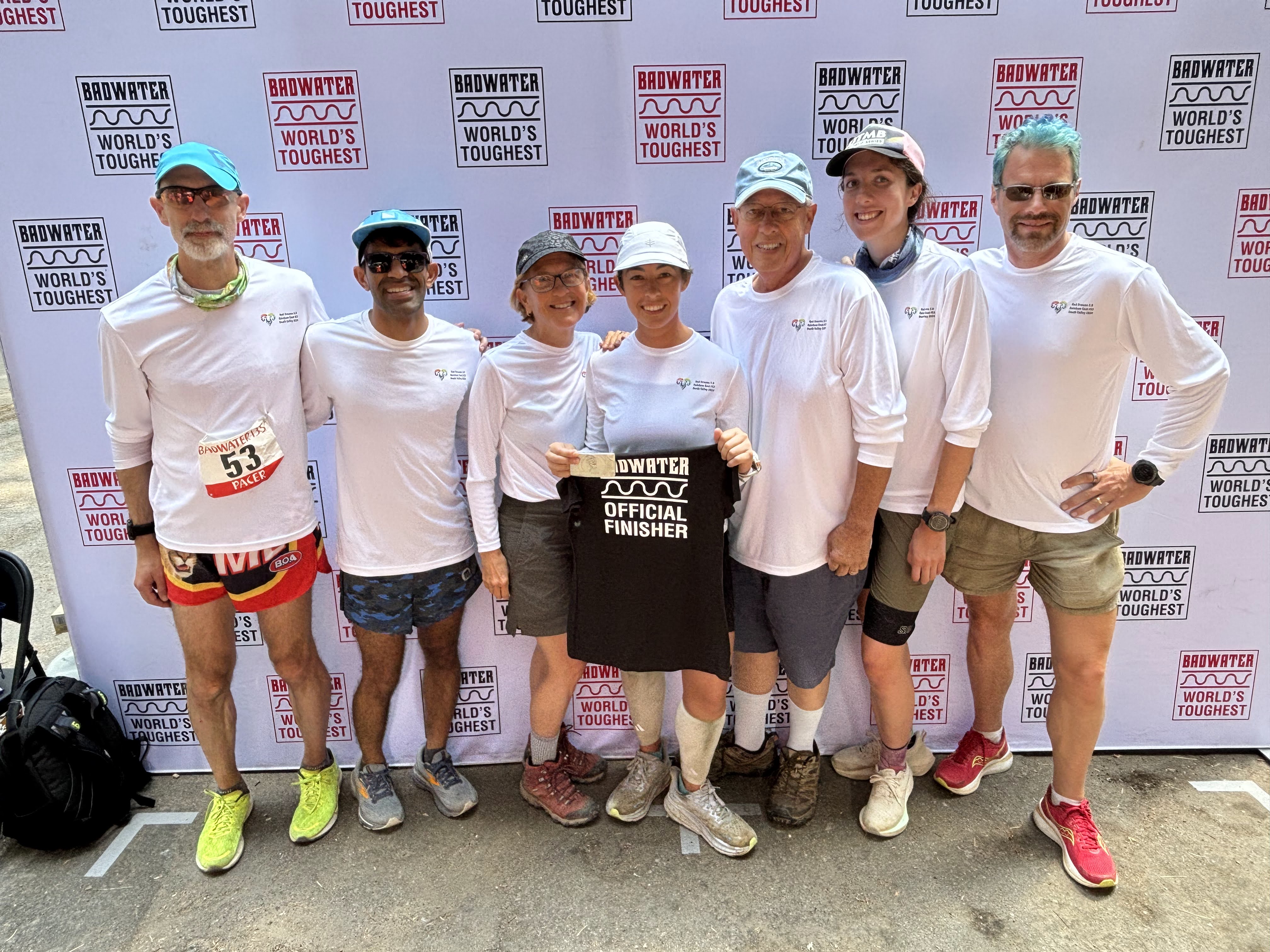
Crew ran with me across the finish line with me, and then we were done.
Post-race
This year, the race had 97 competitors; 23 did not finish (DNF), for a 76.3% finishing rate, which is below the average of 82%. So I guess it was a little harder.
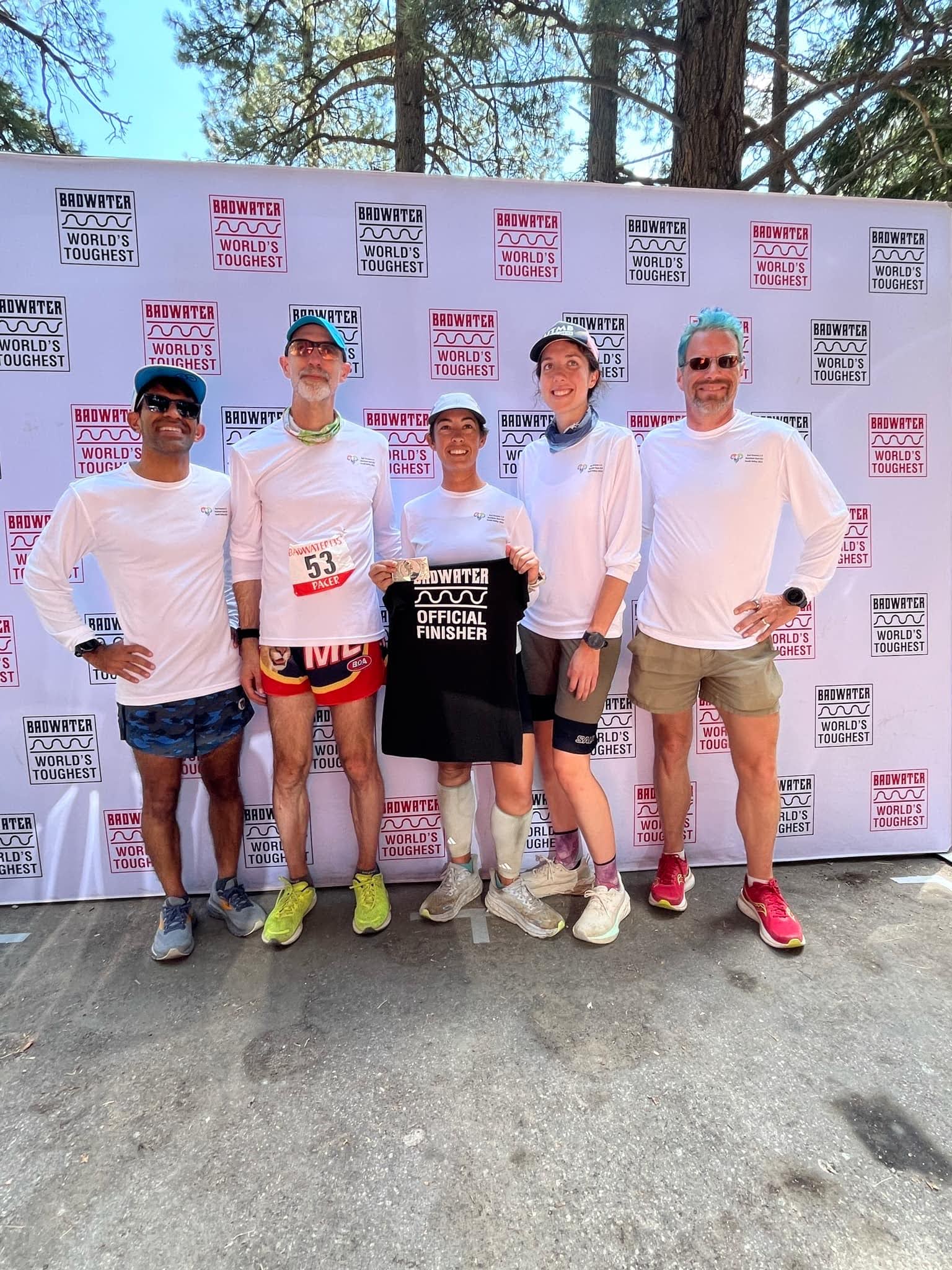
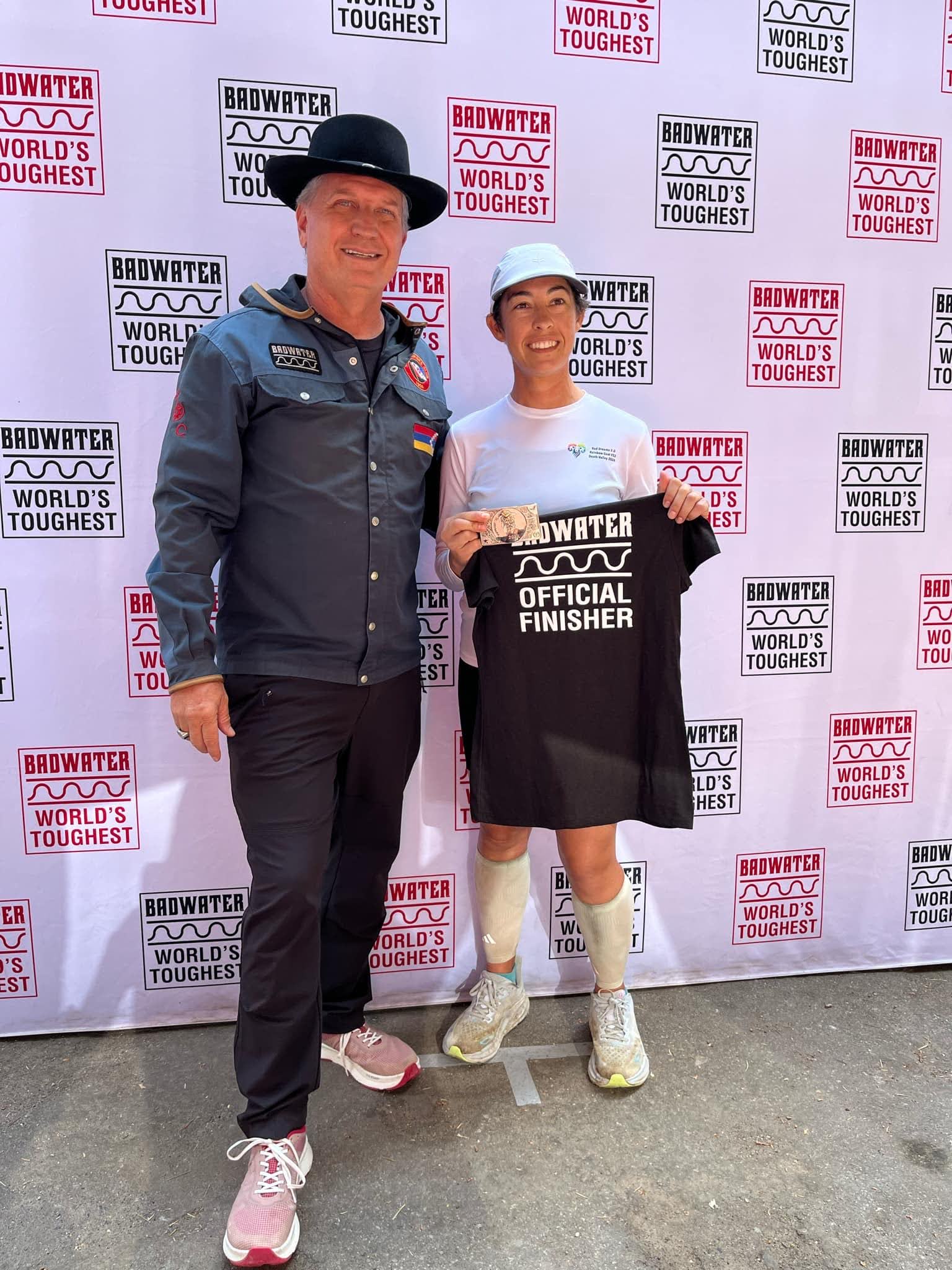
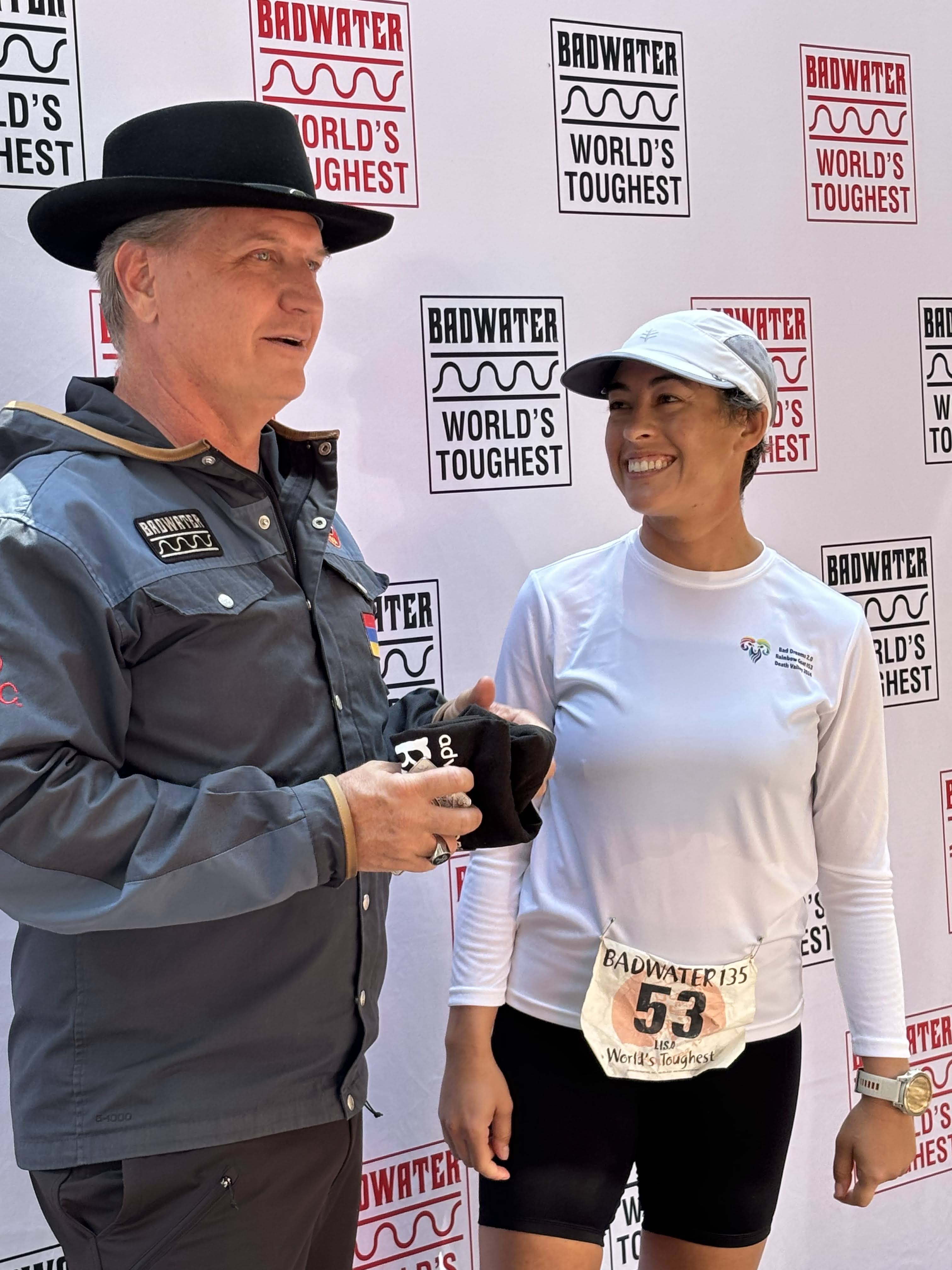
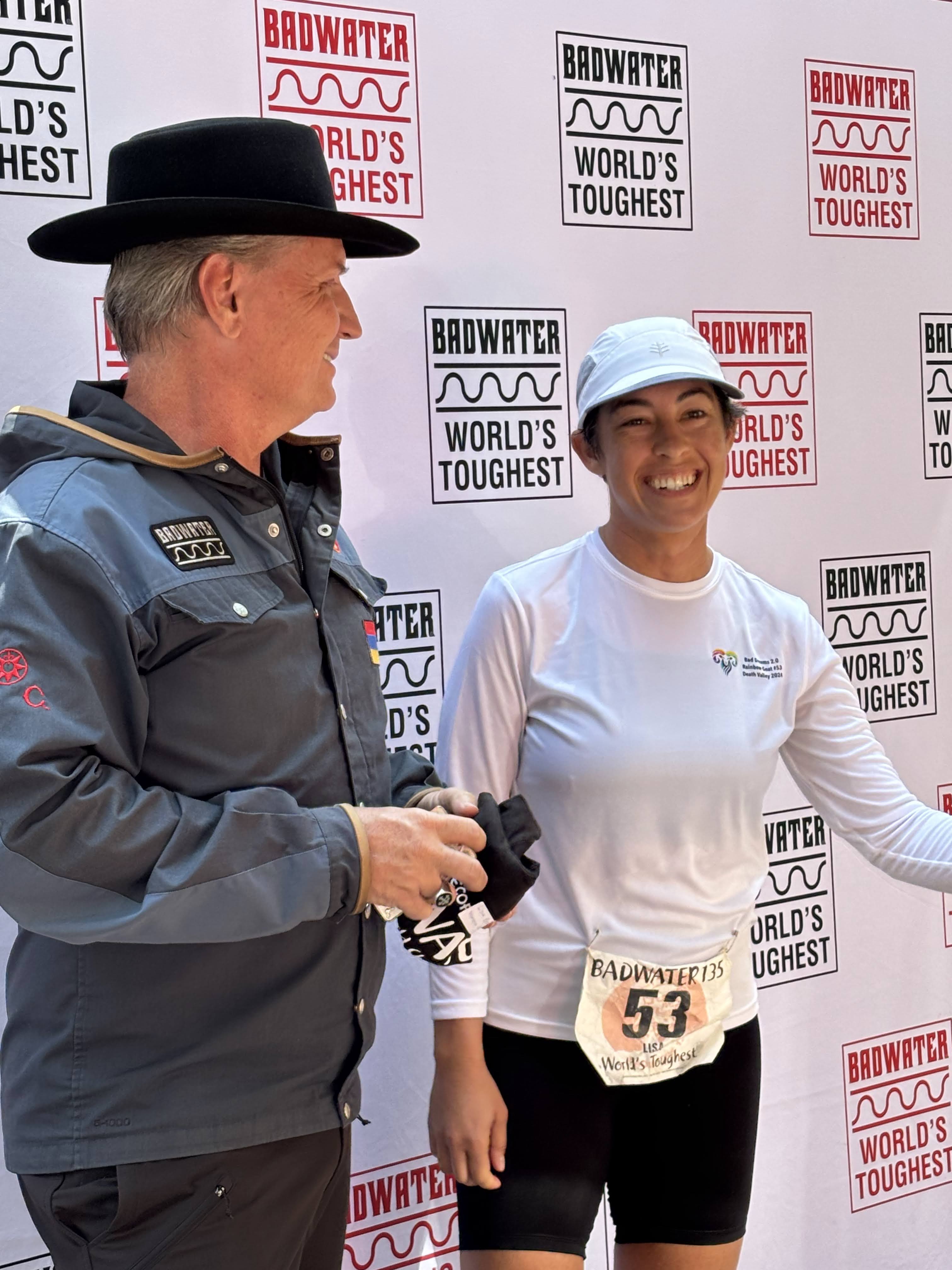
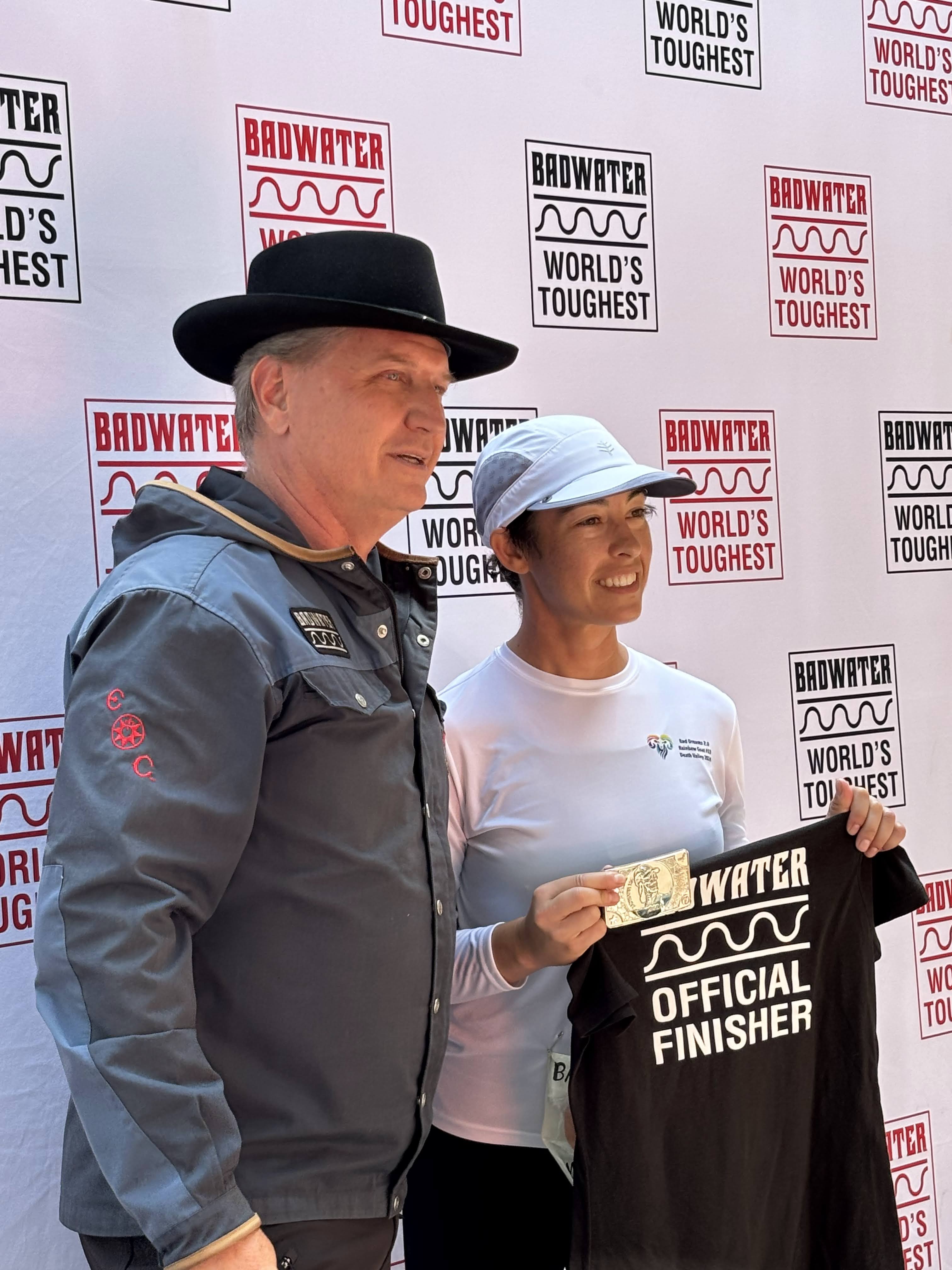
After I crossed, we took some pictures, I talked with Chris, and we spent just a few minutes at Whitney Portal before heading down the hill. Once at the hotel, I made the same mistake as I did at Javelina, which was to get food (despite not being hungry) before napping. I was highly motivated by spending time with friends and family, but almost fell asleep at the table and ended up eating almost nothing. Afterwards, I walked back to the hotel and slept for 3.5 hours.
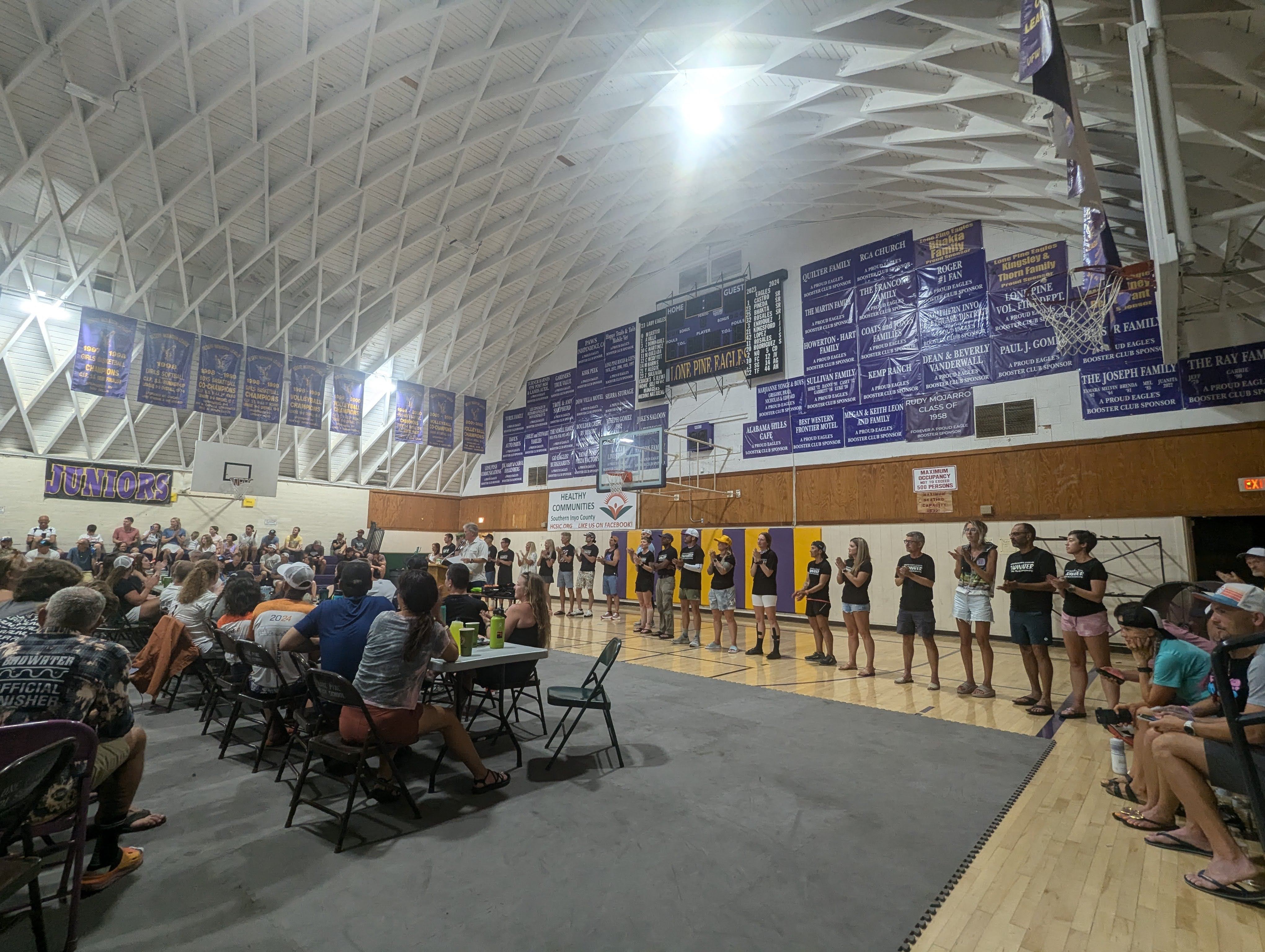
The post-race pizza party was fun, although my stomach was still not ready for food. Chris called up all of the racers one by one, gave the top runners awards, and said some words (although the words were somewhat hard to hear due to the way the speakers were positioned). After the pizza party, everyone haded to Jake’s Saloon. By that time, I was REALLY hungry, because I hadn’t really eaten since finishing, but everything closed at 9pm, so I ended up back in the hotel eating leftover hamburger from lunch. My stomach was still unhappy, so I didn’t eat much and I ended up just crashing.

The next day, we got breakfast at Alabama Hills Cafe & Bakery. I ate some food but not a whole lot – the cinnamon roll was good. We did a quick cleanout of the van then drove home.
Reflections
This was an amazing experience. I am so glad to have gotten to do it.
- I was surprised at how positive I felt mentally, even during the second night. It wasn’t nearly as bad as some other races in that respect. Having pacers for 90 miles, and seeing crew every 15-30 minutes, really prevented any mental doom spiraling.
- My training paid off. My body never hurt beyond a standard amount of hurting. The bottoms of my feet were most hurting, but I got no blisters, and ibuprofen helped. I still can’t feel some of my toes, but that will come back.
- I don’t know that I ever want to train that hard again. It really took over my life. That being said, I probably will train that hard again, because getting to do something this epic – that only about 1,000 people have done – and feeling so good afterwards – is pretty awesome.
- If I had known how much of an ask this was of my crew, I am not sure I would have done it. Crew are working just as hard – if not harder – than their runner. They have to not only run with me, but also drive a car and make strategic decisions. I just have to run. I will eternally be grateful to them for the time they dedicated to this.
One of the coolest things after the race was turning on my phone and having 150 missed messages from friends and family who were cheering me on from afar. Multiple people told me afterwards that they were tracking me, or had side chat groups to discuss the race, or told their kids/friends/physical therapists about it. Even knowing ahead of time that a fraction of these folks cared about the outcome was so motivating – when it was getting hard, I thought about these people in my corner and knew that I had to finish. I just didn’t fully understand how many people there were. You guys are amazing – thank you.
A week or so out, I am definitely feeling post-race lows, which always seem to come from some combination of mental fatigue of this huge effort being over, and physical fatigue of just recovering.
On the Father Crowley climb, Bob and I were reflecting on why runners do stuff like this. We both agreed that, while a lot of runners have canned responses for this question, such “to see how far I can go,” or “to push my limits,” or “to be out in nature,” etc, none of us really know the answer. It isn’t truly clear what the motivation to do something like this is. After 16 years or reflecting on it, I think I am okay with the ambiguity. Just doing cool stuff is enough of a reason.
Understanding motivations is particularly relevant right now as I think about what comes next. Finishing this race is a bit like falling off of a cliff. I had intentionally pushed out a lot of things until “after the race,” including what race to run next and a number of life things. Now that the race is over, I guess I have to face all of those things. Time marches on.
Very glad to have done this race. It is an incredible experience and I got to spend it with some amazing people.
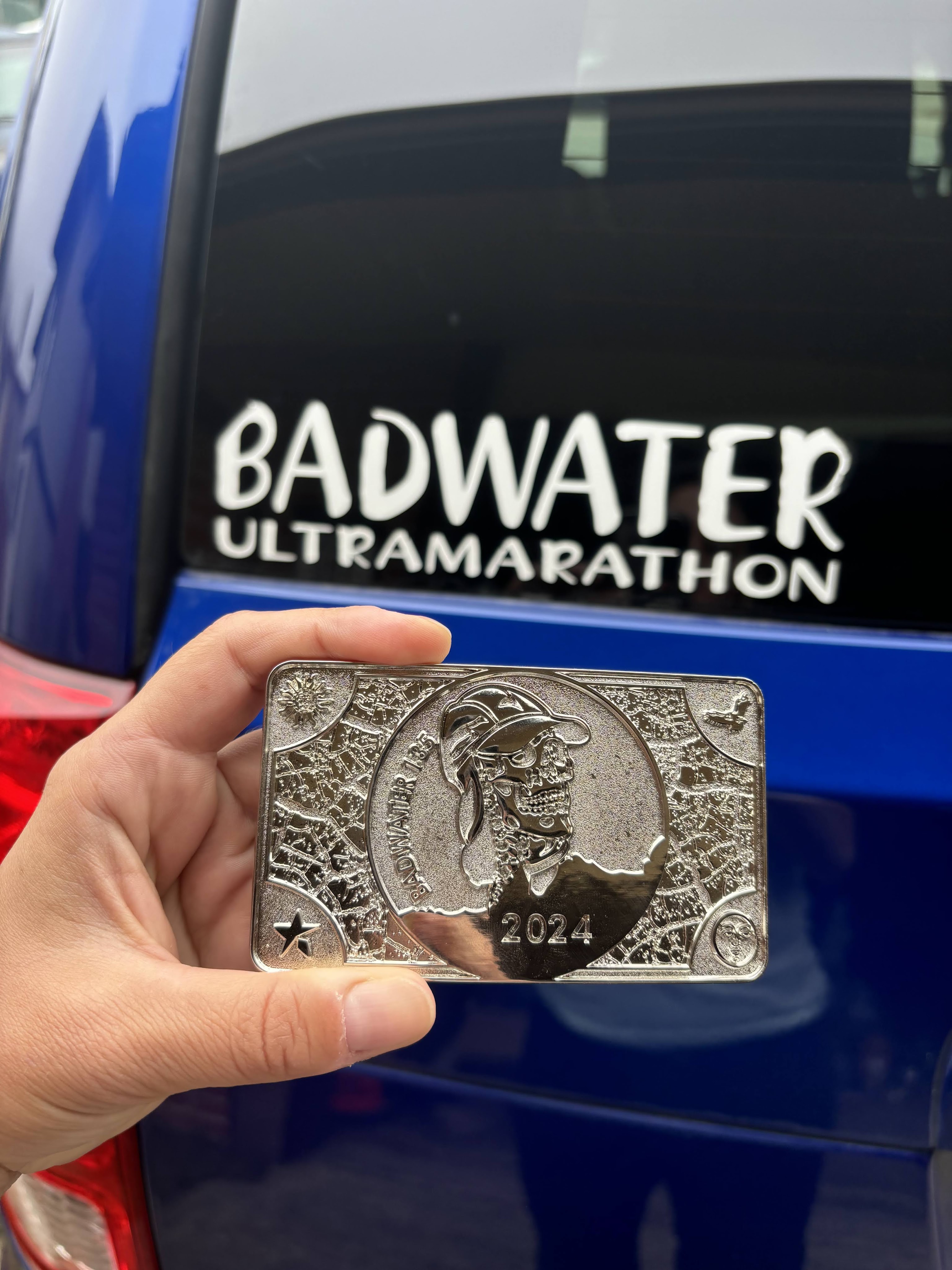

 BRB Running
You never cease to amaze me. Congratulations on the race and thank you for the detailed write up. I’m not a runner but I read it from start to finish and am in awe. Well done all around. Lorraine
Can’t imagine showing up in 125F & saying “let’s go run”. Surprised how many didn’t wear a full body suit. Running in a full body suit, finding a crew always seemed intimidating.
So proud of all of you’ve accomplished. Pure oxygen.